
Apple shares fall 1.5% as iPhone 18 Pro launch comes with $100 price ike
AI Sentiment: 35/100 Bearish
This score is generated through AI-driven analysis of the article's content.

powered by

Buy AAPL. The iPhone 18 Pro/Pro Max launch includes real hardware upgrades (A20 Pro on 2nm, larger vapor chamber, better battery) plus a major software hook (new Siri that can take actions across 300,000+ apps). Even with a $100 price increase, Apple is signaling stronger differentiation, which should stabilize upgrade demand and support margins as the new Siri becomes a platform feature.
Key Risk: iPhone 18 Pro demand underwhelms and the $100 price hike turns into weaker upgrades, forcing Apple to discount or cut guidance.
Buy AAPL (or add via AAPL call spreads). AirPods 5 at $129 adds active noise cancellation to Apple’s entry tier, expanding the addressable market and pulling more buyers into the Apple ecosystem. Longer battery plus ANC should lift attach rates and reduce churn versus cheaper competitors, supporting Services growth over time.
Key Risk: AirPods 5 sales disappoint because competitors match ANC at lower prices, keeping Apple’s unit growth flat.
- Apple shares fall 1.53% despite iPhone 18 Pro launch.
- iPhone 18 Pro starts at $1,199 with a new A20 Pro chip.
- Apple unveils upgraded Siri, AirPods 5 and new Apple Watches.
Apple unveiled its latest iPhone lineup, an updated Siri model, new AirPods and Apple Watch models at its annual product event, with investors showing a muted reaction to the announcements.
Apple shares AAPL were down 1.53% at the time of writing, despite the company introducing several hardware and software updates.
The event was also the first iPhone launch under new CEO John Ternus, who took over from Tim Cook earlier this month.
Apple opened the event with a video featuring different scenes described as “shot on iPhone.” Cook then appeared briefly before handing the spotlight to Ternus, marking the leadership transition at the company.
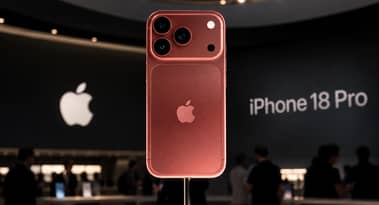
The iPhone 18 and iPhone 18 Pro lineup comes in four color options: Deep Black, Silver, Glacier Blue and Burgundy.
The iPhone 18 Pro models are powered by Apple’s new A20 Pro chip, which is built using a 2nm process.
@Apple wasted no time.
— Invezz (@InvezzPortal) September 9, 2026
The iPhone 18 Pro is here.
Familiar design, two new colors, and a bigger Max.
The real upgrades? AI, performance, battery, and cameras.
Same look. Bigger bets. pic.twitter.com/3jRxUVzigX
The iPhone 18 Pro featuring a next-generation vapor chamber with three times the surface area of the system used in the iPhone 17 Pro.
Apple said the iPhone 18 Pro offers up to 24 hours of battery life, while the iPhone 18 Pro Max can deliver up to 30 hours on a single charge.
The iPhone 18 Pro starts at $1,199 with 256GB of storage, while the Pro Max starts at $1,299.
Apple is also offering a 2TB storage option. The starting prices represent a $100 increase from the corresponding iPhone 17 Pro models.
Apple highlights upgraded Siri AI
Apple also unveiled an improved version of Siri, addressing one of the areas where the company has faced pressure to strengthen its artificial intelligence capabilities.
The company described the updated Siri as an “entirely new version” capable of taking actions within apps that users already use, including third-party applications.
Apple said the new Siri AI works with more than 300,000 apps. The company is positioning the ability to perform actions across applications as a key improvement to its voice assistant.
The company also announced an iOS 27 feature called “iPhone Handoff,” which will allow customers to use a single phone number across multiple devices.
New AirPods and Apple Watch models
Apple introduced AirPods 5 as part of its latest product lineup. The new AirPods offer longer battery life and active noise cancellation, a feature that was previously unavailable on Apple’s least expensive AirPods.
The AirPods 5 are priced at $129, while a version with wireless charging will cost $149.
Apple also announced the Apple Watch Series 12 and Apple Watch Ultra 4, expanding its latest hardware lineup beyond the iPhone and AirPods.
The announcements come as Apple begins a new phase under Ternus, with investors assessing whether the latest hardware and software updates can support the company’s product strategy.
Apple unveils foldable iPhone, redefining flexible displays

UnitedHealth sells WellMed to TPG: what it means for UNH stock

Dell stock hits 52-week high as AI demand fuels growth
Apple stock: what a foldable iPhone really means for it

Why SpaceX stock is slipping around 4% today
No results found
Loading articles...
Failed to load articles. Please try again.