
WTI crude oil price forecast as Middle East risks remain elevated: can it hit $120?

AI Sentiment: 78/100 Bullish
This score is generated through AI-driven analysis of the article's content.

powered by

Buy WTI exposure (USO ETF or NYMEX WTI futures/CL). The article flags multiple supply chokepoints: Saudi East-West pipeline shut, lower Strait of Hormuz traffic from higher insurance risk, and Houthis controlling a major Yemen port. With US/China inventories already low and no US-Iran de-escalation signs, the path of least resistance is higher toward the cited ~$117.75 target.
Key Risk: A rapid US-Iran ceasefire or credible deal that restores shipping through Hormuz and reopens Saudi export routes, collapsing the supply-squeeze narrative.
Buy Brent exposure (BNO ETF or ICE Brent futures). The same Middle East risk stack hits global crude flows, and Brent typically captures broader seaborne disruption. If the market reprices risk premium for Middle East shipping, Brent should outperform on the way to higher global benchmarks.
Key Risk: A surge in non-Middle-East supply (OPEC+ output jump or unexpected outages elsewhere resolve) that offsets the shipping disruption and compresses the risk premium.
- Crude oil price pulled back even after Saudi Arabia shut down the East-West pipeline.
- There is a risk that Iran will have an October Surprise ahead of the election.
- Iranian leaders will meet the GCC members on Monday.
WTI crude oil prices drifted lower on Friday, even as the energy market experienced a major development that could squeeze the already thinned supply. The West Texas Intermediate (WTI) dropped to $99.98 from this month’s high of $104.5, while Brent fell to $104.3.
Crude oil prices face major risks ahead
There are reasons to believe crude oil prices will continue rising in the near future. Saudi Arabia has shut its East-West pipeline, which normally handles several million barrels of oil per day, meaning that supply will be reduced in the near term. Making matters worse, it could take weeks or months for the pipeline to reopen given ongoing attacks in the region.
Second, traffic through the Strait of Hormuz remains significantly lower than where it was a few months ago. Just a handful of ships are passing through these days as insurance costs have risen. Many insurance companies are afraid that the ships will be hit by Iranian missiles and drones. Indeed, the UKMTO reported that a ship attempting to cross was hit by an unknown projectile.
Further, Ansar Allah, commonly known as Houthis, have taken control of a major port in Yemen. This means that it will be difficult for Saudi Arabia to ship its oil in the near term, even when the East-West pipeline is fixed.
Most importantly, there are no signs that the US-Iran war will end any time soon. Trump has insisted that the war will end as soon as the midterm elections end in November. The election is nearly two months away, meaning that the supply squeeze will remain.
Also, there is a likelihood that Iran will seek to escalate the situation. Some analysts warn that it will have an “October Surprise,” possibly an attempt to sink a US destroyer or an aircraft carrier. Such a move would lead to a supply squeeze, pushing oil prices higher.
At the same time, there is a likelihood that China will restart its large-scale oil purchases, which will lead to higher oil demand. All this is happening at a time when oil inventories in key countries like the United States and China have remained at a low level.
The next key catalyst for oil prices will be a meeting between Iranian officials and GCC countries like Saudi Arabia, Bahrain, and Qatar. The meeting’s goal is to reopen the Strait of Hormuz.
WTI crude oil price technical analysis
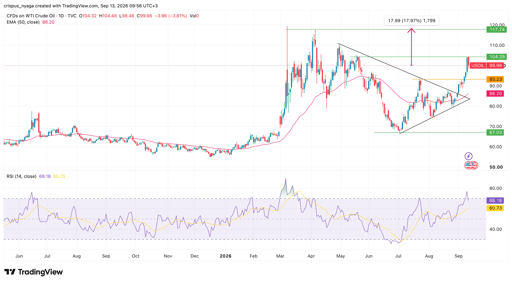
WTI oil price chart | Source: TradingView
The daily chart shows that the WTI crude oil price has rebounded in the past few months, moving from a low of $67 in July to a high of $104 last week. It has moved above the upper side of the symmetrical triangle pattern.
Oil has jumped above the important resistance level of $93.23, its highest swing on July 23rd this year. It has also jumped above the 50-day Exponential Moving Average (EMA), a sign that bulls remain in control for now.
The Relative Strength Index (RSI) has continued rising, moving from a low of 29 in July to the current 68. Therefore, the most likely oil price forecast is bullish, with the next key target to watch being at $117.75. This price target is about 80% above the current level.

How will private credit and equity stocks react to Fed rate hikes?

Top crypto price predictions today: Pi Network, Pepe Coin, Zcash

Here’s why the Enbridge stock is in a strong downward trend

Here’s why the TripAdvisor stock has crashed to a record low

Here’s why Brent crude oil price is falling today and what's next
No results found
Loading articles...
Failed to load articles. Please try again.