
Why is Alibaba ready to pay double for China’s top grocer Pupu?
AI Sentiment: 78/100 Bullish
This score is generated through AI-driven analysis of the article's content.

powered by

Buy BABA. The bid for Pupu signals Alibaba is shifting from subsidy-led quick commerce to asset-led scale—buying an existing 30-minute grocery network and daily consumer habit. That should improve unit economics versus the “losing per order” model in the delivery war and strengthen Alibaba’s local commerce flywheel (traffic → daily orders → retention).
Key Risk: Regulators or local partners block/limit the deal or force Alibaba to unwind quick-commerce operations, preventing the network and habit from scaling.
Sell Sun Art Retail. If Alibaba pays double, it implies the market is repricing the remaining independent grocery delivery asset value upward—leaving Sun Art as the likely loser in a consolidation race. Sun Art’s bargaining power and standalone growth prospects weaken as strategic buyers lock in last-mile density.
Key Risk: Sun Art secures a competing bid or strategic partnership that preserves value and reduces the need for a fire-sale outcome.
- Alibaba reportedly offered $1.5B for Chinese grocery platform Pupu.
- The bid is more than double Sun Art Retail’s earlier $600M offer.
- Pupu gives Alibaba access to a dense 30-minute delivery network.
Alibaba has reportedly offered $1.5 billion (approx. ₦2.1 trillion) to buy Chinese grocery delivery firm Pupu, more than double an earlier $600 million (approx. ₦831.4 billion) bid from Sun Art Retail.
The reported bid, cited by Bloomberg, is not just about buying a grocery delivery company, but a bet on frequency, logistics and consumer habit.
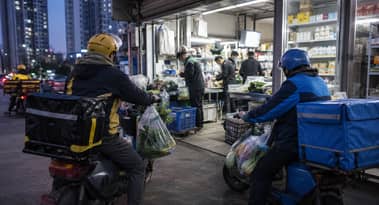
For Alibaba, Pupu offers something difficult to build quickly: a dense 30-minute delivery network in a market where Meituan, JD.com and Alibaba have already spent heavily to win the next phase of Chinese retail.
The grocer worth fighting over
Pupu is not a household name outside China, but it is one of the most valuable remaining independent assets in the country’s front-warehouse grocery market.
Based in Fujian province, the company generates annual revenue of more than 30 billion yuan, or about $4.2 billion, according to Bloomberg.
Its model is built around local warehouses that stock fresh food, daily essentials and fast-moving consumer goods, allowing orders to reach customers in about 30 minutes across several provinces.
That matters because China’s instant retail market has moved beyond restaurant meals.
Consumers increasingly expect fruit, meat, milk, medicine, snacks and household products to arrive almost as quickly as takeaway food.
The company that controls that habit gains not just grocery sales, but daily access to the consumer.
Pupu’s value has also risen because the field has thinned.
In February, Meituan agreed to buy Dingdong’s China business for $717 million (approx. ₦993.5 billion), giving it another front-warehouse grocery platform.
That left Pupu as one of the last sizable independent players available. If Alibaba does not move now, it may not get another similar target.
Also read- Alibaba stock hands investors an AI business for free: find out more
The 150 billion yuan war behind the bid
The price tag looks steep, but less surprising when set against the cost of China’s delivery war.
According to 36Kr, Meituan, Alibaba and JD.com burned at least 150 billion yuan over the past year competing in food delivery and instant retail.
Daily order volumes, once around 80 million to 90 million, crossed 200 million at the peak of the battle.
The economics were brutal as a securities analyst cited by 36Kr estimated that at the worst point, Meituan was losing about 2 yuan per order, while rivals were losing as much as 6 yuan per order.
That gap helps explain why Alibaba may prefer acquisition over endless subsidies.
Buying Pupu could give Alibaba an operational shortcut.
Instead of spending years building warehouse density, supplier relationships, cold-chain systems and local delivery habits city by city, it can plug an existing network into its own ecosystem.
The comparison with Meituan is important as the company has long used food delivery as the entry point into broader local commerce.
Alibaba is trying to do the same from the other direction: turning its e-commerce traffic into daily-use quick commerce traffic.

Nvidia to buy Hugging Face for $12.9B in major open-source AI bet: report

Why Josh Kushner and Bob Iger are paying a record $12.5B for the Lakers

Archer Aviation stock jumps 15% on acquisition of Boeing's 3 subsidiaries

A Tesla and SpaceX merger would create a conglomerate: is it a good deal?

CBIZ stock jumps 17% as Grant Thornton agrees $5B takeover
No results found
Loading articles...
Failed to load articles. Please try again.