
TAO falls 7% as Root Reborn proposal sparks validator-power concerns

AI Sentiment: 18/100 Bearish
This score is generated through AI-driven analysis of the article's content.

powered by

Buy TAO only if it holds the $226–$230 support zone (TAO/USDT). The article shows a specific demand area after the selloff (low near $226.66) and a modest rebound toward ~$230. Thesis: the market is overshooting on governance headlines; once sellers exhaust around support, mean reversion can push TAO back to $240 then $245–$250.
Key Risk: Support breaks and the “triple slippage”/unstaking-to-sell narrative accelerates, turning the drop into a sustained downtrend.
Sell TAO (TAO/USDT). The market is already repricing the Root Reborn proposal from “fix selling” to “new governance and liquidity risk.” Price is below the 20/50/100/200-day EMAs with lower highs/lows and RSI ~45, while Chaikin Money Flow is negative—classic trend + flow confirmation. Thesis: uncertainty keeps validators’ influence fears and redemption/liquidity concerns front-and-center, capping rallies until governance details clear.
Key Risk: The upgrade gets approved with clear guardrails (limits on validator influence + improved liquidity/redemption), triggering a fast sentiment reversal and squeeze higher.
- TAO trades below all major daily and 4-hour EMAs after a 7% drop.
- RSI remains below 50 while CMF signals continued capital outflows.
- Support at $226 to $230 is under pressure as sellers retain control.
Bittensor’s TAO token has dropped nearly 7% from its recent 24-hour high as investors reacted to criticism of the proposed Root Reborn governance upgrade.
According to Yuma, a validator group, the proposed "Root Reborn" upgrade introduces governance, liquidity, and regulatory concerns that could outweigh its intended tokenomics benefits.
The following analysis is a byproduct of lack of process within the ecosystem that leaves business builders limited notice or ability to properly plan, assess risk, and execute.
— Yuma (@YumaGroup) June 18, 2026
We are responding rapidly to the code we’ve seen thus far, in the forum where we see it being… https://t.co/cZ3DQD2gkU
The proposal was originally introduced to stop the continuous block-by-block selling of subnet tokens, a mechanism that many participants viewed as economically inefficient.
Instead of calming concerns, the proposal has sparked a debate within the ecosystem over how much influence validators should hold over capital allocation decisions.
Governance concerns spark investor caution
At the center of the dispute is a new weight-setting mechanism that would allow leading validators to influence how capital flows into subnets.
Yuma argued that such a system could fundamentally alter the role of validators by turning them into active capital allocators rather than neutral network participants.
The validator group warned that concentrating influence among a small number of major operators could create incentives for collusion, preferential treatment, and frontrunning.
Under that scenario, subnet teams might focus more on securing validator support than developing competitive artificial intelligence products, according to the critique.
Growing uncertainty around those governance changes appears to have triggered a defensive response among market participants.
As concerns spread through the community, investors began reassessing whether fixing one economic issue could create new structural weaknesses elsewhere in the network.
Additional concerns stem from the proposal's staking and redemption design.
According to Yuma, rewards would become tied to baskets of subnet tokens that could be difficult to liquidate during periods of market stress.
The group argued that a sudden wave of unstaking could force large amounts of subnet tokens onto the market as users redeem rewards for TAO.
Under that scenario, early redeemers would likely receive better execution prices while later participants could face substantial losses.
Yuma also highlighted what it described as a "triple slippage" problem embedded within the emission process, warning that staking returns could deteriorate over time.
Regulatory implications have added another layer of uncertainty.
The validator group argued that directing capital allocations may expose validators to scrutiny typically associated with investment management activities.
Such a change, if interpreted that way by regulators, could complicate participation for infrastructure providers, exchanges, custodians, and other institutional operators.
TAO price analysis
Price action has mirrored the growing unease surrounding the proposal.
Over the past 24 hours, TAO fell from approximately $243.34 to a low near $226.66 before recovering slightly toward the $230 area.
The decline unfolded through a series of lower highs and lower lows, suggesting persistent selling pressure rather than a single liquidation event.
On the daily chart, TAO remains below all major exponential moving averages.
The 20-day EMA sits near $239.9, while the 50-day, 100-day, and 200-day EMAs stand around $250.2, $255.3, and $266.2, respectively.
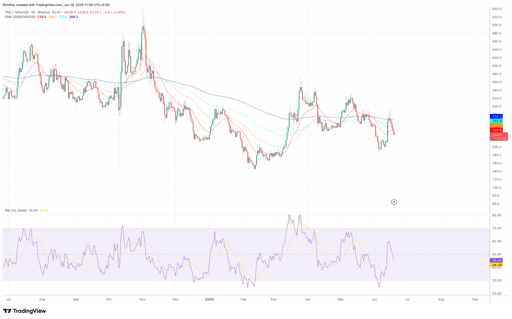
TAO/USDT 1-day price chart. Source: TradingView.
Trading beneath each of those levels leaves the long-term trend tilted to the downside.
Momentum indicators also remain cautious.
The daily Relative Strength Index has fallen to roughly 45, placing it below the neutral 50 level and indicating that buyers have yet to regain control of the trend.
On the 4-hour chart, TAO recently failed to hold above a cluster of moving averages between $243 and $246 before retreating toward $230.
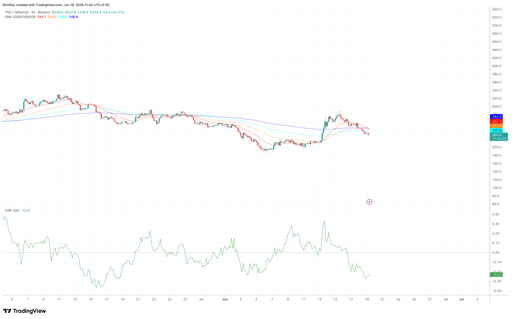
TAO/USDT 4-hour price chart. Source: TradingView.
Price is now trading beneath the 20, 50, 100, and 200-period EMAs on that timeframe.
Capital flows have weakened as well. The Chaikin Money Flow indicator has dropped to around -0.23, a reading that points to continued outflows and stronger selling activity than buying interest.
As of the publication time, the charts suggest TAO remains vulnerable to further downside if the current support zone around $226 to $230 fails to hold.
Any meaningful recovery would first require buyers to reclaim resistance levels near $240, followed by the $245 to $250 region where multiple moving averages currently converge.

Bitcoin rockets past $74K but one warning sign could derail the push to $80K

Bitcoin dubbed 'one of the best hedges you can find' - again

Bitcoin breaches $72K: why BTC is surging 6% even as Wall Street stumbles

BMNR stock jumps as Ethereum rebounds, BitMine nears inflection point

Bitcoin surges 11%, Ethereum 18%, XRP 10%: why crypto is exploding higher today
No results found
Loading articles...
Failed to load articles. Please try again.