
AI boom lifts SK Hynix above Samsung in South Korea market
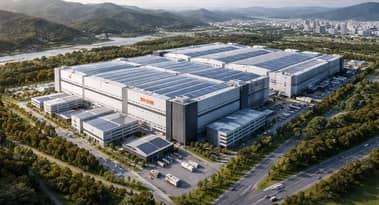
AI Sentiment: 82/100 Bullish
This score is generated through AI-driven analysis of the article's content.

powered by

Buy. The AI boom is driving sustained demand for HBM, and SK Hynix is the clear winner (about 61% global HBM share). The stock has already rerated, but the core thesis is structural: HBM is harder to swap than commodity memory, so SK Hynix should keep pricing power as AI builds out. The “turnaround” matters because it signals the company can fund capex through cycles and still deliver profits.
Key Risk: HBM demand growth slows sharply (AI capex pauses or customers redesign to use less HBM), crushing pricing power and margins.
Sell. Samsung is being outcompeted in the AI memory bottleneck: its HBM share is far behind SK Hynix (17% vs 61%). Even if Samsung’s broader business helps, the market is rewarding the specific AI memory supply chain winner. The valuation gap vs SK Hynix is likely to keep widening if Samsung can’t close the HBM performance/yield gap.
Key Risk: Samsung successfully catches up in HBM (major share gains via better yields/technology), reversing the relative disadvantage.
- SK Hynix overtook Samsung as South Korea’s most valuable listed company.
- Strong AI memory demand has driven a sharp rally in SK Hynix shares.
- Analysts say SK Hynix’s HBM leadership is reshaping the chip industry.
SK Hynix on Monday overtook Samsung Electronics to become South Korea’s most valuable listed company, in a striking turnaround for a chipmaker that had once come close to collapse under a heavy debt burden.
The milestone reflects how the global artificial intelligence boom has reshaped the semiconductor industry and lifted demand for high-bandwidth memory, or HBM, chips.
SK Hynix has emerged as one of the biggest beneficiaries of this shift, driven by its role as a major supplier of HBM chips used in AI systems for customers including Nvidia and Alphabet’s Google.
Shares of SK Hynix rose 5.7 per cent, taking the company’s market capitalisation to 2,082.5 trillion won as of 0347 GMT.
That put it just ahead of Samsung Electronics, whose shares were up 0.4 per cent, giving it a market capitalisation of 2,081.3 trillion won, excluding preferred shares.
Samsung, however, said in a statement that any calculation of its market capitalisation should include preferred shares.
On that basis, it said its market value would be about 2,252 trillion won.
AI boom transforms chip hierarchy
The move marks a major shift in South Korea’s corporate landscape.
Samsung Electronics had held the top spot since 2000.
SK Hynix’s rise comes as specialised memory chips have become increasingly important to the infrastructure behind applications such as ChatGPT and other advanced AI models.
SK Hynix focuses mainly on memory chips, while Samsung Electronics has a broader business spanning logic chips and consumer electronics, including smartphones and televisions.
That difference in focus has become more pronounced as demand for AI-related memory products has accelerated.
The company’s market value surge follows a more than 340 per cent rally in its shares this year.
That has also made SK Hynix the world’s most valuable memory chipmaker, ahead of both Samsung Electronics and Micron.
From near collapse to record profits
The company’s current position represents one of the most dramatic turnarounds in South Korea’s corporate history.
In 2002, then-Hynix Semiconductor was close to being sold to Micron after an aggressive expansion drive left it weighed down by debt.
The deal eventually fell through, and the company remained under creditor control for nearly a decade.
Its shares dropped as low as 135 won in 2003, leaving it widely seen as a penny stock, known in Korean as “Dongjeon-ju”.
Like many companies in the memory business, SK Hynix’s performance has long moved with the industry’s boom-and-bust cycles.
In 2023, a sharp downturn in the memory market pushed the company to an annual operating loss of 7.73 trillion won.
Its fortunes improved sharply a year later as investment in AI gathered pace.
Heavy spending by companies such as Microsoft, Google, and Meta helped fuel a rebound in demand, allowing SK Hynix to post an annual operating profit of 23.5 trillion won in 2024, a record at the time.
HBM strategy pays off
Analysts have attributed SK Hynix’s growing importance in the AI supply chain to its decision to keep investing in HBM during a downturn in the memory market.
HBM is a specialised memory chip built through vertical stacking, which allows faster performance and lower power consumption.
Unlike conventional memory products, HBM chips are closely integrated with AI processors.
That raises barriers to entry for competitors and gives suppliers greater pricing power.
By 2025, SK Hynix had captured 61 per cent of the global HBM market, far ahead of Samsung Electronics’ 17 per cent and Micron’s 21 per cent.
SK Hynix was founded in 1983 as a Hyundai unit before later being spun off and acquired by SK Group, the family-run conglomerate with businesses spanning telecoms to energy.
SK Group Chairman Chey Tae-won, who had faced strong opposition to the acquisition at the time, explained the rationale in a book published in January.
“What I really wanted to accomplish when we acquired Hynix was to transform it from a commodity memory producer into a mainstream semiconductor company whose products are indispensable,” Chey said.
“In the past, it did not matter whether memory came from Hynix, Samsung, or Micron. They were interchangeable commodity products. HBM is different. If SK Hynix’s HBM is replaced with another product, the AI system may not function properly. What used to be a peripheral component has become a core component,” he said.

FTSE 100 Index outlook: top 3 catalysts for the Footsie this week
Bank of America names Nvidia, Meta and three others top tech stocks for H2

Japan’s Kioxia stock is beating Micron, Sandisk, SK Hynix: here’s why

Kospi surges as US-Iran talks cool oil panic across Asian markets

Hang Seng Index just flashed a death cross as Kospi, Nikkei 225 surge: here’s why
No results found
Loading articles...
Failed to load articles. Please try again.