
Planet Labs dives as space stocks reverse after the SpaceX IPO: buy the dip?

AI Sentiment: 18/100 Bearish
This score is generated through AI-driven analysis of the article's content.

powered by

Buy PL. The selloff is driven more by dilution fears and space-sector risk-off than by fundamentals: revenue +42% YoY, recurring ACV at 99%, and backlog rising. The warrant revaluation loss is accounting-driven, not a collapse in demand. Technicals are stretched (down ~50% YTD) and it’s testing $26.25 support; if it breaks, you still get a better entry into the Pelican-11 growth cycle.
Key Risk: Equity dilution actually accelerates (more shares sold than expected), permanently compressing per-share value and forcing repeated capital raises.
Buy UFO. The article shows the whole space complex de-rating (PL, Rocket Lab, SpaceX) and a broad ETF drawdown from ~$68 to ~$46. Second-order effect: when one name’s dilution fears hit, it drags the entire “space” basket via index/ETF flows and risk models; a sector rotation back later in the year should lift the basket even if individual stocks take time to recover.
Key Risk: Space-sector funding dries up (government/corporate satellite budgets pause), keeping the ETF under pressure despite any single-company progress.
- Planet Labs stock has dived by 50% from its highest point this year.
- The company’s business continued growing in the first quarter.
- The ongoing retreat mirrors what is going on in the space industry.
Planet Labs stock continued its strong downward trend last week, reaching its lowest level since March 19. PL has dropped by 50% from its highest point this year, with the market capitalization falling from over $18.40 billion in May to the current $9.28 billion, and technicals suggest that it has more downside to go.
The ongoing PL stock retreat has coincided with that of other companies in the space industry. SpaceX stock has plunged to a record low, while Rocket Lab fell by 47% from its highest point this year. The Procure Space ETF (UFO) dropped from the year-to-date high of $68.3 to $46.
Planet Labs stock dropped despite revenue growth
PL stock has plunged in the past few weeks, even after the company published strong financial results. Its recent results showed that its revenue and backlog continued rising in the last quarter.
Planet Labs revenue jumped by 42% in the first quarter to $94.2 million, with the percentage of recurring annual contract value (ACV) soaring to 99%.
The company’s gross margin softened a bit to 54%, with its net loss soaring to $138.9 million from the $12.6 million it lost a year earlier. This loss jumped because of a $106 million revaluation loss from a change in fair value of warrant liabilities related to stock appreciation.
Planet Labs expects the company’s growth will continue in the foreseeable future, helped by the rising demand from government agencies and corporations. The average estimate among analysts is that its revenue jumped by 42% in the second quarter to $104 million, followed by 40% in the second quarter.
Planet Labs annual revenue is expected to continue rising by over 40% to $436 million, followed by $570 million next year. This growth will likely be because of the Pelican-11 satellite, which is designed to validate new technologies and capabilities in a bid to boost the quality of images.
Most notably, analysts expect the company will become profitable in the coming years. The average estimate is that the company will breakeven in terms of EPS as soon as next year.
Planet Labs stock has dropped because of the rising fears of dilution after the company entered an equity distribution plan to sell up to $1.5 billion of its Class A common stock from time to time. This likely explains why the company has a short interest of 12.4%.
PL stock technical analysis
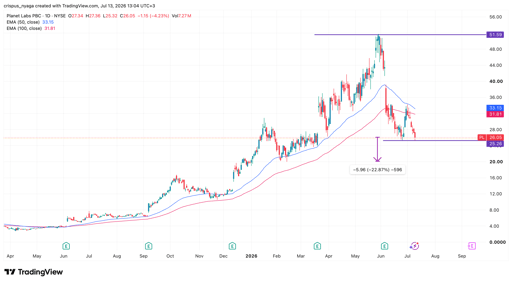
Planet Labs stock chart | Source: TradingView
The daily chart shows that the Planet Labs stock has been in a freefall in the past few weeks, moving from a high of $51.60 in May to the current $26.
It is attempting to drop below the key support level of $26.25, a move that will invalidate the forming of the double-bottom pattern.
It is attempting to move below the 50-day and 100-day Exponential Moving Averages (EMA), which are about to cross each other, forming a mini death cross.
The stock will likely continue falling, potentially to the key support level at $20, down by 23% from the current level. It will likely bounce back later this year as investors rotate back to space companies.
READ MORE: Wedbush makes a strong case for buying the dip in Planet Labs stock

HPE stock declines 8% on Monday: here's why

Netflix stock rises as Evercore raises price target to $110

Why Wedbush and BofA issued bullish notes on Roblox stock today

AI panic triggers a rally in CrowdStrike stock

Nvidia stock: Should investors buy the dip amid AI slowdown fears?
No results found
Loading articles...
Failed to load articles. Please try again.