
Bitcoin price slips below $65,800: is a deeper correction now coming?

AI Sentiment: 35/100 Bearish
This score is generated through AI-driven analysis of the article's content.

powered by

Buy: iShares Bitcoin Trust (IBIT) or Fidelity Wise Origin Bitcoin Fund (FBTC). Setup: price slipped below $65,800 but spot ETF inflows stayed positive for 7 straight days ($68.99M net inflow Wednesday). That’s the market’s “real buyer” stepping in while macro/geopolitics scare traders. Thesis: if ETF demand continues, BTC holds the 50-day EMA (~$65,163) and reclaims the 100-day EMA (~$68,063). Key risk: ETF inflows flip to sustained outflows (or a forced liquidation wave) and BTC breaks and holds below ~$64,000 support.
Key Risk: Spot Bitcoin ETF inflows turn negative and BTC breaks below ~$64,000, forcing a deeper selloff.
Sell/hedge: short United States Oil Fund (USO) or buy puts on USO. Setup: the article ties the selloff in BTC to higher oil prices from Middle East shipping disruptions and inflation fears. Thesis: as crude stays elevated, rates stay tighter-for-longer, keeping pressure on risk assets; oil may also mean-revert if the market prices in worst-case disruption. Key risk: oil keeps grinding higher on real supply shocks (bigger-than-expected Strait of Hormuz/Red Sea disruption), lifting inflation expectations further and worsening the BTC/risk-off trade.
Key Risk: Crude keeps surging on escalating supply disruption, reinforcing “higher-for-longer” and sustaining risk-off.
- BTC extended its correction, slipping below $65,800 amid geopolitical tensions.
- Rising oil prices linked to the conflict have revived inflation concerns.
- BTC remains above its 50-day EMA, but faces strong resistance near $68,013.
Bitcoin BTC extended its recent correction on Thursday, trading below $65,800 after posting modest losses in the previous session.
While institutional investors continue accumulating Bitcoin through spot exchange-traded funds (ETFs), growing geopolitical tensions in the Middle East have dampened investor sentiment and limited the cryptocurrency's upside.
The latest decline comes as higher oil prices and renewed inflation fears prompt traders to reassess expectations for US monetary policy.
Rising geopolitical risks pressure Bitcoin
Bitcoin rallied earlier in the week, climbing toward its mid-June highs and reaching a monthly high of over $66,000.
However, bullish momentum faded as geopolitical developments triggered a shift away from risk assets.
The conflict between the United States and Iran intensified after the US military reportedly carried out another round of strikes targeting Iranian military infrastructure.
In response, Iran continued attacks on US military assets across the Gulf region.
Tensions escalated further after Iran reportedly targeted two oil tankers transiting the Strait of Hormuz, while Yemen's Iran-backed Houthi movement launched attacks on two Saudi oil tankers in the Red Sea.
The incidents have heightened concerns over potential disruptions to global energy supplies.
Adding to market uncertainty, US President Donald Trump warned that the United States could target additional Iranian infrastructure, including bridges and power plants, if attacks on commercial shipping continue.
The escalating conflict has pushed crude oil prices sharply higher, raising concerns that energy-driven inflation could remain elevated.
As inflation expectations rise, investors increasingly believe the Federal Reserve may maintain a tighter monetary policy for longer than previously anticipated.
According to the CME FedWatch Tool, the probability of a July interest rate hike has climbed significantly in recent days, reflecting growing expectations that policymakers could adopt a more hawkish stance if inflation pressures persist.
Higher interest rates generally reduce the appeal of risk-sensitive assets such as cryptocurrencies by increasing the attractiveness of fixed-income investments and tightening financial conditions.
Despite Bitcoin's recent weakness, institutional demand has remained resilient.
Data from SoSoValue shows that US-listed spot Bitcoin ETFs recorded $68.99 million in net inflows on Wednesday, extending their streak to seven consecutive trading days of positive flows.
The continued accumulation by institutional investors suggests that long-term confidence in Bitcoin remains intact, even as short-term macroeconomic uncertainty weighs on prices.
If ETF inflows continue in the coming sessions, they could provide support for Bitcoin and help limit further downside.
Bitcoin technical outlook: Bears target $64,000 support level
Bitcoin is currently trading near $65,800, holding just above its 50-day Exponential Moving Average (EMA) at approximately $65,163.
Maintaining support above this technical level indicates that buyers remain active despite the ongoing correction.
However, the broader recovery remains constrained by stronger resistance levels overhead.
Bitcoin faces immediate resistance around the 100-day EMA at $68,063 and the 200-day EMA ($74,348).
A decisive break above the 100-day EMA could strengthen bullish momentum and open the door for a move toward higher resistance levels.
On the downside, traders are closely monitoring the next support at the 50-day EMA of $65,163.
Failure to defend this support could see the bears push BTC’s price lower towards the demand zone at $64,004.
A sustained break below these levels could increase selling pressure and trigger a deeper corrective move.
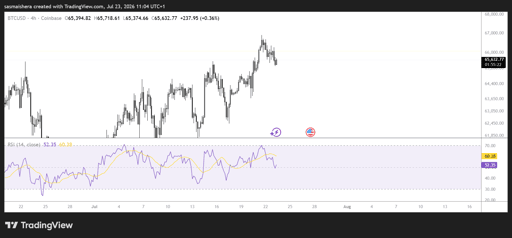
Technical indicators currently present a balanced outlook.
The Relative Strength Index (RSI) remains above the neutral 50 level at around 52, suggesting that bears have not fully gained control.
Meanwhile, the Moving Average Convergence Divergence (MACD) remains in positive territory, signaling that upward momentum still exists, although it has yet to overcome the broader bearish resistance structure.

Strategy, Coinbase stocks rally as Bitcoin reclaims $80,000

Bitcoin reclaims $80K as Fed rate-hike odds fall on Fed Governor's comments

Can Bitcoin price reach $80,000 after its latest breakout?

Bahrain leads the Middle East stablecoin race, but where are the coins?

Could ADA rip past $0.21 as Cardano governance turns from risk to catalyst?
No results found
Loading articles...
Failed to load articles. Please try again.