
UNI jumps as Robinhood Chain turns Uniswap fees into a token-burning machine

AI Sentiment: 78/100 Bullish
This score is generated through AI-driven analysis of the article's content.

powered by

Buy UNI. The news adds a real cash-flow loop: Robinhood Chain fees feed TokenJar, automated searchers buy UNI, then UNI is bridged and burned. That turns UNI from “mostly governance” into a supply-reduction asset tied to sustained DEX activity (not just one-off hype). Technicals back it: UNI is above key daily EMAs with RSI >50 and MACD still positive; $4.18–$4.25 is the next squeeze zone.
Key Risk: Burn/fee redirection underperforms—if TokenJar inflows or the buyback/burn execution slows, UNI loses the new demand-and-supply tailwind.
Sell RBN (or any Robinhood Chain token exposure). The upside is captured by UNI via the fee-to-TokenJar-to-burn mechanism; Robinhood Chain’s role is mainly as the fee generator, not the beneficiary of the burn-driven UNI demand. As UNI becomes the “cash-flow + deflation” trade, relative value shifts away from the chain token.
Key Risk: Robinhood Chain tokenomics also start capturing value (e.g., fee share, buybacks, or burns) so it benefits alongside UNI rather than lagging.
- UNI jumped nearly 7% after the pools.trade launch.
- Protocol revenue is driving automated UNI buybacks and burns.
- UNI continues to trade above key daily moving averages.
Uniswap's UNI token has climbed nearly 7% from its 24-hour low over the past day as traders have responded to new catalysts.
According to information released by Uniswap Labs, the protocol launched pools.trade on Aug. 6, a native token creation platform built specifically for the Robinhood Chain.
The rollout comes after Robinhood Chain has rapidly become one of the largest sources of trading fees for the decentralised exchange, while governance changes have begun redirecting a share of protocol revenue toward automated UNI buybacks and burns.
The combination has given traders a new reason to revisit UNI. During the past 24 hours, the token rallied from $3.92 to $4.19, a gain of nearly 6.9%, before easing to around $4.09 at the time of writing.
The move extended UNI's weekly advance to more than 2% and its monthly gain to over 30%.
pools.trade adds a new token launch engine
At the center of the latest catalyst is pools.trade, which serves as a token issuance and liquidity launch platform integrated directly with Uniswap v4 on Robinhood Chain.
Unlike traditional launchpads that require creators to manually establish liquidity, every token issued through pools.trade automatically creates protocol-owned liquidity pools on Uniswap v4.
Creator fees earned from those pools compound automatically instead of requiring manual management.
The platform introduces two launch formats.
The first is an Instant Launch, which uses a conventional bonding curve to allow immediate token trading after deployment.
The second is a Crowd Launch, which keeps token sales open for four hours and uses Time-Weighted Average Price (TWAP) bidding to reduce sniper bot activity during new launches.
Uniswap Labs said every token launched through pools.trade is immediately available across the Uniswap Web App, Wallet and API, giving projects instant access to trading infrastructure instead of waiting for external listings.
The design also keeps trading activity inside the Uniswap ecosystem because swaps executed through the platform are routed directly through Uniswap v4 pools, generating protocol fees from the first transaction.
The new launchpad builds on Robinhood Chain's growing role inside the Uniswap ecosystem.
Since the network went live on July 1 as an Arbitrum Orbit Layer 2, Uniswap has handled decentralised trading through v2, v3, v4 and UniswapX for tokenized stocks available around the clock.
Users in more than 120 countries can trade tokenized shares of companies including Apple, Nvidia and Google outside traditional market hours, creating a stream of trading activity that differs from the burst-like nature of most cryptocurrency markets.
According to the project, Robinhood Chain processed more than $6 billion in Uniswap swap volume during its first ten days after launch.
The sustained trading activity has turned the network into one of Uniswap's largest revenue contributors.
Robinhood Chain now accounts for nearly half of the protocol's weekly fee generation, rivaling established deployments on Ethereum, Arbitrum and Base.
Unlike temporary trading spikes driven by individual token launches, tokenized equity trading continues throughout the week, producing a steadier flow of swap fees.
Governance changes have changed UNI's value story
Fee generation has become more important because recent governance approvals changed how part of that revenue is used.
Historically, UNI functioned primarily as a governance token while liquidity providers collected trading fees.
Following the approval of governance proposals including Proposal 100, Uniswap activated its v4 fee switch and expanded cross-chain fee collection across major Layer 2 networks, including Robinhood Chain.
Under the new system, a portion of swap fees is redirected into TokenJar smart contracts instead of flowing entirely to liquidity providers.
According to the protocol's design, automated searchers compete to purchase assets accumulated inside TokenJar by buying UNI on the open market.
The acquired tokens are then bridged to Ethereum and permanently sent to the network's burn address, reducing circulating supply.
Protocol revenue has reportedly increased from a baseline run rate of roughly $114,000 per day to more than $325,000 daily, allowing the burn mechanism to remove UNI from circulation at a faster pace whenever network activity remains elevated.
For traders, the change has introduced a cash-flow component that previously did not exist because protocol usage now contributes directly to automated market purchases and token destruction.
Will UNI price rally further?
UNI's technical structure has improved alongside the fundamental developments, although momentum has moderated after the initial breakout.
On the daily chart, UNI remains above its 20-day, 50-day, 100-day and 200-day exponential moving averages, indicating buyers have regained control after months of weakness.
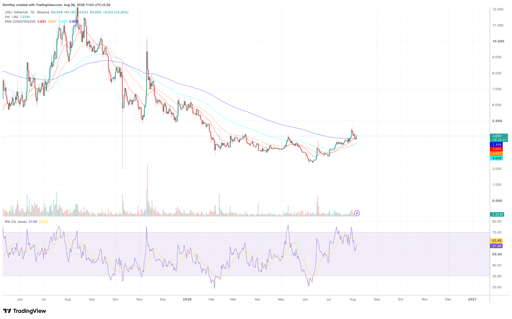
UNI/USDT 1-day price chart. Source: TradingView.
The 20 EMA near $3.89 has moved above the longer-term averages and now serves as the closest dynamic support.
The Relative Strength Index (RSI) sits near 58, retreating from higher readings recorded during the rally but still holding above the neutral 50 level.
Rather than signaling exhaustion, the indicator points to bullish momentum cooling while remaining intact.
On the 4-hour chart UNI price continues to trade around the VWAP, suggesting buyers are still defending the recent advance despite short-term profit-taking.
See below:
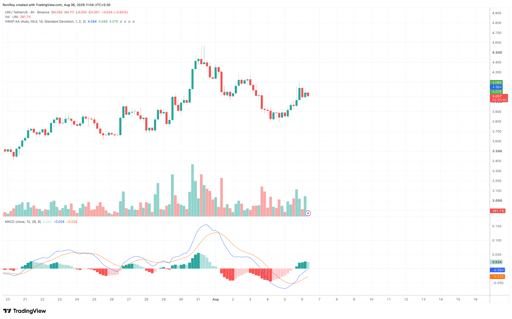
UNI/USDT 4-hour price chart. Source: TradingView.
Meanwhile, the MACD remains above its signal line and the histogram stays positive, although the bars have started to flatten as upside momentum slows following the sharp move from the weekly lows.
Volume expanded during the breakout toward $4.19 before easing as UNI entered consolidation, a pattern that often follows catalyst-driven rallies.
Meanwhile, the 24-hour liquidation heatmap shows the largest concentration of leveraged positions sitting between $4.18 and $4.25.
See below:
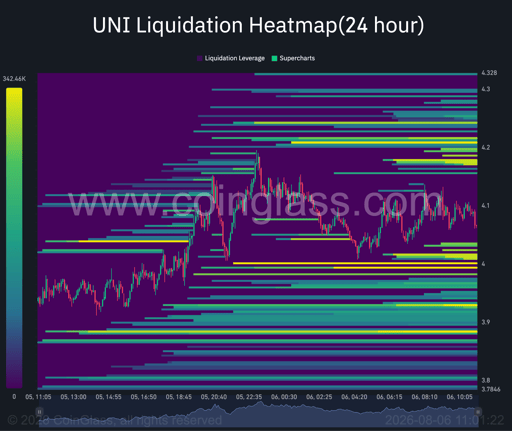
UNI 24-hour liquidation heatmap. Source: Coinglass.
A decisive move through that zone could force short liquidations and create enough buying pressure to test levels above $4.25, making it the nearest upside target if momentum returns.
On the downside, the first significant liquidity cluster appears around $4.00, where leveraged positions have accumulated after the recent rally.
Should sellers push UNI below that level, another large pocket of liquidity sits near $3.88-$3.90, aligning closely with the daily moving averages and providing a stronger support area.
The next move will likely depend on whether buyers can reclaim $4.19 or sellers force the token below the $4.00 support level.

Is XRP quietly building toward $1.90 as macro pressure eases and demand holds?

Bitcoin price defends $80,000 as bulls prepare another run at $82,000

Strategy, Coinbase stocks rally as Bitcoin reclaims $80,000
Bitcoin reclaims $80K as Fed rate-hike odds fall on Fed Governor's comments
Can Bitcoin price reach $80,000 after its latest breakout?
No results found
Loading articles...
Failed to load articles. Please try again.