
Pi Network forms a risky pattern despite some major upgrades

AI Sentiment: 18/100 Bearish
This score is generated through AI-driven analysis of the article's content.

powered by

Go long BTC and/or ETH versus PI (buy BTC/ETH, reduce PI exposure). The article shows PI is underperforming despite “major upgrades,” while it’s trading in a tight range like majors—meaning PI’s idiosyncratic supply/demand problem is the drag. If the bearish breakout hits PI, it should underperform majors further.
Key Risk: PI catches a broad crypto bid and starts moving with BTC/ETH instead of lagging (PI breaks out and holds).
Sell/short PI. The chart is bearish (below 50-day EMA, RSI falling) and a bearish pennant/triangle is about to break, with downside target near $0.070. Upgrades don’t translate into price action, while supply is set to rise (128M unlocks this month) and volume is thin ($5.8M), so rallies should fail fast.
Key Risk: A sudden surge in real demand (volume spikes + sustained buying) that forces a breakout above the triangle/50-day EMA.
- Pi Network price has remained within a narrow range this month.
- The token has formed a bearish pennant pattern, pointing to a retreat.
- The developers announced a major update to the network.
Pi Network price has remained in a narrow range in the past few months, and the recent actions by the developers have not boosted its performance. The token was trading at $0.086 on Tuesday, down by 70% from the year-to-date high, even after the developers launched major upgrades.
Pi Network has made some major updates
Pi Coin price has been in a tight range in the past few months, mirroring the performance of other cryptocurrencies like Bitcoin, Ethereum, and XRP.
This consolidation continued today, even after the developers launched some major upgrades. On August 14, the developers launched Pi Node version 0.6.2, which introduced improvements to SoloHost, Node connectivity, and Pi Desktop user experience.
At the same time, the developers completed the distributed computing test through a SoloHost, which advanced the utility of Pi Nodes beyond supporting the Pi blockchain.
In a separate statement, Pi Network launched an upgraded version of the Pi App Studio that will change how apps are priced. This upgrade means that creators in the ecosystem will now pay more money to build their apps.
Before the changes are implemented, creators pay 0.25 Pi to create and 0.25 Pi to make an edit to an app. Since the real costs of doing this is higher than that, Pi has been paying the difference, something that he will change.
The update means that Pi will only subsidize apps that are trying to achieve real utility. For other apps, the App Studio will have a standard creation and editing price that reflects the actual cost of these services. This means that the overall cost of building apps in the ecosystem will be more expensive than where it is today.
Update to Pi App Studio creation pricing on August 24, 2026! Read to learn more. https://t.co/NoBTHOXiMJ
— Pi Network (@PiCoreTeam) August 17, 2026
Pi faces some major challenges
Pi Network price faces some major challenges that are affecting its performance. The most important one is demand and supply. Demand remains weak, with the 24-hour trading volume being $5.8 million, down by 17% in the last 24 hours. This is a significantly tiny amount for a coin that has a market capitalization of $952 million.
At the same time, the coin’s supply continues growing, with the circulating supply of 11 billion. The network will unlock over 128 million tokens this month and 1.705 billion in the next 12 months. A combination of weak demand and higher supplies often leads to more downside over time.
Pi Network price has formed the risky bearish pennant pattern
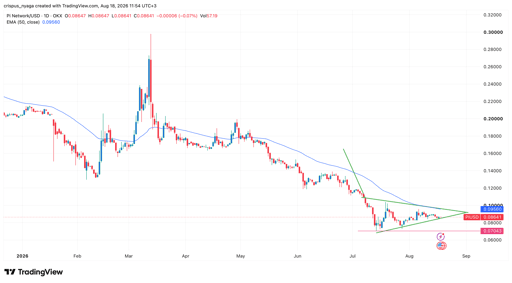
Pi Coin price chart | Source: TradingView
The daily chart shows that the Pi Coin price has remained under pressure in the past few days. Now, it has formed a symmetrical triangle pattern, whose two lines are about to converge. This triangle is part of the bearish pennant pattern, a common continuation sign in technical analysis.
The token has dropped below the 50-day Exponential Moving Average (EMA), a sign that bears remain in control. Also, the Relative Strength Index (RSI) has continued falling. Therefore, the token will likely have a bearish breakout, potentially to the key support at $0.070, its lowest level this year.

Dogecoin looks weak below $0.07, yet one signal hints the selloff is fading

Rolls-Royce shares are on a path to 2,000p, but a key technical risk remains

Can XLM hold $0.14 as bearish traders tighten their grip on Stellar?

Why is XRP falling below $1 even as Ripple expands its banking footprint?

Ethereum struggles near $1,900 as BitMine bets ETH will beat Bitcoin
No results found
Loading articles...
Failed to load articles. Please try again.