
Why is AMD stock falling while Intel stock rises after Nvidia's earnings?
AI Sentiment: 58/100 Bullish
This score is generated through AI-driven analysis of the article's content.

powered by

Nvidia’s $5B investment and NVLink-based joint CPU+GPU product roadmap makes Intel the “picks-and-shovels” CPU supplier to Nvidia’s AI platform growth. With hyperscalers expanding GPU fleets (AWS +2M GPUs), Intel should capture more CPU attach and platform share alongside Nvidia’s ecosystem, not just fight it. Key catalyst: Intel’s ability to sell CPUs that directly pair with Nvidia accelerators via NVLink-connected joint generations.
Key Risk: Intel fails to deliver the joint NVLink CPU+GPU products on time or at scale, so hyperscalers keep standardizing on other CPU platforms.
AMD is the most direct AI accelerator competitor to Nvidia, and the news flow strengthens Nvidia’s “full-stack” capture: AWS is deploying 2M more Nvidia GPUs and Nvidia is ramping its own server CPUs (Vera). That combination pressures AMD’s attach rate in hyperscaler AI racks even if AMD’s Helios platform is strong. Near-term stock sensitivity to hyperscaler partner decisions is the setup; this is another Nvidia-led customer signal.
Key Risk: AMD’s Helios rack-scale wins accelerate faster than Nvidia’s CPU push, keeping AMD’s enterprise AI server CPU and GPU share gains intact.
- Intel gained as its partnership with Nvidia could boost demand for its CPUs alongside Nvidia GPUs.
- Nvidia's latest AWS deal is likely to have reinforced competitive pressures on AMD.
- Analysts say AMD is the company to beat in enterprise AI server CPUs.
Nvidia's blowout earnings gave semiconductor stocks a lift on Thursday, after the world's leading AI chipmaker projected 70% revenue growth for fiscal 2028 and signaled that demand for artificial intelligence infrastructure remains well above current supply.
The Philadelphia Semiconductor Index rose about 1.7%, while shares of Marvell Technology, Arm Holdings, SK Hynix and Broadcom also gained.
The forecast provided investors with a fresh reason to believe the AI investment cycle has further to run, countering concerns in recent months that spending on data centers and AI computing infrastructure could eventually plateau.
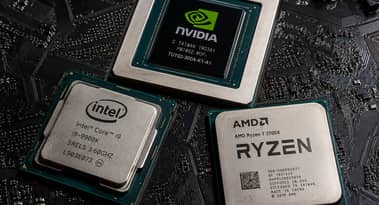
But there was an interesting divergence among the three major US chipmakers competing across AI and data-center markets.
Intel shares INTC rose more than 3%, while AMD shares fell about 1%.
Nvidia, AMD, and Intel compete across the AI and data-center chip markets, with Nvidia leading in GPUs and AI accelerators, AMD challenging it with its Instinct accelerators, and Intel competing through its CPUs and Gaudi AI chips.
Nvidia's deeper push into CPUs has heightened its competition with established players like Intel and AMD.
Intel and AMD have spent decades building relationships with cloud providers and hyperscalers, particularly in server CPUs.
Intel's Nvidia partnership changes the equation
While AMD remains Nvidia's most direct competitor in AI accelerators, Intel's relationship with Nvidia is becoming more collaborative.
Nvidia has invested $5 billion in Intel for a roughly 4% stake.
More importantly, the companies have agreed to develop multiple generations of joint products that will connect Intel's central processors with Nvidia's AI and graphics chips using Nvidia's proprietary NVLink interconnect technology.
That creates an unusual dynamic for Intel.
Rather than trying solely to displace Nvidia in AI accelerators, Intel can benefit from the growth of Nvidia's AI systems by supplying the CPUs that sit alongside its GPUs.
This explains Intel's Nvidia-led share price rise on Thursday.
Nvidia's gains highlight AMD's challenge
Alongside the earnings announcement on Wednesday, Nvidia also disclosed a deeper partnership with Amazon Web Services.
The company announced that Amazon plans to deploy 2 million additional Nvidia GPUs across AWS's global infrastructure, while the companies will also expand their work across AI factories, CPUs, networking, open models, data processing and robotics.
In an interview with CNBC's "Mad Money," Nvidia CEO Jensen Huang said Amazon could also purchase “millions of CPUs” in addition to the GPUs.
Nvidia is ramping up its own CPU business with Vera, putting it into direct competition with Intel and AMD, the two established leaders in server processors.
This could have been the trigger for AMD's stock movement on Thursday.
Gartner analyst Kevin Knox has previously said AMD is currently the company to beat in enterprise AI server CPUs.
AMD reportedly holds about 33% of the server CPU market, compared with 66.8% for Intel, although AMD has been gaining share and maintains relationships with major hyperscalers.
AMD's stock has nevertheless remained sensitive to developments involving major AI customers.
Earlier this month, shares fell after Elon Musk said SpaceX had selected Nvidia as its exclusive AI infrastructure partner going forward.
AMD had also benefited from Amazon's decision to increase its planned 2026 capital expenditure to about $220 billion from approximately $200 billion.
The latest AWS announcement could therefore have reinforced concerns about Nvidia's ability to capture a growing portion of hyperscaler AI spending.
AMD's AI ambitions continue to expand
Meanwhile, AMD is increasingly pitching itself as a provider of complete AI infrastructure rather than simply a maker of GPUs.
Its Helios platform combines Instinct accelerators, EPYC processors, Pensando networking and ROCm software in a rack-scale system.
The approach is intended to allow customers to deploy the infrastructure required to train and run advanced AI models without assembling individual components themselves.
AMD's growing customer base is becoming an important part of that strategy.
Anthropic has committed to deploy up to 2 gigawatts of MI450-series GPUs in Helios systems.
OpenAI and Meta each have agreements covering up to 6 gigawatts of AMD GPUs, while Microsoft plans large-scale Helios deployments on Azure. Oracle is also listed among customers deploying AMD's rack-scale infrastructure.
Benchmark responded by raising its AMD price target to $685 from $485, saying “the customer map is getting harder to dismiss.”
Roth MKM analyst Suji Desilva was similarly “encouraged by the technical advantages” of Helios.
The firm raised its target to $650 from $500, arguing that AMD's combination of GPUs, CPUs and networking can support hyperscalers and frontier AI companies at scale.

Analysts see further upside as Okta stock hits YTD high on Q2 earnings
Why are memory stocks MU, SNDK, and WDC falling despite Nvidia’s results

IREN stock jumps ahead of earnings as neoclouds cheer Nvidia's results

These three stocks are must-owns after the PCE data

Affirm stock is compressing: here’s why it may pop after earnings today
No results found
Loading articles...
Failed to load articles. Please try again.