
Sterling holds firm despite economic weakness and political uncertainty
AI Sentiment: 62/100 Bullish
This score is generated through AI-driven analysis of the article's content.

powered by

Buy GBP/USD. The pound is holding up despite UK contraction and political noise, and it’s set for its strongest weekly rise in nearly a month as the US dollar weakens. The catalyst is a potential Middle East peace deal boosting risk sentiment and reducing USD safe-haven demand, while UK rates are expected to stay unchanged near-term (BoE June 18).
Key Risk: BoE turns more hawkish than expected (or inflation re-accelerates), pushing UK yields up and reversing the USD-driven tailwind.
Sell silver (e.g., iShares Silver Trust SLV). Silver is retreating after a sharp spike because investors are balancing safe-haven demand against stubborn inflation that keeps rates elevated. Second-order: if the Middle East peace optimism strengthens, industrial growth expectations improve—but that typically helps silver only after real-rate pressure eases; right now inflation fears are winning, so silver’s “growth beta” won’t offset the rate headwind.
Key Risk: A renewed risk-off shock (escalation in the Middle East) reignites safe-haven buying and forces silver back above recent highs.
- Sterling heads for strongest weekly gain since mid-May.
- UK economy contracts as war-related disruptions hit entertainment sector.
- Investors assess inflation risks, central banks and geopolitical developments.
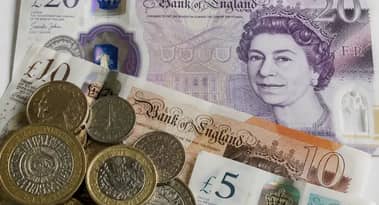
The British pound was on track for its strongest weekly performance in nearly a month on Friday, benefiting from a weaker US dollar as investors responded to growing optimism that a potential Middle East peace agreement could be approaching.
Sterling showed little reaction to fresh economic data indicating that the UK economy may be beginning to feel the effects of the conflict involving Iran.
The currency was slightly weaker against the dollar at $1.3403 during Friday trading but remained on course for a weekly gain of around 0.5%, its strongest weekly rise since mid-May.
According to data released by the Office for National Statistics, the UK economy contracted by 0.1% in April, marking its first monthly decline since August.
Political and policy developments in focus
Attention is now shifting toward several key events that could shape the near-term direction of UK markets.
Market participants view Burnham as more supportive of expansionary fiscal policies than Prime Minister Keir Starmer, who is facing mounting political pressure amid voter dissatisfaction over the economy and growing tensions within Labour ranks.
The political backdrop is particularly significant given the UK's limited fiscal flexibility and elevated borrowing costs.
On the monetary policy front, the Bank of England is also set to meet on June 18.
Markets widely expect policymakers to leave interest rates unchanged.
Upcoming data on inflation and consumer spending are likely to influence investor sentiment ahead of the decision.
Until March, Britain had experienced some of the highest consumer price pressures among the Group of Seven economies for much of the previous four years.
However, in April, US inflation surpassed Britain's rate, while May US consumer price inflation reached a three-year high of 4.3%.
Precious metals retreat as inflation concerns persist
Gold prices moved lower on Friday and were headed for a weekly decline as traders weighed persistent US inflation concerns against hopes that a Middle East peace agreement could reduce energy-related risks that have supported bullion markets in recent months.
Spot gold traded near $4,191 per ounce during Asian trading hours, putting the metal on course for a weekly decline of approximately 3%.
Although US gold futures for August delivery advanced, the broader market tone remained cautious.
Silver also retreated during Asian trading, giving back part of the previous session's sharp gains.
The metal traded near $67 per ounce after surging more than 6% on Thursday.
Market participants reassessed precious metals positions as geopolitical safe-haven demand competed with concerns that stubborn inflation could keep global interest rates elevated for longer.
Silver has been particularly sensitive to these competing forces because, unlike gold, it is also closely tied to industrial demand and economic growth expectations.
Dollar stabilises after volatile session
The US dollar steadied during Asian trading after experiencing a sharp reversal in the previous session.
Investors continued to balance optimism surrounding a potential Middle East ceasefire with uncertainty over the future path of US interest rates.
The dollar edged up to around 160.07 yen after previously falling to its weakest level in a week.
Meanwhile, the Australian and New Zealand dollars eased slightly after overnight gains against the greenback.
Sterling remained largely unchanged near $1.34, while the euro stayed close to a one-week high around $1.1576.
The euro's resilience was supported by the European Central Bank's quarter-point interest rate increase on Thursday, highlighting a growing contrast between the ECB's inflation-focused stance and a Federal Reserve outlook that remains dependent on incoming economic data.
With central bank decisions, political developments, and geopolitical events converging, investors face a crucial week that could determine the near-term direction of currencies, precious metals, and broader financial markets.

US dollar steadies as Iran peace hopes and Fed rate risks jolt FX markets
Dollar holds ground as investors await ECB policy announcement

EUR/GBP forecast: rare chart pattern points to a crash after ECB decision

Global markets stay cautious as inflation and geopolitical concerns intensify

Pound strengthens slightly against dollar despite geopolitical tensions
No results found
Loading articles...
Failed to load articles. Please try again.