
SK Hynix stock jumps 11%: will Nasdaq listing trigger a memory-chip rerating?
AI Sentiment: 78/100 Bullish
This score is generated through AI-driven analysis of the article's content.

powered by

Buy SK Hynix ADRs (Nasdaq). The Nasdaq listing is a catalyst for a US “AI infrastructure” rerating versus a Korea memory-cycle label, and it should pull in Micron-like investors plus passive ETF/index flows once it’s benchmark-visible. The offering funds HBM capacity (Y1 fab + advanced packaging), aligning supply with the AI memory bottleneck narrative.
Key Risk: AI/HBM demand cools or pricing weakens, so the stock rerates back to a cyclical memory valuation despite the Nasdaq move.
Buy Micron and SK Hynix together (relative strength). The news increases the odds that US investors treat HBM as a scarce AI input across the whole complex; SK Hynix joining Micron on Nasdaq should lift the entire “HBM/AI memory” basket and improve sentiment toward Micron’s supply-demand outlook.
Key Risk: HBM supply ramps faster than AI demand, compressing margins and making the rerating story fail for both names.
- SK Hynix shares rose as much as 11.6% after its Nasdaq ADR plan.
- The chipmaker aims to raise up to $29.4 billion from the listing.
- Analysts say Nasdaq could help SK Hynix close its valuation gap.
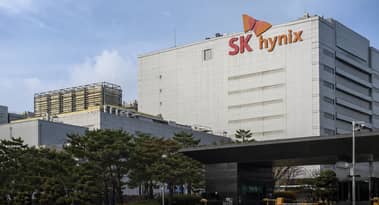
SK Hynix shares jumped as much as 11.6% on Thursday, after the South Korean chipmaker laid out plans for one of the biggest equity offerings in market history.
The Nvidia supplier plans to raise up to 45.45 trillion won, or about $29.4 billion (approx. Rs 8.2 trillion), through a Nasdaq listing of American depositary receipts.
The deal involves up to 17.79 million new shares, with trading targeted for July 10 on the Nasdaq Global Select Market.
If completed at the top end, the offering would eclipse Saudi Aramco’s 2019 IPO and Alibaba’s 2014 listing, though it would still sit behind SpaceX’s recent record deal.
The bigger question is not just how much money SK Hynix can raise. It is whether Wall Street finally starts valuing Korea’s biggest memory-chip winner like its US-listed peers.
Why Nasdaq, not the NYSE?
The logic behind Nasdaq is simple: SK Hynix wants to be priced as an AI infrastructure stock, not just as a Korean memory-cycle name.
Reuters quoted Ryu Young-ho, senior analyst at NH Investment & Securities, as saying the most attractive benefit for investors is that SK Hynix will trade on Nasdaq alongside Micron.
That, he said, gives the company a chance to be “re-rated in the US market”.
That is the heart of the bull case. On Nasdaq, SK Hynix would appear on the same screens as Micron, Nvidia and the broader AI hardware complex.
It would be seen by investors who increasingly treat high-bandwidth memory, or HBM, as a scarce input for artificial intelligence rather than a commodity that simply rises and falls with the chip cycle.
Kim Sun-woo of Meritz Securities made a similar argument before the final $29.4 billion (approx. Rs 8.2 trillion) and July 10 terms were confirmed.
According to Maeil Business Newspaper, he said ADR issuance could bring in funds that already hold Micron and trigger a sharp revaluation.
There is also the passive-flow angle. If SK Hynix eventually finds its way into US semiconductor or tech benchmarks, index-linked funds and ETFs may have to absorb the shares.
That does not guarantee a rerating, but it gives the listing a built-in demand story beyond active stock pickers.
The capacity bet behind the capital raise
The Nasdaq deal is not just a financial transaction, but a capacity bet.
SK Hynix is already one of the biggest winners from the AI memory squeeze.
Counterpoint Research director MS Hwang told CNBC that SK Hynix is the “top-notch player” in HBM, adding that it has the “best product, lowest cost”.
That matters because HBM is one of the hardest bottlenecks in the AI supply chain.
Nvidia, Google and other major AI players need huge volumes of advanced memory to feed their accelerators, and SK Hynix has been among the clearest beneficiaries.
The money from the ADR sale is expected to go straight into factories and equipment.
Tom’s Hardware reported that SK Hynix has earmarked proceeds for the Yongin Y1 fab, a 31 trillion won project, and a Cheongju advanced packaging plant worth 19 trillion won.
The risk nobody’s pricing in
The rerating argument is powerful, but not risk-free.
Memory chips remain a cyclical business and while AI demand has changed the shape of the cycle, it has not abolished it.
If hyperscalers slow data-centre spending, delay orders or push back on pricing, SK Hynix would feel that quickly.
There is also market concentration risk as Samsung Electronics and SK Hynix together account for more than 55% of the KOSPI’s market capitalisation.

Micron, Nvidia, AMD stocks at risk as Anthropic, OpenAI leads push to slow AI growth

How will private credit and equity stocks react to Fed rate hikes?
Why SpaceX stock is up around 1% on Friday

Should you buy the dip in OKLO stock today?

Analyst: Adobe stock's post-earnings dip isn't about AI disruption fears only
No results found
Loading articles...
Failed to load articles. Please try again.