
Is Chainlink’s $7 support the start of a LINK price rebound? Check forecast

AI Sentiment: 38/100 Bearish
This score is generated through AI-driven analysis of the article's content.

powered by

Buy Chainlink (LINK) for a bounce off $7.02–$7.04 support. The article shows price already tagged $7.04 and recovered, while RSI-14 is ~30 (near oversold) and momentum looks like selling pressure is easing. Ecosystem catalysts (Aave sGHO via CCIP, Strategic Reserve converting service revenue into LINK, and bank testing through Project Pangea) support demand even while the chart is weak. Key trigger: hold above ~$7.02 and reclaim the 10–20 day EMAs.
Key Risk: LINK breaks and closes below ~$7.01–$7.02, starting a new down-leg toward lower support.
Sell/short LINK into resistance at $8.315. The token is below every major EMA (10/20/50/100/200), so rallies are likely to be sold until it proves a trend change. With 14 sell signals out of 23 and trend-following indicators still bearish, a push toward $8.315 offers a clean risk-defined exit/short entry. Key trigger: rejection near $8.315 without a daily close above it.
Key Risk: LINK closes above $8.315, flipping the setup toward $9.193 and invalidating the “rally to resistance” thesis.
- LINK holds above the key $7.02 support level.
- Bears retain control as all major daily EMAs remain overhead.
- Chainlink’s CCIP adoption expands through banking and DeFi initiatives.
Chainlink LINK remains under pressure after another week of losses, but traders are now watching closely to see whether the token has finally established a short-term bottom at $7.04.
At the time of writing, LINK was trading at $7.29 after falling 7.2% over the past seven days and 3.29% over the past 24 hours.
Earlier, the cryptocurrency slipped to a low of $7.04 before recovering to $7.29.
The decline has extended LINK's monthly loss to 22.6%, while the token is down 45.4% over the past year.
Strong network developments continue despite weak price action
While LINK's chart remains under pressure, activity across the Chainlink ecosystem continues to expand.
One of the latest developments involves the Aave community, which is considering deploying its yield-bearing sGHO stablecoin across multiple blockchain networks using Chainlink's Cross-Chain Interoperability Protocol (CCIP).
If implemented, the proposal would allow users on different networks to access yield-bearing GHO while relying on Chainlink's infrastructure to facilitate secure cross-chain communication.
Chainlink has also strengthened the economic model surrounding its ecosystem through its Strategic Reserve.
The reserve has now accumulated more than $4.6 million (approx. Rs 1.3 billion) worth of LINK in June, with tokens acquired using revenue generated from Chainlink services.
$LINK RESERVE UPDATE
— Chainlink (@chainlink) June 25, 2026
In the month of June, the Chainlink Reserve accumulated 593,088 LINK for $4.6M+.
Total holdings: 4,504,167 LINK. pic.twitter.com/cP0sr6eT4n
Instead of distributing those proceeds immediately, the system converts service payments into LINK, creating an additional source of demand tied directly to network usage.
Institutional adoption has also continued to grow.
Chainlink recently became part of Project Pangea, an initiative involving more than 50 banks from Europe and South Korea representing over $10 trillion (approx. Rs 2,795.9 trillion) in assets under management.
The project is testing stablecoin-based foreign exchange settlement with the goal of reducing settlement times from the traditional T+2 cycle to same-day settlement while lowering counterparty risk.
Chainlink provides the interoperability layer connecting blockchain infrastructure with existing banking systems through standards such as ISO 20022 and integrations with SWIFT messaging.
Another notable development came from T-RIZE Group, which introduced the first on-chain proof of insurance solution for tokenised private credit on the Canton Network using Chainlink technology.
The implementation enables institutional investors to verify insurance coverage through cryptographic proofs anchored on-chain, reducing reliance on manual documentation while improving transparency for tokenised assets.
Has Chainlink (LINK) already formed a bottom?
The technical picture remains tilted to the downside despite LINK holding above the $7.00 mark.
Across 23 tracked technical indicators, Chainlink has a net bearish reading with 14 sell signals, four buy signals and five neutral signals.
The sell signals come almost entirely from trend-following indicators.
All 12 monitored moving averages are flashing sell signals, while oscillators present a more balanced picture with four buy signals and only two sell signals.
LINK is trading below the 10-day, 20-day, 50-day, 100-day and 200-day EMAs, leaving every major moving average above the current price as potential resistance.
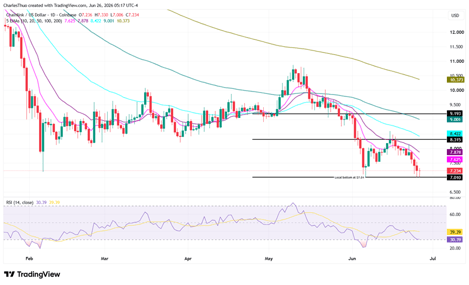
Remaining below the 200-day EMA, particularly, suggests that long-term momentum has yet to recover.
Momentum indicators, however, are beginning to show signs that selling pressure could be easing.
The daily Relative Strength Index (RSI-14) stands at 30.39, placing the token just above oversold territory.
On the weekly chart, the RSI is at 36.85, reflecting a market that has weakened considerably over recent months.
Looking at the important price levels, the immediate support sits at $7.02, only slightly above the recent low of $7.01. A sustained break below that level could expose LINK to another leg lower.
On the upside, the first major resistance is located at $8.315. A confirmed close above that level would shift attention toward the next resistance at $9.193.

PURR stock price forecast as Hyperliquid’s HYPE token hits a record high

Bitcoin ETFs keep buying, so why is BTC still stuck below $80K?

Why XRP traders are watching $1.47 as Evernorth and ETF demand build pressure

ENA explodes 10% as Ethena moves to kill its biggest token overhang

Can Ethereum price reclaim $2,500 as ETF demand battles profit-taking?
No results found
Loading articles...
Failed to load articles. Please try again.