
DEXE price crashes 80% in 24 hours as alleged team sell-off sparks panic

AI Sentiment: 12/100 Bearish
This score is generated through AI-driven analysis of the article's content.

powered by

Buy DEXE (small, tactical) for a mean-reversion bounce. RSI ~27 and support at $4.00–$4.50 after an 80% 24-hour crash sets up a reflex rally if selling pressure pauses. Trade the bounce toward ~$7.50 resistance; exit quickly if price can’t reclaim $5.50–$6.00.
Key Risk: Another liquidation wave: price breaks below ~$4.00 and leveraged selling/funding stays deeply negative, turning the bounce into a continuation down.
Sell DEXE (DEXE/USDT or DEXE spot). The move looks like a holder-driven dump: team-linked wallets reportedly sent ~625k DEXE to Binance, then leveraged liquidations cascaded. Even if the first wave is over, oversold bounces often fail when exchange-selling pressure can repeat and funding stays stressed. Key trigger: watch for any new large transfers to exchanges and continued weak bids under $4.50.
Key Risk: A clean reversal: no further exchange inflows plus DEXE reclaims and holds above ~$7.50, squeezing shorts and liquidations.
- DEXE token price has fallen from its $48.91 all-time high to around $4.83.
- Alleged team-linked wallet sales fueled heavy selling pressure.
- Liquidations deepened losses as leveraged positions were wiped out.
DeXe DEXE has suffered one of the sharpest declines in the cryptocurrency market this year after its price plunged more than 80% on Wednesday.
The dramatic sell-off erased almost all of the gains from the token's recent rally and left traders scrambling to understand what triggered the collapse.
While the broader crypto market remained relatively stable, DEXE dropped from trading above $23 during the day to around $4.83, marking an unusually severe move that quickly became one of the biggest talking points across the digital asset market.
The token is now trading more than 90% below that record level, with losses extending to 88% over the past seven days.
Notably, the collapse came only days after DEXE reached a new all-time high of $48.91 on July 13, highlighting just how quickly market sentiment changed.
Alleged team-linked token sales trigger market panic
The biggest catalyst behind the crash appears to be large token transfers linked to wallets reportedly associated with the DeXe project team.
According to on-chain data shared by blockchain analyst morsyxbt, wallets believed to be connected to the team transferred approximately 625,000 DEXE, valued at about $6.2 million at the time, to cryptocurrency exchange Binance on July 21.
The tokens were subsequently sold, adding significant selling pressure to a market that had already experienced a rapid price run-up.
The reported sales sparked immediate concern among traders, many of whom viewed the transfers as a sign that major holders were reducing their exposure.
Panic selling followed as market participants rushed to exit their positions, accelerating the decline within hours.
The speed of the drop stood out because it occurred while the broader cryptocurrency market showed no comparable weakness.
Instead of moving in line with Bitcoin or the wider altcoin market, DEXE experienced a sharp decline that appeared largely isolated to the token itself.
The crash also followed an extraordinary rally that had lifted DEXE from much lower levels to nearly $49 in a matter of days.
Such rapid gains often leave markets vulnerable when large holders begin selling, particularly when liquidity is relatively thin.
Liquidations magnified the decline
The initial wave of selling did not end with spot market activity. As prices continued falling, leveraged traders were forced out of their positions, creating another round of selling pressure.
Crypto market commentator Crypto__Haris reported that funding rates turned deeply negative as the decline intensified, while leveraged traders faced six-figure losses during the sell-off.
An Indian trader lost $100K on his $DEXE long position. 💔
— Crypto with Haris ₿ (@Crypto__Haris) July 21, 2026
If $DEXE drops another 10%, he’ll be liquidated and lose everything.
Today, $DEXE crashed over 75% after big holders started selling. The price crashed from $41 to $8 within 12 hours, accompanied by massive volume… pic.twitter.com/eolwT84vNf
Forced liquidations added to the downward momentum, creating a chain reaction that pushed the token even lower.
This type of liquidation cascade is common after strong rallies. When traders use borrowed funds to amplify gains, a sharp decline can trigger automatic liquidations.
Those liquidations become market sell orders, which place additional pressure on price and often lead to even more liquidations.
That sequence appeared to play out in DEXE's case.
What began as heavy selling reportedly linked to large wallets quickly evolved into a broader market-wide exit as leveraged positions were unwound.
DEXE’s technical picture remains heavily bearish
The scale of the decline has left DEXE in an extremely oversold position from a technical perspective.
The token is down 80.2% over the past 24 hours, 84.3% over 14 days, 71.7% over the past month, and 40.3% over the past year.
Technical indicators also reflect the severity of the move.
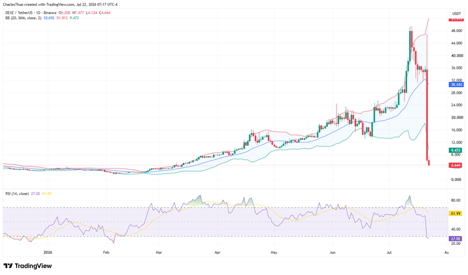
The 7-period Relative Strength Index (RSI) reportedly fell to around 27.02, a level that typically signals heavily oversold conditions after aggressive selling.
However, despite the oversold reading, traders remain focused on whether selling pressure has fully subsided.
Market participants are also monitoring on-chain wallet activity for signs that additional large transfers to exchanges could emerge.
Current technical levels place immediate support between $4.00 and $4.50, where buyers may attempt to stabilise the price.
On the upside, analysts have identified $7.50 as an important resistance level that needs to be reclaimed before short-term sentiment begins to improve.

Why is Bitcoin price struggling around $80,000?

Zcash price breaks above $1,000 as institutional and privacy demand rise

Is XRP quietly building toward $1.90 as macro pressure eases and demand holds?

Bitcoin price defends $80,000 as bulls prepare another run at $82,000

Strategy, Coinbase stocks rally as Bitcoin reclaims $80,000
No results found
Loading articles...
Failed to load articles. Please try again.