
Here’s why the Uber stock price is in a free fall

AI Sentiment: 18/100 Bearish
This score is generated through AI-driven analysis of the article's content.

powered by

Buy DHER. Uber is paying a big premium for Delivery Hero exposure, and the article shows DHER momentum: GMV +9%, revenue +23%, adjusted EBITDA €903M, and positive free cash flow (€250M). If Uber’s acquisition closes, DHER’s fundamentals and deal-driven demand can re-rate the stock.
Key Risk: Regulatory/closing delays or a deal renegotiation that reduces the value Uber is paying, or a sharp deterioration in DHER growth/margins.
Sell UBER. The article flags stalled growth, two straight quarters of missing estimates, and a large $13.7B Delivery Hero acquisition that will be funded with cash and equity—dilution risk plus execution risk. The Waymo relationship is deteriorating, raising uncertainty around autonomous/robotaxi optionality. Technicals also point down: bearish flag, RSI below 50, and $50 as the next target.
Key Risk: Uber beats expectations and proves growth is re-accelerating while the Delivery Hero deal quickly improves margins/cash flow.
- Uber stock has been in a free fall in the past few months.
- Waymo may end its exclusive relationship with Uber.
- The company recently announced a Delivery Hero buyout.
Uber stock price is in a free fall this year and is trading at the lowest level since April last year. It has plunged by over 35% from its highest point since September last year. This retreat has pushed its market capitalization from a record high of $206 billion to the current $134 billion. So, why is this ride-hailing stock plunging?
Uber stock has plunged as its growth slows
Uber, the biggest ride-hailing company in the world, is under intense pressure as signs emerge that its growth has stalled in the past few months.
Analysts believe that the upcoming earnings will show that its revenue grew by 12.7% in the second quarter to $14.26 billion. They also expect the upcoming numbers to show that its earnings-per-share rose from 63 to 83 cents, respectively. Uber has missed analysts' estimates in the last two consecutive quarters, meaning that this trend may continue in the upcoming earnings.
The most recent earnings report showed that Uber’s revenue rose by 14% in the first quarter to $13.2 billion, while its gross bookings soared by 25%. Its income from operations rose by 57% to $1.9 billion.
Uber stock has also dropped after the company announced a large acquisition recently. It will spend about $13.7 billion for the Delivery Hero purchase, a substantial amount since Uber ended the last quarter with over $6.1 billion in cash. It will fund the deal using cash on hand and equity.
The most recent results showed that Delivery Hero’s gross merchandise value (GMV) jumped by 9% to €49.2 billion, with its revenue soaring by 23% to €14.8 billion last year. It made an adjusted EBITDA of €903 million, while the free cash flow to €250 million.
Meanwhile, Uber stock has fallen as it explores a split from its Waymo deal. Just last week, Waymo said that it would end its exclusivity in Austin and Atlanta in January 2028.
According to the FT, the relationship between the two sides has deteriorated as they have become direct competitors in some markets. Also, the two sides are lobbying for robotaxi legislation that would benefit their businesses at the expense of the other. A full breakup between the two companies would dent Uber’s autonomous ambitions since it already sold its in-house business in 2020.
On the positive side, Uber has become a bargain, especially for a company with such a big market share. It now trades at a forward price-to-earnings ratio of 16, lower than the S&P 500 average of 21.
Uber stock price technical analysis
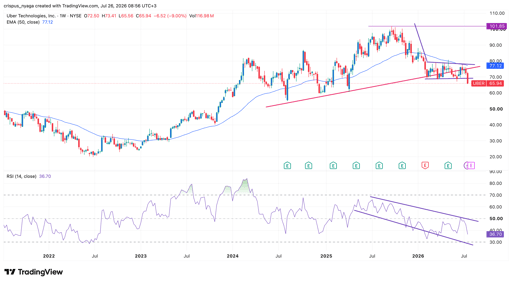
Uber chart | Source: TradingView
The weekly chart suggests that Uber shares may have more downside to go. It has slumped from a high of $101 in September last year to the current $65. It recently formed a bearish flag pattern and has moved below the lower side.
The Relative Strength Index (RSI) has formed a descending channel and has moved below the neutral level of 50. Therefore, the path of the least resistance for the stock is downwards, with the next key target to watch being at $50.

Software stocks are back from the dead as AI fuels growth: can the rally continue?

GoPro stock soars 200% after Markiplier stake, $285M Starman deal

SpaceX stock rally meets another lockup expiry test on September 9: what to expect

Dow closes 270 pts lower as strong jobs report lifts September Fed rate-hike bets

Evening digest: Trump pressures Fed as US jobs rise, gold falls
No results found
Loading articles...
Failed to load articles. Please try again.