
IAG share price in focus as Q2 earnings loom: buy or sell?

AI Sentiment: 28/100 Bearish
This score is generated through AI-driven analysis of the article's content.

powered by

Buy IAG. Jet fuel is up, but IAG is a hedger and has already shown it can pass through price and lean on loyalty (asset-light) to cushion margins. The stock is also technically oversold (below 50-day, RSI < 50) after a sharp drawdown, setting up a post-earnings relief bounce if guidance confirms limited net impact.
Key Risk: Fuel hedges roll off faster than expected and management guides to a much bigger margin hit than the market is pricing.
Sell unhedged US airline exposure (e.g., American Airlines Group—AAL). The article highlights that higher jet fuel is adding massive costs for airlines that don’t hedge (United cited ~$6B). If IAG’s hedging helps, the gap widens versus US peers, and the market will re-rate US airlines’ earnings power downward.
Key Risk: US airlines prove they can quickly offset fuel costs via pricing/ancillary revenue more than expected, shrinking the earnings gap.
- IAG stock price will be in the spotlight as it releases its earnings on Friday.
- The management will provide color on the impact of the ongoing US-Iran war.
- Technicals suggest that the stock may drop to about 400p in London.
International Consolidated Airlines Group (IAG) share price has hit turbulence and dropped into a technical correction after falling by 14.30% from its peak this year. It retreated as jet fuel prices rose amid the resumption of US-Iran war, with focus now shifting to the upcoming earnings.
IAG share price in the spotlight as jet fuel prices rise
International Consolidated Airlines Group, the parent company of British Airways and Aer Lingus, has retreated in the past few weeks as the US and Iran have resumed their strikes.
The US military launched major attacks against Iranian targets overnight after the latter launched a surprise attack against US bases in Jordan. Iran has also responded to these attacks by launching major attacks on US targets in the Middle East.
Crude oil prices have jumped substantially in the past few weeks, with Brent and the West Texas Intermediate (WTI) approaching $90 a barrel. IATA data shows that jet fuel prices have rebounded, with the weekly average price rising by 7.1% to $160 a barrel. It has jumped by over 23.9% on a MoM basis and 77.8% on a YoY basis.
IAG and other airlines are exposed to the rising jet fuel prices because it is usually one of the biggest costs. To offset this increase, IAG has embraced hedging and price increases across its key routes.
The most recent results by most airlines showed that their revenues jumped in the second quarter as they boosted their prices. However, their profits were impacted by the higher jet fuel prices, which mostly affected American airlines that don’t hedge. In its statement, United Airlines said that higher prices will add nearly $6 billion to its expenses this year.
IAG to release earnings on Friday
The next important catalyst for the IAG share price is its earnings report that comes out on Friday this week. These results are expected to provide more color on its business amid the ongoing US-Iran war and how fuel prices are affecting its operations.
The consensus estimate among 22 analysts is that its operating profit dropped to 1.36 billion euros in the second quarter from 1.68 billion euros in the same period last year as fuel prices rose.
The most recent results revealed that IAG’s revenue rose by 1.9% in the first quarter to 7.18 billion euros, helped by the transatlantic business. Its operating profit jumped by 77.3%, with the management citing the limited impact from the Middle East conflict.
Additionally, the company pointed to its asset-light loyalty business, whose revenue grew by 10% during the quarter.
IAG stock price technical analysis
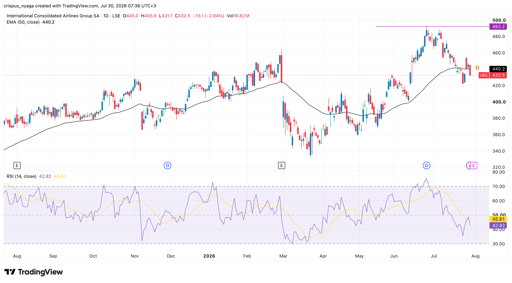
IAG share price chart | Source: TradingView
The daily chart shows that the IAG stock has been in a steep downward trend in the past few days, moving from a high of 492p to the current 432p. It has already slipped below the 50-day moving average, while the Relative Strength Index (RSI) fell below the neutral level of 50.
These technicals suggest that the stock will likely continue falling as sellers target the next key support level of 400p. In the long-term, however, the stock will likely bounce back as the Middle East crisis eases. If this happens, a rebound towards the year-to-date high of 492p cannot be ruled out.

SCHD ETF rally has stalled as a major risk emerges despite soaring inflows
Bloom Energy stock surges 8% as S&P 500 inclusion boosts investor interest

ALLW: Is this Ray Dalio’s All Weather fund a good ETF to buy today?

SpaceX stock could see massive buying on Nasdaq 100 rebalance: will SPCX rally?

Micron stock: a coiled spring ready to pounce ahead of earnings?
No results found
Loading articles...
Failed to load articles. Please try again.