
Boeing stock falls 2% today: here's why
AI Sentiment: 35/100 Bearish
This score is generated through AI-driven analysis of the article's content.

powered by

Buy LMT. If Apache scrutiny spreads to Army rotorcraft procurement, the Army may rebalance toward other proven platforms and sustain budgets with less execution risk. LMT is a cleaner defense exposure with less single-program headline risk than BA’s mixed commercial/defense profile.
Key Risk: Army procurement shifts back to Boeing quickly, or rotorcraft spending is insulated and BA’s defense outlook remains intact.
Sell BA. The Apache grounding is a direct hit to Boeing’s defense credibility and can trigger contract delays, investigations, and cost overruns just as the defense segment is only starting to stabilize. The market already priced a lot of commercial recovery; this adds another uncertainty lever.
Key Risk: The grounding is quickly cleared with no program impact, and Boeing wins/accelerates Apache follow-on orders, proving the hit is temporary.
- US Army grounds Apache helicopters after fatal Texas crash.
- Boeing defense sales rose 13% to $7.5 billion in Q2.
- Boeing targets higher jet deliveries and free cash flow by 2028.
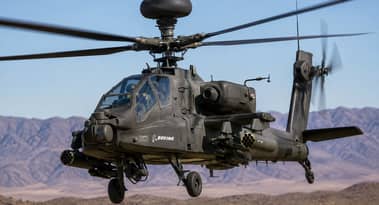
Boeing shares BA fell 2% on Monday after the US Army temporarily grounded its fleet of Apache helicopters following a fatal crash near Fort Hood, Texas, that killed two service members.
The Army said the temporary stand-down would remain in place until officials have a better understanding of the accident's root cause.
Boeing manufactures the AH-64 Apache, but the company had not immediately commented on the grounding.
The development adds another issue for Boeing's defense business, which has been working to improve its financial performance while the company remains heavily dependent on its commercial aircraft operations.
Army grounds Apache fleet after fatal crash
The Army ordered the temporary grounding following the crash and expressed condolences to the families, friends and unit of the two aviators.
“We mourn these aviators, and our deepest condolences remain with their families, friends, and unit during this extraordinarily difficult time,” the Army said in a news release.
The Apache has been in US Army service for more than 40 years.
The twin-engine attack helicopter is typically operated by two crew members and can carry guns, missiles and rockets.
Boeing has produced thousands of Apaches over the years, with hundreds operated by the US military and additional aircraft in service with US allies.
The grounding comes as Boeing's defense business continues to recover from significant losses in recent years.
The segment reported $7.5 billion in second-quarter sales, up 13% from a year earlier, although it recorded a $15 million loss.
Defense business shows signs of improvement
Boeing's defense and space division has faced pressure from inflation, fixed-price contracts and delivery delays across some programs.
Despite those challenges, losses have narrowed considerably. The business lost $128 million in 2025, compared with a $5.4 billion loss in 2024.
The performance of the defense unit remains relevant to investors as Boeing works to improve its overall financial position.
However, the company continues to rely primarily on its commercial aircraft business.
Boeing delivered 600 aircraft in 2025 and is expected to deliver about 670 in 2026.
That figure is projected to rise above 800 by 2028.
Analysts expect Boeing's free cash flow to improve to roughly $10 billion in 2028 from about $2 billion in 2026. The company used approximately $2 billion in cash during 2025.
737 Max 7 and Archer deal add to Boeing's focus
Boeing also recently received certification from the Federal Aviation Administration for the 737 Max 7, the smallest aircraft in the company's bestselling Max family.
The certification followed years of regulatory reviews and delays after safety concerns surrounding the 737 Max.
Southwest Airlines has already-built Max 7 aircraft in inventory, but those planes will require additional work before entering service, meaning the carrier is not expected to begin flying them until next year.
Meanwhile, Boeing is restructuring parts of its business through a deal with Archer Aviation. The company agreed to sell three subsidiaries to Archer in exchange for a stake in the electric vertical take-off and landing aircraft maker.
The transaction will give Boeing a 19.75% stake in Archer's Class A shares, along with options to acquire additional shares over the next four years.
For Boeing investors, the Apache grounding adds a near-term uncertainty to a defense division that has been improving, while commercial aircraft deliveries remain central to the company's broader recovery.

More details of the mega Anthropic IPO are coming out: here’s what we know

Software stocks are back from the dead as AI fuels growth: can the rally continue?

GoPro stock soars 200% after Markiplier stake, $285M Starman deal
SpaceX stock rally meets another lockup expiry test on September 9: what to expect

Dow closes 270 pts lower as strong jobs report lifts September Fed rate-hike bets
No results found
Loading articles...
Failed to load articles. Please try again.