
Why are Intel and AMD stocks falling today
AI Sentiment: 35/100 Bearish
This score is generated through AI-driven analysis of the article's content.

powered by

Buy Intel (INTC) for a technical mean-reversion bounce: it’s below the 200-day and 20-day SMAs but still holding just above the 50-day (~$89). The article frames this as a pullback after a strong rally, not a confirmed reversal. Catalyst is simply price stabilization and reclaiming near-term moving averages as broader markets stabilize.
Key Risk: Intel breaks and stays below the 50-day support, turning the pullback into a real downtrend.
Sell AMD (AMD) short-term: ARK’s position cuts are a clear signal of institutional de-risking even as AMD announces AI infrastructure expansion. With AMD trading at a very high ~74x valuation, any sentiment wobble can compress the multiple quickly. Trade on continued selling pressure until price stops making lower lows.
Key Risk: AMD’s AI infrastructure news triggers sustained buying and the stock reclaims key moving averages, reversing the selling pressure.
- Intel, AMD stocks fall as US markets start September lower.
- Intel technicals show weakness.
- AMD faces ARK selling pressure despite strong AI growth prospects.
Intel and AMD stocks fell on Tuesday as US equities started September on a weaker note, with semiconductor shares among those facing renewed pressure.
The S&P 500 declined 0.4%, while the Nasdaq Composite fell 0.8%. The Dow Jones Industrial Average dropped 38 points, or 0.1%.
AMD stock fell 2.4%, while Intel recovered most of its earlier losses and was down 0.45% at the time of writing.
Intel’s decline appeared to reflect broader market weakness rather than a company-specific catalyst. The stock is also pulling back from its June swing high, leaving traders focused on whether it can hold nearby support and reclaim key moving averages.
Intel technical outlook remains mixed
Intel is trading 5.7% below its 200-day simple moving average of $94.54, showing bearish trends are intact in the stock. The stock is 0.85% below its 20-day SMA of $89.83. However, the stock is 0.1% above its 50-day SMA of $88.97.
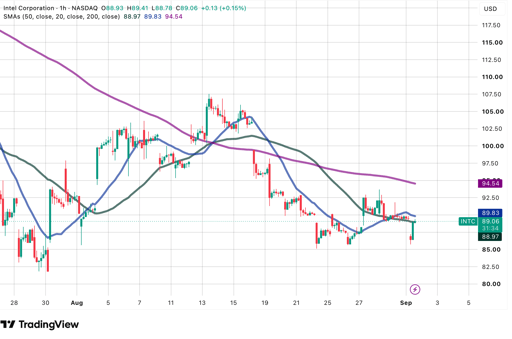
Intel reached a 52-week high of $142.35 in June before recording a swing low and breaking below support in July. As a result, previous support levels could act as resistance if the stock attempts to recover.
The current decline continues to resemble a pullback following a strong rally rather than a confirmed trend reversal.
However, holding key support could remain important for the stock’s technical outlook.
Intel has a consensus Hold rating and an average analyst price forecast of $110.
Bank of America Securities maintained a Buy rating while lowering its price forecast to $145 on Aug. 12.
UBS maintained a Neutral rating and reduced its forecast to $112 on the same day.
Bank of America had previously maintained a Buy rating and $160 price forecast on July 28.
AMD faces selling pressure despite AI expansion
AMD is also facing investor scrutiny after ARK Invest reduced its position in the chipmaker.
ARK sold 156,286 AMD shares valued at about $74.5 million across several ETFs, following the sale of another 37,977 shares worth roughly $18.3 million a day earlier.
The selling comes despite AMD’s expansion in AI infrastructure.
The company announced an AI infrastructure platform in Saudi Arabia in collaboration with Cisco and sovereign technology firm HUMAIN.
The initiative will combine AMD’s Instinct MI355X GPUs and EPYC CPUs with Cisco’s Silicon One AI networking architecture to provide GPU-as-a-Service infrastructure across Saudi Arabia.
AMD targets growing sovereign AI demand
The platform will connect AMD’s MI355X chips using Cisco’s 800G optics and N9000 Series fabric. The planned infrastructure is intended to support AI model training and real-time inference workloads.
Initial operations are expected to provide the foundation for 250 megawatts of AI deployment beginning in 2027, with the deployment potentially scaling to 1 gigawatt by the end of the decade.
AMD is trading at a premium valuation of about 74 times, making the stock more expensive than Nvidia.
Nevertheless, analyst sentiment remains positive, with AMD carrying a consensus Strong Buy rating and a mean price target of nearly $622, implying more than 30% potential upside from current levels.

Why Oracle stock is down around 5% on Tuesday

CoreWeave stock flashes a warning sign despite strong revenue growth

Dell stock falls before earnings: strong AI demand will not alone sustain 250% rally

SCHD nears title of biggest dividend ETF, but technical risks loom

Amazon stock falls on FTC lawsuit but analysts bullish despite near-term pressure
No results found
Loading articles...
Failed to load articles. Please try again.