
Apple unveils foldable iPhone, redefining flexible displays
AI Sentiment: 58/100 Bullish
This score is generated through AI-driven analysis of the article's content.

powered by

Buy Samsung Display (SDC). Apple’s move validates the foldable display path and raises the bar for crease-free, thin, durable panels—benefiting the suppliers best positioned for next-gen flexible OLED and hinge/display integration. Even if Apple’s stock sells off, the supply-chain narrative can improve as competitors and OEMs accelerate adoption.
Key Risk: Apple’s design uses a materially different supply chain (or keeps key components in-house), reducing Samsung Display’s share of the next wave.
Sell AAPL now into the foldable reveal. The article flags investor skepticism and a likely “sell-the-news” setup; the market already expects Apple to be premium, so incremental upside from the announcement is limited near-term. Let the stock re-rate lower until real demand signals (preorders, carrier commitments, margins) show up.
Key Risk: Apple’s foldable demand is immediate and strong (big preorder numbers and clear margin upside), forcing the market to re-rate higher instead of selling off.
- Apple Inc just unveiled its first-ever foldable iPhone.
- CEO John Ternus explains why it's different from rival designs.
- Wall Street remains bullish as ever on AAPL shares.
Apple Inc AAPL officially entered the foldable market today, taking direct aim at rival designs.
Addressing attendees at the flagship Cupertino launch event, newly installed CEO John Ternus emphasized that modern smartphones require expansive visual space to keep up with user demands.
“For a device that plays such a central role in your life, a larger display would open up entirely new possibilities,” Ternus said. “We think the best way to achieve that is with a foldable design.”
Ternus confronted market criticism head-on, noting existing foldable hardware feels like “two phones awkwardly stuck together.”
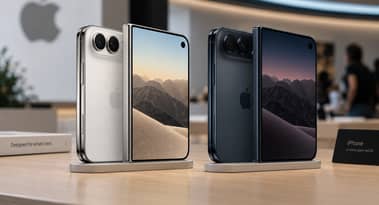
Apple’s passport-sized foldable device features dual internal and external displays.
@Apple's foldable iPhone won’t come cheap.
— Invezz (@InvezzPortal) September 9, 2026
The Duo starts at $1,999 for 256GB, $100 more than Samsung’s Galaxy Z Fold 8, but $100 less than the Z Fold 8 Ultra.
Pre-orders open October 16, with sales starting October 23. Storage goes up to 2TB. pic.twitter.com/l61pDzhZ8s
Apple is reimagining the foldable form factor
For years, consumer electronics brands have struggled to eliminate display creases, structural bulk, and clumsy hinges in foldable smartphones.
Apple Inc’s newly unveiled foldable iPhone re-engineers this approach by utilizing a proprietary dynamic hinge mechanism and custom flexible glass, eliminating visible panel gaps.
Roughly the size of a standard passport when closed, the smartphone expands into an “ultra-thin,” continuous workspace.
During the launch event, Ternus showcased how the titan’s custom display architecture avoids the thick, disjointed feel of competing dual-screen handsets.
Powered by Apple’s next-gen silicon, the hardware delivers seamless fluid transitions between the external cover display and the inner tablet-like screen.
Technical innovation meets software synergy
Rather than relying on brute force or raw mechanical joints, Apple focused on seamless integration between hardware engineering and custom iOS multitasking paradigms.
The external display offers quick “single-handed access for daily tasks,” while the expansive inner panel supports split-screen workflows, drag-and-drop workspace gestures, and professional application suites.
By engineering the battery cells, frame chassis, and display layers to distribute mass uniformly across the entire body, AAPL eliminated the top-heavy imbalance typical of rival foldable designs.
This structural alignment ensures the device feels unified and ergonomic, whether closed in a pocket or fully open in hands.
Foldable iPhone: new benchmark for premium mobility
Apple’s entry into the foldable category signals a major shift for the global smartphone market.
By focusing on structural durability, sleek passport-style proportions, and a completely flat inner presentation, the company aims to redefine consumer expectations for high-end mobile devices.
“We didn’t just want to make a folding phone; we wanted to perfect the experience,” Ternus told the audience during his keynote address.
Still, institutional investors aren’t convinced that a foldable iPhone would do much for AAPL stock – at least in the near-term.
In fact, Michael Khouw (Tidal Financial) and Wamsi Mohan’s (Bank of America Securities) pre-event prediction of the launch proving a “sell-the-news” event is proving correct as of writing.
For the longer-term though, Wall Street remains bullish on Apple with price targets going as high as $400.

Why is AMD stock surging 3% today
Apple shares fall 1.5% as iPhone 18 Pro launch comes with $100 price ike

UnitedHealth sells WellMed to TPG: what it means for UNH stock

Dell stock hits 52-week high as AI demand fuels growth
Apple stock: what a foldable iPhone really means for it
No results found
Loading articles...
Failed to load articles. Please try again.