
Amazon’s $40 billion Ohio AI bet faces a tax shock: what it means for the stock
AI Sentiment: 35/100 Bearish
This score is generated through AI-driven analysis of the article's content.

powered by

Buy AMZN. Ohio tax-break risk is a near-term headline, but the real setup is that AWS demand is still outpacing supply, so Amazon can pass higher marginal costs via pricing and mix while keeping long payback on servers/networking. The stock should hold up because the balance-sheet impact is limited and AI/AWS growth is already strong (AI >$25B run-rate; AWS +37% YoY).
Key Risk: Ohio and other states simultaneously repeal incentives and force big grid-upgrade cost sharing, squeezing AWS margins enough that the “return hurdle” rises faster than Amazon can reprice.
Sell DLR and AMT. The news is a direct hit to the incentive stack that makes new capacity profitable (sales-tax breaks, power/grid cost treatment). Even if demand stays strong, higher local taxes and grid-upgrade charges raise development costs and delay returns, which compresses valuation for landlords/owners more than for hyperscalers that can self-fund and negotiate.
Key Risk: Regulators back off and preserve incentives (or utilities absorb grid costs), allowing data-center economics to normalize and keeping capex returns intact.
- Ohio reviews data-centre tax breaks after costs surged past $1.5 billion.
- Amazon plans $220 billion of 2026 capex as AWS races to expand AI capacity.
- Rising tax and grid costs could lift the return hurdle on new data centres.
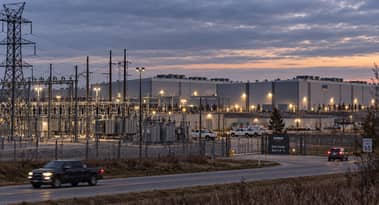
Amazon’s nearly $40 billion data-centre buildout in Ohio is facing a new risk as lawmakers reconsider tax breaks that helped turn the state into a major cloud-computing hub.
The immediate numbers are unlikely to threaten Amazon’s balance sheet, but the bigger issue is what happens to the economics of its AI expansion if states begin asking Big Tech to pay more.
AMZN expects roughly $220 billion of cash capital expenditure in 2026 as AWS races to add capacity.
With Wall Street focused on returns, Ohio is becoming an important test case.
Ohio helped fund the buildout, but the rules are changing
Amazon has invested nearly $40 billion in Ohio data centres since 2015, and paid almost $11 million in property taxes and fees last year.
That figure is cumulative infrastructure investment, not $40 billion spent solely on AI.
Ohio’s sales-tax exemption for data-centre equipment cost the state more than $1.5 billion in 2025, versus an earlier estimate of about $136 million.
Governor Mike DeWine paused new exemption requests in May while lawmakers review the programme.
Some legislators want the break repealed, while bipartisan proposals would require data centres to shoulder more grid-upgrade costs created by their electricity demand.
Morgan Stanley’s Ariana Salvatore said on the firm’s Thoughts on the Market podcast that “the biggest debate far and away is on data center pushback,” identifying Ohio among states where development could become more conditional.
AWS is growing fast, but the return hurdle is rising
Second-quarter AWS revenue rose 37% to $42.2 billion, its fastest growth in 18 quarters. Amazon also said its AI business exceeded a $25 billion annual revenue run rate and was growing at triple-digit rates.
Amazon has said investments in servers and networking can pay back in less than three years, while data centres can operate for more than three decades.
That is why Ohio matters. Sales-tax relief, power infrastructure and construction costs sit underneath those returns.
Mawer Investment Management analyst Irena Petkovic framed the broader risk: “You can be right, but still be wrong.”
Her point was that AI adoption can be enormous while investor returns disappoint if pricing, margins or financing move against infrastructure owners.
The bigger risk is that Ohio is not alone
As per reports, more than 10 states are reconsidering similar data-centre incentives as electricity, water use and infrastructure costs become political issues.
Amazon is already financing an extraordinary buildout. On Wednesday, it raised £4.25 billion, or about $5.76 billion, in its first sterling bond sale.
Hyperscalers have issued more than $200 billion of debt this year.
That does not mean Amazon’s balance sheet is under strain. Each additional tax, grid contribution or financing cost still raises the return hurdle on new capacity.
D.A. Davidson analyst Gil Luria has warned against extrapolating AWS’s growth indefinitely.
Discussing forecasts that AWS could reach $1 trillion in annual revenue, he told MarketWatch such estimates were “bold speculation” and projecting today’s growth far into the future was “more than ambitious”.
Luria was not commenting on Ohio, but his caution matters, as AWS is growing rapidly, and Amazon says it cannot build capacity fast enough to satisfy demand.
Ohio does not change that overnight, but it changes the economics at the margin.

KOSPI loses 7,000 in 24 hours as oil and yields hammer Korean stocks

Nikkei 225 Index on edge as foreigners buy, odds of BoJ rate hike jump

Samsung stock plunges as Apple enters foldables: is its seven-year lead at risk

Dow falls 400 pts as oil tops $100 and treasury yields hit 2023 high

Evening digest: Apple unveils iPhone Duo, oil tops $100
No results found
Loading articles...
Failed to load articles. Please try again.