
DoorDash stock jumps 11% after earnings beat and strong delivery demand
AI Sentiment: 78/100 Bullish
This score is generated through AI-driven analysis of the article's content.

powered by

Buy DASH. Earnings beat and, more importantly, GOV and GOV guidance are ahead (Q2 GOV $32.4B–$33.4B vs ~$31.8B). That signals demand durability across grocery/retail, not just restaurants, and should re-rate the stock after a weak year. The market will also focus on improving order value (AOV up) as a path to better unit economics even with higher driver reimbursement costs.
Key Risk: Fuel-driver reimbursement costs keep rising faster than GOV growth, squeezing margins and forcing a guidance reset.
Buy UBER. The article notes Uber’s delivery segment revenue beat alongside DoorDash’s strength, pointing to a sector-wide demand tailwind for app-based delivery. If consumers keep choosing convenience, both platforms should see better order trends and operating leverage as marketing spend normalizes.
Key Risk: Regulators or platform policy changes force higher take rates/fees or limit delivery economics, breaking the demand-to-profit link.
- DoorDash shares jump 11% after beating earnings estimates.
- Gross order value tops forecasts as delivery demand stays strong.
- Company sees continued momentum in grocery and international markets.
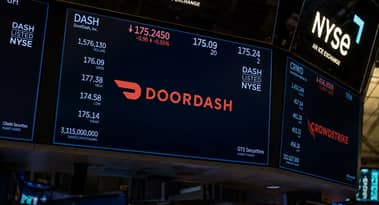
Shares of DoorDash surged 11% during pre-market trading on Thursday after the delivery platform posted quarterly earnings that topped Wall Street expectations and issued a stronger-than-expected outlook for order growth.
The company reported adjusted earnings of 42 cents per share for the first quarter ended March 31, ahead of analysts’ expectations of 36 cents per share, according to LSEG data.
Revenue rose to $4.04 billion but came in slightly below analyst estimates of $4.14 billion.
Despite the revenue miss, investors appeared encouraged by continued strength in demand and improving order trends.
DoorDash said “continued product improvements and healthy consumer demand trends” helped support results during a period when consumers continue to face elevated living costs.
Order value beats estimates
A key highlight for investors was the company’s gross order value (GOV), which measures the total value of all orders placed through the platform.
DoorDash reported GOV of $31.6 billion for the quarter, slightly above analyst expectations of $31.5 billion.
Average order value also climbed to $33.87 from $31.52 a year earlier.
The company forecast second-quarter GOV between $32.4 billion and $33.4 billion, ahead of Wall Street estimates of about $31.8 billion.
Analysts at Citi said investor attention remained centered on DoorDash’s gross order value forecast, especially as the company continues to absorb roughly $50 million per quarter in costs tied to reimbursing drivers for higher fuel prices.
It said it expects adjusted EBITDA for the second quarter to range between $770 million and $870 million.
The midpoint of that forecast was slightly below analyst expectations of $822.5 million.
“Demand continues to be quite strong ... Q2 is off to a good start, (we) feel good about the demand patterns that we're seeing on the business,” Chief Financial Officer Ravi Inukonda said during a post-earnings call.
Analysts said the results reflect consumers’ continued preference for convenience, particularly in grocery and retail delivery.
“Consumers' desire for convenience continues to be a powerful tailwind for DoorDash's business,” eMarketer analyst Rachel Wolff said.
Expansion efforts gain traction
DoorDash has been broadening its business beyond restaurant deliveries, pushing deeper into grocery, retail and international markets as competition intensifies across the sector.
The company’s performance comes shortly after rivals including Instacart and Uber also reported resilient delivery demand.
Uber, which operates Uber Eats, posted delivery-segment revenue above estimates earlier in the day, while Instacart projected stronger-than-expected transaction values for the current quarter.
Fuel costs remain a concern
The company also warned that higher fuel prices are increasing costs for its Dasher gas relief program, which was launched last month to support gig workers dealing with rising energy prices linked to the US-Iran conflict.
DoorDash said the gross cost of the program is expected to exceed $50 million.
Despite the latest rally, DoorDash shares had struggled for much of the year prior to the earnings release, falling 27% in 2026 and about 7% over the past 12 months as investors weighed slowing consumer spending and rising operational costs.
The stronger order outlook, however, suggests the company continues to benefit from durable demand trends as consumers increasingly rely on app-based delivery services across categories.

More details of the mega Anthropic IPO are coming out: here’s what we know

Software stocks are back from the dead as AI fuels growth: can the rally continue?

GoPro stock soars 200% after Markiplier stake, $285M Starman deal

SpaceX stock rally meets another lockup expiry test on September 9: what to expect

Dow closes 270 pts lower as strong jobs report lifts September Fed rate-hike bets
No results found
Loading articles...
Failed to load articles. Please try again.