
India’s retail inflation rises to 3.48% in April amid food price pressure
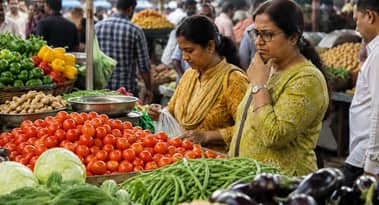
AI Sentiment: 22/100 Bearish
This score is generated through AI-driven analysis of the article's content.

powered by

Buy USD/INR (or short INR via an INR FX position) because CPI is being pushed by food and energy: food inflation (CFPI 4.20%) is rising and oil-price/rupee weakness is already feeding imported inflation. With the rupee at a record low ~95.6 and oil still a key upside risk, the market will keep pricing less RBI easing and more FX pressure.
Key Risk: Oil falls fast and the rupee stabilizes, letting imported inflation cool and reviving RBI easing expectations.
Buy Indian FMCG/food staples with strong rural pricing power and distribution (e.g., ITC, Hindustan Unilever). The CPI acceleration is driven by food: tomato +35%, cauliflower +26%, coconut/copro +45%, and rural food inflation (4.26%) is higher than urban. These firms can pass through costs better than commodity processors, so margins hold up as food inflation stays sticky into the monsoon risk window.
Key Risk: Monsoon improves and food prices mean-revert quickly, crushing pricing power and compressing margins.
- India’s retail inflation rose to 3.48% in April 2026.
- Food inflation accelerated to 4.20% from 3.87% in March.
- Rising oil prices and weak monsoon risks cloud inflation outlook.
India’s retail inflation accelerated to 3.48% in April from 3.40% in March, driven mainly by higher food prices, government data released on Tuesday showed.
The latest Consumer Price Index (CPI) reading remained below Reuters’ projection of 3.8% and stayed close to March’s print of 3.4%.
India also shifted to a revised CPI series in January 2026 with a new basket of goods and a new base year.
Food inflation continued to rise during the month, adding pressure to the broader inflation trajectory.
The year-on-year inflation rate based on the Consumer Food Price Index (CFPI) stood at 4.20% in April, compared with 3.87% in March.
The rural inflation rate was recorded at 3.74%, while urban inflation came in at 3.16%.
Rural food inflation stood at 4.26%, slightly above the urban rate of 4.10%.
Food prices continue to push inflation higher.
Inflation has steadily increased since January, moving closer to the Reserve Bank of India’s 4% target.
Economists said risks remain tilted to the upside because of rising oil prices and concerns over food supply.
Government data showed that inflation in the “Food and beverages” category reached 4.01% in April at the combined level.
Inflation in “Restaurants and accommodation services” was recorded at 4.20%.
Among individual items, tomato prices rose 35.28% year-on-year in April, while cauliflower inflation stood at 25.58%.
Coconut or copra prices increased 44.55%.
Precious metals also remained expensive.
Inflation for silver jewellery stood at 144.34%, while gold, diamond and platinum jewellery inflation came in at 40.72%.
However, some items continued to witness price declines.
Potato inflation remained negative at -23.69%, while onion prices fell 17.67% year-on-year.
Inflation for motor cars and jeeps stayed in negative territory at -7.12%.
Oil prices and rupee weakness add uncertainty
India’s inflation outlook has become more uncertain as rising global oil prices increasingly affect domestic costs.
Higher energy prices risk widening the current account deficit, weakening the rupee and increasing imported inflation pressures for India, the world’s third-largest oil importer.
The Indian rupee weakened to a record low of 95.6250 on Tuesday.
Losses in the currency have reached 5.2% since the Iran conflict began, according to the report.
Prime Minister Narendra Modi has reportedly urged austerity measures aimed at conserving fuel and foreign exchange reserves as energy prices continue to rise.
The report also noted that expectations of a deficient monsoon this year could push food prices higher in the coming months, further complicating the inflation outlook.
RBI policy outlook remains in focus
The Reserve Bank of India has kept interest rates unchanged amid relatively moderate headline inflation.
However, economists said a sustained rise in fuel and food prices could reduce the central bank’s room for future policy easing and may eventually shift the policy outlook towards possible rate hikes later in the year.
Housing inflation for April stood at 2.15%, while transport inflation remained largely flat at -0.01%. Education services inflation was recorded at 3.15%.
At the state level, Telangana recorded the highest combined inflation rate at 5.81%, followed by Puducherry at 4.41%.
Tamil Nadu and Andhra Pradesh also reported inflation above 4%.
The Ministry of Statistics and Programme Implementation said price data for April were collected from 100% of rural and urban markets covered under the survey process.
India’s CPI data for May 2026 will be released on June 12, 2026.

Invezz Explains: why you should closely watch payrolls, claims, ADP and JOLTS data

Column: The Fed’s inflation problem is getting harder to ignore

America wants cheaper debt: why Wall Street says Treasury tricks won’t fix it

US-Canada trade talks collapse as 50% tariffs take effect: what happens next?

What do Walmart's and Target’s results say about the US consumer?
No results found
Loading articles...
Failed to load articles. Please try again.