
Buying SpaceX at IPO? 3 big risks smart investors are watching
AI Sentiment: 18/100 Bearish
This score is generated through AI-driven analysis of the article's content.

powered by

Buy a basket of “space/launch” public winners instead of SpaceX: e.g., buy Lockheed Martin (LMT) and/or Northrop Grumman (NOC) for government-linked launch/satellite exposure, and buy a satellite broadband beneficiary like Intelsat/SES only if liquid and aligned with Starlink-like demand. The thesis: SpaceX’s valuation and governance overhang cap upside, while the underlying demand for space infrastructure still benefits incumbents with steadier cash flows.
Key Risk: A rapid re-rating of SpaceX that pulls capital out of incumbents and compresses their relative multiples, plus any major program loss to competitors.
Sell/short SpaceX shares at/after the Nasdaq open. The article flags extreme valuation (about 110x trailing sales) versus a much lower fair value (~$780B) and a structure that leaves public holders with economic risk but limited control (dual-class voting). Expect a first-day pop, then mean reversion as buyers realize they’re paying for years of execution risk.
Key Risk: A sustained, broad-based rally that keeps the IPO multiple elevated because Starlink growth and launch cadence exceed expectations fast enough to justify the price.
- SpaceX targets a record IPO valuation near $1.75 trillion.
- Investors worry about rich pricing and Musk’s voting control.
- Analysts warn mega IPO hype does not guarantee long-term returns.
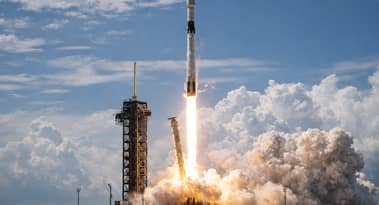
SpaceX is days away from what could become the largest initial public offering in history, and investors are already treating it like a once-in-a-generation market event.
The Elon Musk-led company is targeting an IPO price of about $135 a share, with trading expected to begin on Nasdaq on June 12.
At roughly $1.75 trillion, the listing would put SpaceX among the most valuable companies in the world from day one.
But the smarter question is not only how investors can get in, but what could go wrong once the first-day excitement fades.
Price tag: Are you paying for reality or a dream?
The first risk is the price as SpaceX is coming to market at about 110 times trailing sales, a level that leaves very little room for disappointment.
Its target market cap of about $1.75 trillion is already below earlier talk of a US$2 trillion (approx. $2.6 trillion) figure, but it is still a breathtaking ask for a company whose future depends on rockets, satellites, broadband, artificial intelligence and several still-unproven projects.
Morningstar has taken one of the clearest sceptical positions.
Nicholas Owens, equity analyst at Morningstar, described the shares as “overvalued in almost any scenario, at least in the near term.”
Morningstar’s fair value estimate sits near US$780 billion (approx. $1 trillion), less than half the IPO target.
That does not mean SpaceX is weak. Starlink has become a real business, the launch franchise is dominant, and Musk has a record of building companies that investors once doubted.
But the stock price appears to be asking buyers to pay today for a future that may take years to arrive.
There is another pressure point. OpenAI, Anthropic and other marquee artificial intelligence names are also expected to compete for public-market capital.
If investors are forced to choose between several mega-growth stories at once, even SpaceX may not get unlimited patience.
Also read: Before you invest in SpaceX: the IPO details most investors are missing
Rockets, regulators, and one man’s iron grip
SpaceX lives and dies by launches, satellite deployments and government-linked contracts. A launch failure, regulatory delay or Starlink growth slowdown could quickly change investor sentiment.
This is not a software company with near-zero delivery costs. It operates in space, hardware, telecoms and now artificial intelligence, all of which are expensive and exposed to technical setbacks.
Then comes governance.
David Trainer, CEO of New Constructs Research, told Fortune: “We recommend that investors avoid this IPO.” His concern is not only the price. It is the structure.
Elon Musk owns about 42% of the company’s equity but controls around 85% of voting power through dual-class shares.
That means public shareholders will carry economic risk without meaningful influence over board elections or strategic decisions.
Joseph Lucoski, founder and managing partner of Lucoski, Brookman, LLP, told Fortune:
“I practice every day with the exchanges and regulators, and they would never accept this onerous and one-sided a structure for an emerging growth company.”
History has a warning for first-day buyers
Mega IPOs can produce first-day excitement and still disappoint long-term investors.
Jay Ritter, director of the IPO Initiative at the University of Florida, has found that among IPOs with more than US$100 million (approx. $129 million) in sales and a price-to-sales ratio above 40 at the offer price, 12 of 14 underperformed the market over the next three years when bought at the first close.
That warning matters because SpaceX is coming at a much richer multiple than most public debuts. A first-day pop is possible, perhaps even likely, because the Musk effect is real and demand is intense.
But a first-day gain is not the same as a durable return.
Truist Research has also warned that the average maximum first-year drawdown for major IPOs has reached 55%.
In simple words, even strong companies can leave early buyers sitting on large paper losses before the long-term story has time to play out.
Meta stock looks undervalued: settlement and AI could unlock up to 40% upside

Micron, SanDisk stocks slip premarket as a new China risk emerges

Dow futures plunge 315 points: 5 things to know before Wall Street opens
Why the S&P 500 could defy the 'September Effect' this year

Tesla stock jumps 5.5% ahead of Cybercab launch: can its $1.45T valuation hold?
No results found
Loading articles...
Failed to load articles. Please try again.