
Crude oil price falls on Hyperliquid ahead of US-Iran deal as risks remain

AI Sentiment: 20/100 Bearish
This score is generated through AI-driven analysis of the article's content.

powered by

Sell WTI (USO) and Brent (BNO) into the current weakness. The article flags a likely near-term reopening of the Strait of Hormuz (more supply) plus a temporary oil-selling waiver (more Iranian barrels), while price is already below the 50/100-day EMAs and under the $86 neckline support. Technicals point to $80 first and $60 as the double-top measured move.
Key Risk: Israel forces a renewed Iran–US/Israel escalation that shuts shipping again, sending oil back above $86 and invalidating the breakdown.
Short the energy-sensitive inflation trade by selling XLE (Energy Select Sector SPDR) versus the broader market (SPY). If oil keeps sliding toward $80/$60, headline inflation pressure eases, which reduces the market’s need to price higher-for-longer rates—typically a headwind for energy equities and a tailwind for cyclicals outside energy.
Key Risk: Oil rebounds sharply on deal failure or war risk, lifting inflation expectations and pulling XLE back in line with the broader market.
- Crude oil prices have continued falling this weekend on Hyperliquid.
- Trump hinted that the US and Iran will sign a deal later today.
- Technical analysis suggests that the prices may drop further soon.
Crude oil prices retreated on Hyperliquid as investors focused on the upcoming deal between the US and Iran. Brent crude oil fell to $84 from the year-to-date high of $126, while the West Texas Intermediate (WTI) fell to $81. Still, some major risks may threaten the falling oil prices.
Crude oil price falls ahead of US-Iran deal signing
President Donald Trump confirmed that the US and Iran would sign a deal to reopen the Strait of Hormuz later today in Zurich. However, Iranians tempered the optimism, saying that the deal may come at a later date. They also noted that it will likely be signed electronically. Pakistan’s prime minister said:
“We are closer to a peace deal than ever before. With finalization likely expected in the next 24 hours, Pakistan is preparing for the electronic signing of the peace deal immediately after, followed by technical-level talks next week.”
This is not a full nuclear deal that Trump has always wanted. Instead, it is a memorandum of understanding (MoU) to reopen the Strait of Hormuz and launch nuclear talks. The US will also end its blockade against Iran and give it a temporary waiver to sell oil, a move that will help lower prices.
Still, the deal faces some major challenges. For one, Israel has opposed any deal that gives Iran financial resources, arguing that it will give it the cash it needs to fund Hezbollah, Hamas, and Houthis.
Israel has also vowed to continue fighting in Lebanon, where it has killed thousands of people in the past few weeks. Such a move may push Iran to intervene, reigniting a war in which the US will be involved in.
Trump desperately needs a deal
The upcoming deal comes at a time when President Trump desperately needs it. His approval rating has tanked this year because of the elevated inflation.
At the same time, he is aware of the risks to extending the war. For one, US oil inventories have plunged, with the Strategic Petroleum Reserves (SPR) falling to the lowest level in decades.
According to Axios, Trump has also heard from oil executives, who have warned him about the state of the energy market. They said that prices would surge sharply in July when the inventories will plunge.
At the same time, Trump understands that the ongoing war may make it hard for the Federal Reserve to cut interest rates. Recent data showed that the headline consumer and producer price indices jumped 4.2% and 6.4%, respectively.
Brent crude oil price technical analysis
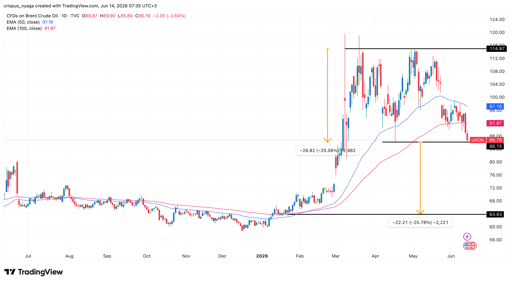
UKOIL price chart | Source: TradingView
The daily chart shows that the Brent crude oil price has slumped in the past few months, moving from a high of $120 to $86. It dropped to $84 on Hyperliquid.
Oil has slumped below the 50-day and 100-day Exponential Moving Averages (EMA). it has also moved below the key support at $86, the neckline of the double-top pattern.
Therefore, the most likely scenario is where the prices continue falling, potentially to the key support at $80. By measuring the height of the double-top pattern, we can estimate that prices will ultimately drop to $60.

HYPE crypto price prediction as Hyperliquid volume, ETF inflows jump

How new Fed Chair Warsh could influence gold market outlook

Commodity wrap: Gold rebounds; oil slips 3% on hope of US-Iran deal

Figma stock price is stuck in a bear market: will it crash further or rebound?

Here’s why Nebius and CoreWeave stocks have lost momentum lately
No results found
Loading articles...
Failed to load articles. Please try again.