
Here’s why Barclays, NatWest, Lloyds shares are pumping this week

AI Sentiment: 78/100 Bullish
This score is generated through AI-driven analysis of the article's content.

powered by

Buy BARC. The stock is already rerating on the US-Iran ceasefire (lower oil/pressure on inflation) plus a likely BoE hold at 3.75% near-term. If the BoE signals a later hike, banks’ net interest income expands; Barclays also has a bigger investment-banking/trading engine that should benefit from higher deal activity and market volatility. Thesis: earnings momentum + rate sensitivity + diversified revenue beats peers.
Key Risk: BoE turns hawkish *now* (or cuts later than expected) in a way that compresses loan demand or triggers a credit-loss spike, wiping out NII gains.
Buy LLOY. It’s up sharply to multi-month highs, but the setup is still favorable: easing crude/shipping costs support UK growth and inflation cooling, while a BoE hike later this year would lift NII. Lloyds’ underlying net interest income growth and profit improvement give the market a reason to keep paying up if rates stay supportive.
Key Risk: A ceasefire breaks down and oil/shipping reprice higher, forcing the BoE to stay restrictive and hurting UK consumer/credit quality.
- UK bank stocks jumped to their multi-month highs this week.
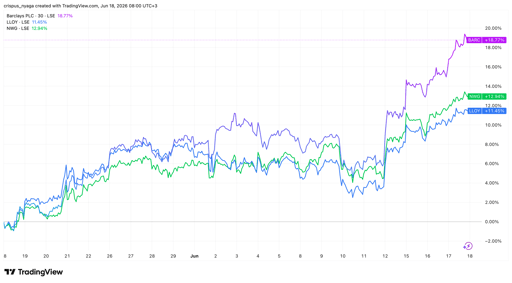
- Lloyds, NatWest, and Barclays shares have soared by double digits from the YTD low.
- The banks will react to the upcoming Bank of England interest rate decision.
UK banking stocks jumped to multi-month highs this week as investors cheered the US-Iran ceasefire deal and waited for the latest Bank of England interest rate decision.
NatWest share price jumped to 638p, its highest level since February 9 this year, and 26% above its lowest point in March. Lloyds Bank soared to 105.80, its highest level since February, while Barclays spiked to 503p. BARC has jumped by 40% from its lowest level this year.
US-Iran ceasefire agreement
UK banks have become highly sensitive to the US-Iran conflict. In most cases, they were among the top laggards whenever the crisis escalated and the main gainers whenever hopes of a deal rose.
The stocks jumped this week after the US and Iran reached a deal to end fighting for 60 days. As part of this deal, the Strait of Hormuz will be reopened, while Iran will get sanctions and monetary relief.
The deal has led to a sharp plunge in crude oil prices, with Brent and WTI benchmarks falling below the key $80 support level. Other prices, especially shipping and fertilizer have also started moving downwards. The hope, therefore, is that the deal will hold as this will help to boost the British economy.
UK bank stocks also jumped after the Office of National Statistics (ONS) released an encouraging consumer inflation report. This data showed that the headline consumer, producer, and retail inflation came short of expectations. The CPI remained unchanged at 2.8%, while the core CPI rose 2.6%.
Bank of England interest rate decision
The next important catalyst for key UK bank stocks like Lloyds, NatWest, and Barclays is the upcoming Bank of England (BoE) interest rate decision, which will come out later today.
Economists are unanimous that the bank will leave interest rates unchanged at 3.75% in this meeting. Nonetheless, with inflation remaining above the 2% target, there is a possibility that the bank will point to a hike later this year. Polymarket traders have placed a 58% chance that the bank will hike this year.
A BoE rate hike would benefit banks by helping them boost their net interest income (NII). In its statement on Wednesday, the Federal Reserve hinted that it may hike this year, citing the strong economy and elevated inflation.
Barclays has done better than other banks because of its business model, which combines the normal banking activity and investment banking. Its investment banking division is expected to thrive this year as corporate activities like M&A, debt, and equity raising jump. Its trading business is expected to benefit from the robust volatility in the market.
The most recent results showed that its income rose by 6% in Q1 to £8.2 billion, with its UK income and investment banking rising by 9% and 6%, respectively. Its strong numbers helped it to boost its share buyback.
Lloyds Bank said that its statutory profit before tax rose to £2 billion from £1.5 billion a year earlier. Its underlying net interest income rose by 8% to £3.6 billion.
NatWest, on the other hand, made £3.39 billion in net interest income from £3.026 billion in the same period a year earlier.

KOSPI jumps, Nikkei hesitates as Asia tests whether the bond rout is over

Crude oil price forecast as Iran ramps up attacks on Kuwait

Dell stock looks stronger than ever, but one financial line is moving the other way

Samsung, SK Hynix rebound after selloff: why Dell’s 16% surge matters

AUD/USD signal: forecast as RBA and Fed rate hike odds rise
No results found
Loading articles...
Failed to load articles. Please try again.