
Why is Palantir stock falling 5% today?

AI Sentiment: 28/100 Bearish
This score is generated through AI-driven analysis of the article's content.

powered by

Buy Palantir (PLTR). The OSR scrutiny is about NHS England’s performance-metrics framing, not a contract cancellation or a proven data failure. Meanwhile, Palantir still has strong cash generation, profit margins, and long-term contracts that fund product work and sales. The stock is also technically weak (below 50/200-day), which creates a better entry ahead of Aug. 3 earnings when investors may refocus on execution and cash flow rather than UK paperwork.
Key Risk: OSR/regulators expand the review into a finding that the FDP contract is non-compliant or must be materially reworked, leading to revenue/renewal risk.
Sell Palantir (PLTR) ahead of Aug. 3. The news adds two pressure points at once: regulatory noise around UK NHS metrics and credible competition risk from an open-source “World Monitor” tool that could undercut Palantir’s differentiation. With implied volatility elevated and the stock below key moving averages, the path of least resistance is more downside until earnings clarifies growth and margin durability.
Key Risk: Earnings show acceleration (or strong guidance) that proves competition isn’t taking share and UK contract risk is contained, triggering a sharp rerating higher.
- Palantir slips as UK NHS data platform faces fresh regulatory scrutiny.
- Open-source rival raises competition concerns before Aug. 3 earnings.
- Analysts expect Q2 EPS of 33 cents on revenue of $1.81 billion.
Palantir Technologies Inc. PLTR shares fell on Wednesday as investors weighed fresh regulatory scrutiny surrounding the company's UK National Health Service (NHS) Federated Data Platform (FDP) contract alongside growing concerns over emerging competition ahead of its upcoming earnings report.
The decline comes as the UK's Office for Statistics Regulation (OSR) addressed concerns over how NHS England presented performance metrics related to the FDP, while investors also assessed reports of a new open-source intelligence tool that mirrors some of Palantir's core capabilities.
UK regulator reviews NHS Federated Data Platform metrics
The UK's Office for Statistics Regulation (OSR) addressed public concerns on Wednesday regarding NHS England's communication of performance metrics for the Federated Data Platform.
On June 6, NHS England updated its methods page, adding: "We cannot therefore draw conclusions about cause and effect as other variables have not been controlled for."
According to the OSR, NHS England added the caveat following Freedom of Information requests regarding FDP data analysis. NHS England also committed to placing similar caveats on its main FDP website and said Imperial College would conduct an independent academic evaluation of the platform.
The regulatory developments add to broader scrutiny surrounding the NHS contract.
Jo Maugham, executive director of the Good Law Project, criticized the arrangement, stating: “Palantir is not — and frankly never has been — a company that can be trusted with this nationally important contract.”
Regional NHS organizations have also pursued alternative approaches.
In a Guardian letter published on July 20, Dr. Devan Moodley, CEO of Health Connect Global, said Greater Manchester's integrated care board chose not to adopt the platform, instead relying on capabilities developed with UK universities and companies.
Investors monitor competition and upcoming earnings
Investor sentiment has also been pressured by reports of a new open-source "World Monitor" tool published on GitHub that is designed to replicate aspects of Palantir's global intelligence capabilities.
The development has raised concerns about potential competition in one of Palantir's core business areas ahead of the company's second-quarter earnings report, scheduled for Aug. 3.
Analysts expect Palantir to report earnings per share of 33 cents on quarterly revenue of $1.81 billion.
Options activity on the Cboe also reflects increased caution, with elevated implied volatility suggesting traders expect significant price movement around the earnings release.
Despite the recent weakness, Palantir continues to benefit from strong cash generation, healthy profit margins and long-term customer contracts, which provide financial flexibility to invest in software development and expand its sales operations.
At the same time, investors remain focused on risks including rising costs, capacity constraints and the company's reliance on US government contracts. Increased competition and slower growth could make it more challenging for Palantir to maintain the growth expectations reflected in its valuation.
Technical picture remains under pressure
From a technical perspective, Palantir continues to trade below several key moving averages.
The stock is approximately 5.7% below its 50-day simple moving average of $132.14 and 19.5% below its 200-day moving average of $154.82, keeping both the intermediate and longer-term trend negative.
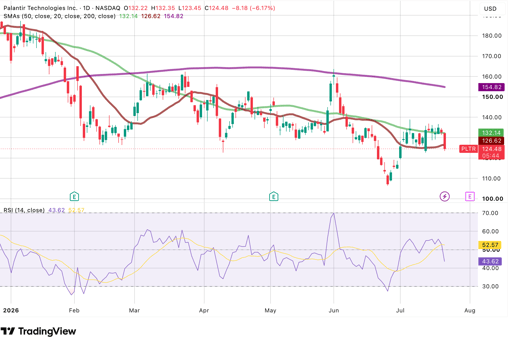
Its 20-day moving average of $126.62 remains below the 50-day average, while the Death Cross formed in February continues to weigh on the technical outlook.
Momentum indicators remain neutral, with the Relative Strength Index (RSI) at 43.62, suggesting the stock is trading in a consolidation phase rather than a strong directional trend.
Technical traders are watching resistance near $136.50 and support around $122.50 as Palantir approaches its quarterly earnings announcement.

Broadcom stock falls to a key support: is it about to surge after earnings?

Can AI manage your portfolio? InvestorAI's Bruce Keith answers on 'Zero Sum'

Meta stock looks undervalued: settlement and AI could unlock up to 40% upside

Micron, SanDisk stocks slip premarket as a new China risk emerges

Dow futures plunge 315 points: 5 things to know before Wall Street opens
No results found
Loading articles...
Failed to load articles. Please try again.