
Silver price rebounds from last week’s drop: can $65 come into view?

AI Sentiment: 72/100 Bullish
This score is generated through AI-driven analysis of the article's content.

powered by

Buy spot silver targeting $63.28 then $65.25. Thesis: the $59 breakout is holding (100-period 4H MA + 23.6% Fib confluence), RSI/MACD stay constructive, and a persistent supply deficit (projected ~67M oz) plus rising physical investment (Silver Institute: +20% to 227M oz) should cushion dips and keep rallies supported.
Key Risk: Silver breaks and holds below $59, flipping the move into a profit-taking/short-covering bounce that exposes $54.94 support.
Buy First Majestic Silver (AG) for leverage to a sustained silver rebound. Thesis: if silver holds above $59 and pushes toward $65, miners typically amplify upside via operating leverage and improved sentiment toward the physical deficit story; the technical trigger above $61.31 can pull forward equity re-rating.
Key Risk: Silver fails at/under $61.31 and rolls back below $59, crushing miner leverage and triggering de-risking in small-cap silver equities.
- Silver holds near $60 as buyers keep short-term momentum broadly intact.
- $59 support now separates a healthy pause from a deeper bearish reversal.
- Supply deficits and AI demand reinforce silver’s long-term price outlook.
Silver hovered just below $60 an ounce on Thursday as buyers defended a breakout that has restored short-term momentum after last week’s sharp retreat.
Spot silver traded near $59.80 after moving between roughly $59.33 and $60.08, while futures remained close to $60.10.
The metal had approached $61 in the previous session, its strongest level in more than two weeks, before profit-taking slowed the advance.
Unlike gold, silver’s recovery is being driven by a mix of technical buying, renewed investment interest and expectations that a persistent supply deficit will cushion deeper pullbacks.
Buyers defend the $59 breakout
The immediate technical picture remains constructive while silver holds above the $59 area.
That zone combines the 100-period moving average on the four-hour chart with the 23.6% Fibonacci retracement of the decline from the June 17 high, making it the key line separating consolidation from a broader reversal.
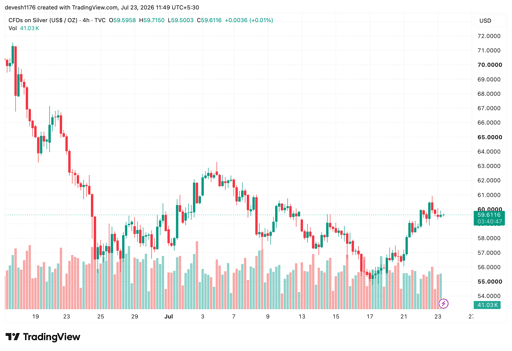
FXStreet analyst Haresh Menghani sees the breakout above that confluence as an important trigger for buyers.
The relative strength index remains in positive territory near 61, while the MACD histogram is still mildly positive, suggesting momentum has cooled without turning bearish.
A decisive move above $61.31, the 38.2% Fibonacci level, would open the way towards $63.28 and then $65.25.
Failure to hold $59 would weaken the setup and expose the $54.94 area, which marks a more important structural support zone.
Investment demand meets a tight physical market
Silver’s rebound also reflects a market that remains sensitive to renewed investor demand.
The Silver Institute expects physical investment to rise 20% this year to a three-year high of 227 million ounces, supported by macroeconomic uncertainty and renewed interest from Western buyers.
That demand is arriving in a market projected to record its sixth consecutive annual deficit.
Total supply is forecast to rise only 1.5% to 1.05 billion ounces, leaving a shortfall of about 67 million ounces and requiring further releases from above-ground inventories.
This backdrop does not guarantee a straight-line rally, but it can make declines shallower when technical buyers and physical investors enter together.
Industrial demand keeps the outlook two-sided
Silver’s industrial role adds both support and volatility.
Consumption linked to data centres, AI technologies and vehicles is expected to remain structurally strong, helping offset weakness in other segments.
However, the Silver Institute expects overall industrial fabrication to fall 2% in 2026, largely because solar manufacturers are using less silver per panel and substituting alternative materials where possible.
That means the metal cannot rely on the energy transition alone to sustain higher prices.
For now, $59 remains the level that matters most.
Holding above it would keep the rebound intact, while a break below would suggest the latest move was driven more by short covering than durable demand.

Gold price stalls near $4,130: is the oil shock killing the breakout?

Brent crude oil price forecast: targets $100 as US-Iran war escalates
Brent breaks $92 as a second oil supply shock begins to unfold

Silver price jumps for fourth day as $60 breakout comes into focus

Here’s why wheat prices are soaring this year
No results found
Loading articles...
Failed to load articles. Please try again.
