
Alibaba shares jump 6% after launch of Qwen3.8-Max, its biggest AI model yet
AI Sentiment: 78/100 Bullish
This score is generated through AI-driven analysis of the article's content.

powered by

Buy BABA. The Qwen3.8-Max launch is a credible product step (Arena.AI top Chinese text rank; strong multimodal; 1M-token context) plus a cost angle (mixture-of-experts: ~95B active vs 2.4T total). That combination supports near-term enterprise demand for Alibaba Cloud Model Studio and improves the odds of monetizing AI beyond hype. Key upside is multiple expansion from “AI execution” rather than just “AI spending.”
Key Risk: Qwen3.8-Max underperforms in real enterprise usage (quality/cost) and fails to drive meaningful cloud revenue growth, so the stock jump fades.
Buy BABA again, but for the infrastructure/usage thesis: the model’s 1M-token + MoE design is built for high-throughput serving, which should increase inference demand per customer and raise utilization of Alibaba Cloud GPUs. If Model Studio adoption accelerates, it lifts margins via better capacity utilization and stickier developer workflows around Qwen.
Key Risk: Cloud customers don’t scale usage (or switch to cheaper/open alternatives), keeping GPU utilization and margins flat despite the model launch.
- Alibaba jumps 6% after launching the 2.4-tn-parameter Qwen3.8-Max AI model.
- The model is only slightly smaller than rival Moonshot AI's Kimi K3.
- It ranked as top Chinese text AI system on Arena.AI and second globally.
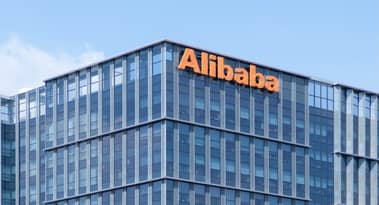
Alibaba shares climbed more than 6% in Hong Kong on Monday after the Chinese technology giant unveiled what it described as its largest and most capable artificial intelligence model, Qwen3.8-Max, as competition among Chinese AI developers continues to intensify.
The new model, which has 2.4 trillion parameters, is only slightly smaller than domestic rival Moonshot AI's Kimi K3 model, which launched last month with 2.8 trillion parameters.
The announcement comes as Chinese technology companies accelerate efforts to build more powerful AI models while keeping operating costs under control, challenging both domestic rivals and leading US AI developers.
Parameter race gathers pace
Parameters are the numerical settings an AI model learns from data and uses to recognize patterns, generate responses and perform tasks.
While a larger parameter count does not automatically translate into better performance, it has become one of the most closely watched indicators of the computing power and data used to train advanced AI systems.
Chinese AI developers have increasingly highlighted parameter counts as they compete for attention among software developers and enterprise customers.
Unlike OpenAI, Anthropic and Google, which do not disclose the parameter counts of their closed-source models, Chinese companies generally publish these figures because many of their AI models are open-weight, allowing developers to download and adapt the learned model weights.
Strong performance on global rankings
Alibaba introduced Qwen3.8-Max on the crowdsourced model comparison platform Arena.AI, where it immediately became the highest-ranked Chinese model for text generation.
However, it still trails Anthropic's Claude Fable 5 and three Claude Opus variants on the overall text leaderboard.
The model performed even better on multimodal tasks involving images and visual content, where it ranked second globally behind only one Claude Fable 5 variant.
Like Moonshot AI's Kimi K3, Qwen3.8-Max can process text, images and video while handling context windows of up to one million tokens.
Tokens are chunks of information, often representing parts of words or short words.
A large token window allows models to analyze extensive datasets in a single request, including lengthy legal documents, large software codebases or hundreds of pages of text.
Mixture-of-experts design lowers costs
Alibaba said Qwen3.8-Max uses a mixture-of-experts architecture, a design that activates only specialized parts of the model instead of deploying the entire network for every request.
Although the model contains 2.4 trillion parameters in total, only around 95 billion parameters are activated at any given time.
The company said this approach significantly reduces computing costs while also improving response speed, making the model more practical for commercial deployment.
Alibaba added that benchmark testing showed Qwen3.8-Max was broadly competitive with leading AI models from OpenAI and Anthropic.
According to the company, the model outperformed several US rivals on coding, engineering and multimodal benchmarks while trailing on some general-purpose reasoning tasks.
AI competition continues to heat up
The launch underscores Alibaba's growing commitment to artificial intelligence as it competes against Chinese rivals including DeepSeek, Baidu, Tencent and Moonshot AI.
China has rapidly emerged as one of the world's largest sources of open-weight AI models, with developers racing to improve model performance without sharply increasing inference costs.
The competition has intensified in recent months following the release of several advanced Chinese models capable of rivaling leading Western systems across coding, reasoning and multimodal applications.
AI investment remains a strategic priority
Alibaba has steadily expanded investment in AI infrastructure and cloud computing as it seeks to strengthen its position in the fast-growing market.
Earlier in May, the company said it would exceed its previously announced plan to invest up to 380 billion yuan ($55.96 billion) in AI infrastructure over the next three years.
The latest model launch reinforces that strategy by targeting enterprise developers through Alibaba Cloud's Model Studio platform, where Qwen3.8-Max is scheduled to become available next week.
Alibaba also said the model successfully completed a software engineering project in 16 days, highlighting its capabilities in complex coding tasks.
The release is expected to further intensify competition in China's AI market as technology companies continue investing heavily in increasingly capable large language models while attempting to narrow the gap with leading US AI firms.

Top reasons why South Korea’s KOSPI Index is falling today (Sept. 14)

Micron, Nvidia, AMD stocks at risk as Anthropic, OpenAI leads push to slow AI growth

How will private credit and equity stocks react to Fed rate hikes?
Why SpaceX stock is up around 1% on Friday

Should you buy the dip in OKLO stock today?
No results found
Loading articles...
Failed to load articles. Please try again.