
Nvidia stock stablizes after Monday's fall: are circular financing fears fading?
AI Sentiment: 72/100 Bullish
This score is generated through AI-driven analysis of the article's content.

powered by

Buy NVDA. The $500B+ third-party capital mobilization lowers customer financing friction for non-hyperscaler AI data centers, reinforcing Nvidia’s “default infrastructure” position beyond the biggest buyers. The stock’s Monday drop looks like circular-financing fear; Tuesday stabilization suggests that fear is fading as the consortium structure (Apollo/BlackRock/Blackstone/etc.) shifts funding off Nvidia’s balance sheet.
Key Risk: Nvidia’s residual-value/credit backstop language expands in practice, turning this into meaningful vendor financing that triggers a credit/circular-demand backlash and multiple compression.
Buy BlackRock (BLK) and/or Apollo (APO). They’re directly tied to the consortium that will originate and underwrite AI infrastructure financing. If the market stops worrying about circularity, these asset managers benefit from higher deal flow, more structured finance activity, and stronger sentiment around AI capex funding.
Key Risk: The consortium deal fails to translate into real funded volumes (MoUs stay “paper”), or regulators/investors force tighter limits on AI-related credit exposure, cutting returns.
- Nvidia shares edged higher as investors assessed its new financing initiative.
- Wall Street firms committed to making $500 billion available for AI.
- Investors remain focused on potential balance-sheet exposure and circular financing risks.
Nvidia stock NVDA edged higher on Tuesday as investors assessed the chipmaker's new partnership with major Wall Street firms to mobilize more than $500 billion of third-party capital for artificial intelligence infrastructure.
Nvidia stock rose about 0.3% to around $218 after falling 2.9% on Monday, when the company announced MoUs with several financial institutions to expand access to capital for AI companies purchasing Nvidia hardware.
The broader market was under pressure. The S&P 500 fell 0.1%, while the Nasdaq Composite declined 0.4% and the Dow Jones Industrial Average shed 42 points, or 0.1%.
Oil prices also rose as uncertainty surrounding the conflict in the Middle East weighed on hopes that the Strait of Hormuz would reopen and raised doubts over a broader US-Iran resolution.
Nvidia brings Wall Street into AI financing
Nvidia's latest initiative is designed to address financing constraints facing companies building AI infrastructure.
The chipmaker has increasingly invested across the AI ecosystem, particularly in smaller companies that rely on Nvidia hardware.
The latest arrangement brings outside financial institutions into that funding process, potentially allowing Nvidia's customers to access significantly more capital without requiring Nvidia to fund the entire buildout itself.
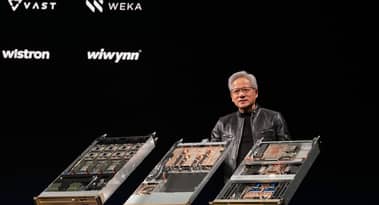
Nvidia has signed MoUs with Apollo Global Management, BlackRock, Blackstone, Brookfield Asset Management, Goldman Sachs, and KKR to establish financing platforms designed to mobilize more than $500 billion of third-party capital over time.
Wedbush analyst Matt Bryson said the initiative could support Nvidia's position as the dominant infrastructure supplier for data-center projects outside the largest hyperscalers and frontier AI companies.
"Nvidia remains almost the sole supplier of infrastructure for non-hyperscale/frontier model datacenter builds. We see this fund as another mechanism that likely supports Nvidia's leadership and growth away from hyperscalers," Bryson wrote in a research note.
Balance-sheet exposure remains a question
The involvement of outside investors could reduce the amount of capital Nvidia needs to commit directly to financing AI infrastructure.
However, investors are also examining Nvidia Chief Executive Jensen Huang's comments about potential guarantees connected to the initiative.
"In some cases, Nvidia may provide a residual-value support mechanism for up to 25% of an opportunity, assessed carefully on a project-by-project basis," Huang wrote on X.
He said the support would be limited and based on residual value, designed to complement rather than replace independent underwriting.
Circular financing debate continues
The financing initiative arrives as investors increasingly scrutinize the interconnected funding structures underpinning the AI infrastructure boom.
Nvidia has been involved in financing arrangements with companies that use its chips, raising concerns among some investors that vendor financing could create circular demand within the AI ecosystem.
Huang sought to address those concerns when Nvidia announced the new initiative, saying the capital would come from the financial consortium rather than represent Nvidia revenue.
Bank of America analyst Vivek Arya said the arrangement appeared to represent a shift away from vendor financing and argued that the capital commitment would sit with the financial consortium rather than Nvidia's balance sheet.
Morgan Stanley analysts also said the arrangement should help alleviate concerns over circular financing.
"For all of the handwringing over circularity, Nvidia’s actual direct credit exposure thus far is mostly confined to credit backstops with a couple of smaller neoclouds," Morgan Stanley analyst Joseph Moore wrote.
AI spending increasingly relies on outside capital
The financing push comes as major technology companies have raised substantial amounts of debt and equity to fund data centers, AI models, and AI-related infrastructure.
Alphabet, Amazon, Meta, Microsoft, and Oracle have raised more than $150 billion combined this year through debt and equity offerings.
Intel also recently announced a $15 billion stock offering before increasing the size to $20 billion.
The scale of external financing highlights the growing capital requirements of the AI buildout, particularly as some major technology companies have seen their cash flow come under pressure from heavy infrastructure spending.
SK Hynix stock rebounds, but a new HBM4 risk is getting harder to ignore

Shein’s $1.7B IPO was heavily subscribed, so why did the stock crash 10%?

Dow falls 380 pts as Iran conflict lifts oil prices and rate hike concerns

Evening digest: Amazon faces FTC suit, gold falls as oil rises

Why is Micron stock gaining today
No results found
Loading articles...
Failed to load articles. Please try again.