
Here’s the top reasons why the Kospi Index is falling today
AI Sentiment: 28/100 Bearish
This score is generated through AI-driven analysis of the article's content.

powered by

Buy KOSPI exposure (e.g., iShares MSCI South Korea ETF, EWY) because the selloff is driven by bond-yield jitters and a gap-down, but the index still holds a bullish flag and remains above the 200-day EMA—set up for a snapback toward the 7,215 resistance retest.
Key Risk: South Korea yields keep rising and break the 200-day support, turning the bullish flag into a full trend reversal.
Buy Samsung Electronics because it’s a top Kospi weight being hit by the same rate/memory volatility as SK Hynix, Micron, and Kioxia. If yields stabilize, the market will re-rate mega-cap tech quickly, and Samsung’s oversold move (down ~7.5% in the session) offers a fast mean-reversion path.
Key Risk: Memory demand expectations deteriorate further (not just rates), forcing earnings downgrades and keeping the stock weak even if yields calm.
- The Kospi Index gapped lower on Wednesday.
- South Korea’s long-term bond yields soared to 4.72%.
- Samsung Electronics and SK Hynix stocks plunged.
The Kospi Index gapped lower on Wednesday as jitters in the bond market continue and as top constituents like Samsung and SK Hynix retreat. It plunged to 6,473 points, down by 10% from its highest point this week.
South Korea long-term bond yields jump
The Kospi Index slumped, joining other top global benchmarks like the Nikkei 225 and Nasdaq 100. This retreat is happening as concerns about the bond market escalates, with yields jumping to the highest level in years.
In South Korea, the 30-year yield rose to 4.72%, its highest level in decades. It has been in a steady uptrend after bottoming at 1.10% in 2021. This price action mirrors what is happening in other countries like the United States, Germany, and France.
Global bond yields have soared as geopolitical risks rose. One of these risks is the ongoing US-Iran conflict that has now moved to a stalemate. Trump is hoping that his blockade against Iran will push officials to surrender. Iran, on the other hand, believes that it can escalate, especially now that the challenges the US is facing are well known.
This stalemate is affecting South Korea directly since it imports most of its oil from the Middle East. The latest data shows that Brent and the West Texas Intermediate (WTI) have jumped to 91% and $86, respectively, and the uptrend may continue.
South Korean risks also jumped after Trump criticized the US defense pact with the country. He praised North Korea’s Kim Jong Un and blasted South Korea’s president for not helping the US in its fight against Iran. This means that South Korea may now be forced to boost its defense spending in the near term.
Samsung and SK Hynix stocks are plunging
Meanwhile, the Kospi Index is also falling as its top constituent companies continue their strong downtrend. Samsung Electronics stock dropped by 7.45%, while SK Hynix fell by 8.72%. As a result, SK Square, which holds a stake in SK Hynix, dropped by 10.84%.
This retreat coincided with the ongoing plunge in other top memory companies like Micron, Kioxia, and SanDisk. All these companies have become highly volatile in the past few months as investors remained concerned about their growth prospects.
Other top losers in South Korea were companies like Samsung Electr-Mechanics, Hyundai Motor, Samsung C&T, and Samsung Life Insurance.
Kospi Index technical analysis
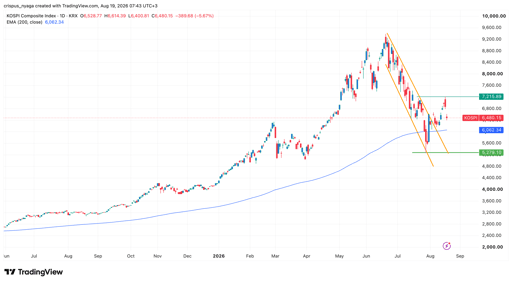
Kospi Index chart | Source: TradingView
The daily chart shows that the Kospi Composite Index has been in a slow uptrend in the past few weeks as technology companies rebounded. It moved from a low of 5,279 in July to a high of 7,215 points.
The index then gapped lower today, reaching a low of 6,493 today. On the positive side, it has still formed a bullish flag pattern, a common bullish continuation sign in technical analysis. It also sits above the 200-day Exponential Moving Average (EMA).
Therefore, the most likely scenario is where the index resumes rising and retests the resistance level of 7,215. A move above that level will point to more gains. If this fails, there is a risk that the index will drop further to 5,279.

Apple’s foldable iPhone could add $14 billion: why Wall Street still fears a selloff

Hang Seng Index forms a highly bullish pattern as China trade surplus jumps

Samsung, SK Hynix send KOSPI above 7,100 as Nikkei buckles under yen pressure

Michael Burry calls Lululemon his portfolio trickster: why he is buying the crash
Nvidia supplier Wistron is spending big on AI: why is the stock falling?
No results found
Loading articles...
Failed to load articles. Please try again.