
Dell stock falls before earnings: strong AI demand will not alone sustain 250% rally
AI Sentiment: 68/100 Bullish
This score is generated through AI-driven analysis of the article's content.

powered by

Buy Dell (DELL) into/after earnings for AI infrastructure momentum plus backlog-to-revenue visibility. The thesis is that ISG AI servers are the core driver (big share of revenue) and the debate has shifted from “is demand real?” to “can Dell ship fast enough?” Supply constraints are the near-term limiter, but they also create pricing power and backlog durability. Nvidia’s financing push and potential SpaceX compute buildout extend the demand runway beyond one quarter. Key risk: Dell guides to slower-than-expected revenue conversion from backlog because supply/capacity constraints worsen or persist longer than the market expects.
Key Risk: Dell can’t convert its AI backlog into revenue fast enough due to prolonged supply/capacity constraints, causing guidance disappointment.
Buy Hewlett Packard Enterprise (HPE) as a sector read-through. The article frames Dell and HPE earnings as the next test after Nvidia’s blowout forecast, and Super Micro’s stronger outlook supports the server-market cycle. If AI server demand stays strong, both names should benefit from multiple expansion even if each has different backlog dynamics. Key risk: HPE’s margins or guidance disappoint (e.g., mix, costs, or slower order fulfillment), breaking the “AI demand translates to earnings” link.
Key Risk: HPE’s guidance/margins disappoint because AI demand doesn’t translate into profitable, shippable revenue.
- Dell expected to report 112% growth in adjusted EPS on strong AI server demand.
- JP Morgan expects Dell could raise its fiscal 2027 outlook.
- Dell's high valuation leaves little room error.
Dell Technologies DELL shares fell over 4% on Tuesday ahead of the company’s quarterly earnings report, as broader market weakness and rising bond yields weighed on technology stocks.
Inflation concerns and elevated oil prices have pushed yields higher in the US and overseas, raising questions about whether the Federal Reserve could tighten monetary policy later this month.
But Dell enters its July-quarter earnings report with a much stronger fundamental backdrop.
The company is expected to post sharp growth, with analysts increasingly focused on whether it can expand production quickly enough to meet surging demand for artificial intelligence infrastructure.
Dell is scheduled to report results after the market closes on Tuesday.
The company’s shares have already gained about 250% this year, making expectations around the earnings report particularly high.
Earnings reports from Dell and HP Enterprise come just days after Nvidia delivered a blowout revenue forecast, reinforcing expectations that AI infrastructure spending remains strong.
With Nvidia’s results lifting its shares and raising the bar across the sector, investors will now be looking for Dell and HPE to show that demand is translating into sustained growth.
AI servers set to dominate Dell's results
The strength of AI infrastructure demand is expected to be reflected in Dell’s Infrastructure Solutions Group, or ISG.
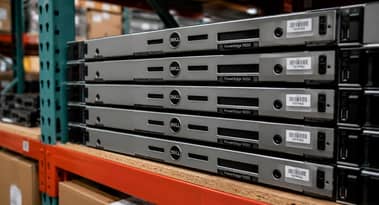
AI-optimized servers are expected to generate about US$16 billion (approx. $20.6 billion) out of the US$29.8 billion (approx. $38.4 billion) revenue for the segment, which itself accounts for more than half of the roughly US$45.1 billion (approx. $58.2 billion) in total revenue expected for the quarter.
Visible Alpha Research expects Dell to report diluted non-GAAP earnings per share of $4.91, representing growth of 112% from a year earlier.
The figures illustrate how quickly AI infrastructure has become a central driver of Dell’s financial performance.
The company's previous earnings report showed that its AI server backlog had reached a record US$51.3 billion (approx. $66.2 billion), according to Evercore ISI analyst Amit Daryanani.
That backlog has also changed the nature of the debate around Dell’s stock.
Daryanani said investors previously questioned whether AI infrastructure demand was strong enough to justify Dell’s rally.
Now, the bigger question is how much of that demand the company can actually fulfill.
Supply constraints could limit near-term upside
Dell’s challenge is increasingly one of capacity rather than customer interest.
Daryanani said supply shortages are preventing the company from recognizing some of the upside embedded in its backlog.
Across the AI infrastructure industry, "constraints are broadening rather than easing," Daryanani said, adding that he expects the situation to become worse in 2027.
That could provide Dell with considerable visibility into future revenue, even if some orders take longer to convert into reported sales.
The analyst also pointed to "material capex raises" from neocloud company CoreWeave and SpaceX, which he identified as Dell’s "two largest customers."
Rising capital expenditure by these companies suggests that demand for computing infrastructure could remain elevated well beyond the current earnings cycle.
Nvidia financing could boost AI infrastructure demand
One of the biggest potential catalysts for Dell comes from Nvidia’s latest push to help finance the expansion of AI infrastructure.
Nvidia recently announced a US$500 billion (approx. $645.1 billion) financing platform involving third-party capital to support frontier AI labs and other major AI customers.
Mizuho analyst Vijay Rakesh believes the initiative could create a significant opportunity for Dell even if only a portion of the financing ultimately translates into infrastructure spending.
The platform "could drive meaningful demand" for AI infrastructure, Rakesh said in a recent note to clients, according to MarketWatch.
Dell supplies data-center servers that incorporate central processing units used for agentic AI and inference workloads.
It also sells AI-optimized systems capable of supporting Nvidia’s graphics processing units.
That puts the company directly in the path of the massive infrastructure investment required to support increasingly compute-intensive AI applications.
Industry forecasts now call for AI server growth of more than 80% in 2026, up from an earlier estimate of 64%, highlighting the strength of the market Dell is targeting.
SpaceX could become a major source of demand
SpaceX represents one of the more significant potential long-term opportunities for Dell.
Rakesh believes SpaceX’s plan to deploy as much as 10 gigawatts of computing capacity by the end of next year is "potentially optimistic."
However, even a deployment of around seven gigawatts could generate meaningful upside for Dell in 2027, he said.
Rakesh estimates that a seven-gigawatt deployment could represent a more than US$200 billion (approx. $258 billion) opportunity for Nvidia, which SpaceX has said it will exclusively purchase chips from.
Nvidia and Dell already collaborate on enterprise-grade servers and racks designed for AI training and inference.
Rakesh also expects SpaceX’s data-center capital expenditure could eventually surpass spending by Amazon and Google.
If that happens, Dell could benefit from another major customer committing billions of dollars to AI computing infrastructure.
JP Morgan sees room for an outlook upgrade
Analysts are also looking for signs that Dell could become more optimistic about its longer-term financial outlook.
JP Morgan expects Dell could raise its fiscal 2027 outlook when it reports results, citing continued demand for AI servers as well as traditional infrastructure.
The bank expects the company to build on its existing forecast for 47% revenue growth and maintains an Overweight rating with a $565 price target.
That view suggests Wall Street believes Dell’s current guidance could prove conservative if AI infrastructure demand remains strong and supply constraints gradually ease.
Meanwhile, better-than-expected guidance from fellow server maker Super Micro Computer earlier this month has provided another positive read-through for Dell.
Rakesh said Super Micro’s stronger revenue and gross-margin outlook supports the broader case for continued strength in the server market.
Storage and PC demand remain important
AI servers are not the only part of Dell’s business attracting attention.
Daryanani expects strong performance from the company’s storage operation and its client-solutions group, which includes personal computers.
Investors will be watching for signs of an enterprise PC refresh cycle, particularly as businesses increasingly look to equip employees with hardware capable of supporting AI workloads.
Melissa Otto, global head of Visible Alpha Research, said commentary around Dell’s AI server backlog and planned enterprise PC upgrades will be important for assessing the company’s outlook.
"In addition, it will be interesting to hear management’s perspective on the magnitude and trajectory of demand for storage from the AI opportunity. The potential timing of the refresh cycle and AI pipeline are worth watching in H2 and for next year," she said.
For Dell investors, Tuesday’s earnings report will therefore be about more than whether the company beats quarterly expectations.
High valuation leaves little room for error
Despite improving earnings expectations, Dell’s strong rally this year has pushed its valuation well above historical levels.
The stock currently trades at about 21 times forward earnings, down from a peak multiple of 25 on June 1 but still far above its 10-year average of 8.7.
That elevated valuation leaves little room for disappointment in the upcoming results and puts greater emphasis on management’s outlook.
Investors are likely to scrutinize not only the quarterly numbers but also what executives say about AI infrastructure demand, supply constraints, and the company’s earnings trajectory in the coming quarters.

CoreWeave stock flashes a warning sign despite strong revenue growth
Why are Intel and AMD stocks falling today

SCHD nears title of biggest dividend ETF, but technical risks loom

Amazon stock falls on FTC lawsuit but analysts bullish despite near-term pressure

Dow falls 250 pts as oil, Treasury yields rise and Fed rate hike bets grow
No results found
Loading articles...
Failed to load articles. Please try again.