
Nio stock: Why Tesla rival dropped despite strong revenue growth

AI Sentiment: 18/100 Bearish
This score is generated through AI-driven analysis of the article's content.

powered by

Sell NIO. Revenue and gross margin improved, but losses worsened (net loss $77.8M) and the stock broke key technical support ($4.40) with a head-and-shoulders breakdown. The market is pricing “growth without profitability” as a value trap, so downside can persist toward $3.50.
Key Risk: NIO proves losses are structurally shrinking fast enough (clear path to sustained profitability) and the stock reclaims $4.40 with improving guidance.
Sell a basket of Chinese EV makers (BYD, XPeng, Li Auto, Polestar). The article shows broad weakness across the sector even when results are strong, pointing to a shared demand/cost squeeze and multiple compression. If NIO is punished despite better margins, the whole group is vulnerable to further de-rating.
Key Risk: A sector-wide demand rebound (or major cost relief) shows up in multiple companies’ guidance at once, reversing the de-rating trend.
- Nio stock crashed to its lowest level since July last year.
- The company’s results showed that its revenue soared in Q2.
- Technicals suggest that the stock may continue falling as risks rise.
Nio stock continued its strong downward trend, reaching its lowest level since July 2025 after the company announced its financial results, which showed that its losses continued last quarter. It dropped to a low of $4.20, down by over 40% from its highest point this year.
Nio’s losses continued despite the revenue boom
Nio, a top Chinese company, published a mixed financial result. Its revenue soared by 69% in the second quarter to $4.7 billion. It had grown by over 27.5% from a quarter earlier, with its volume continuing to surge amid the rising demand for its vehicles.
The results also showed that its gross margins rose to 18.4%, higher than the 10.3% in the same period last year. This metric, however, was lower than the 19% from the previous quarter.
Most notably, the company’s bottom line remained in the red, with its net loss jumped to $77.8 million. This figure has been getting worse after it made a big profit in the fourth quarter of last year. The CEO said:
“The Company continued to improve its overall operating quality. Supported by strong sales of higher-margin models and ongoing optimization of our cost structure, we maintained healthy gross and vehicle margins despite rising cost pressures.”
Nio’s performance after earnings mirrors that of other companies. For example, BYD stock dropped to $11, its lowest level since July 23rd, even after it reported a strong profit. Xpeng stock dropped to $11.36, down by 60% from its highest point last year.
Li Auto shares plunged to $12.10, down by 30% this year, while Polestar is down by over 40%. Other Chinese EV companies like Xiaomi and Zeekr have all dropped substantially this year.
BYD highlighted some of the challenges that the company is facing. In its earnings last week, BYD noted that the industry was contending with higher costs and sluggish demand. As a result, the management is expanding its business globally to offset the weak Chinese demand.
On the positive side, Nio believes that its growth will continue in the foreseeable future. Its deliveries in the third quarter is expected to be between 108,000 and 111,000, with its revenue growing by over 50% YoY.
Nio stock price technical analysis
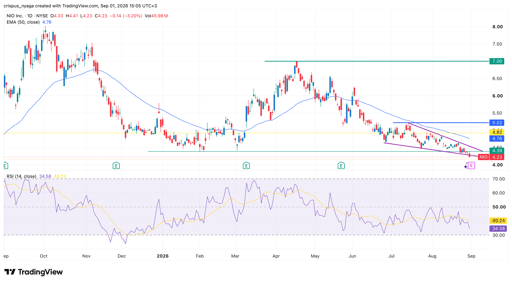
Nio stock chart | Source: TradingView
The daily chart shows that the Nio shares have continued to fall in the past few months. It dropped below the important support level of $4.40, its lowest level in February and March this year.
Moving below that level confirmed the bearish outlook. At the same time, the stock has formed a head-and-shoulders pattern, a common bearish reversal sign in technical analysis.
The stock has moved below all moving averages and the Supertrend indicator. Also, the Relative Strength Index (RSI) has continued falling, reaching a low of 34, its lowest level since July 14.
Therefore, the stock will likely continue falling, potentially to the key support level of $3.50. On the other hand, the stock has also formed a falling wedge pattern, a sign that it may rebound in the coming weeks.

Amazon stock falls on FTC lawsuit but analysts bullish despite near-term pressure

Dow falls 250 pts as oil, Treasury yields rise and Fed rate hike bets grow

Robinhood stock rises as Morgan Stanley upgrades HOOD to overweight

Nvidia stock analysis: top reasons why the shares may go parabolic soon

Broadcom stock falls to a key support: is it about to surge after earnings?
No results found
Loading articles...
Failed to load articles. Please try again.