
Rio Tinto earnings flat on iron ore dip; copper drives dividends
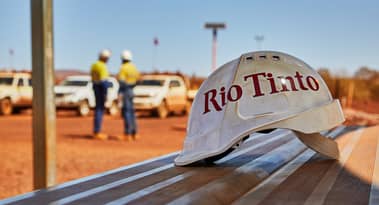

- Underlying earnings flat at $10.87B, falling short of market expectations.
- Copper division earnings doubled, offsetting lower iron ore contributions.
- Final dividend of 254 US cents per share announced, up from 225 cents in 2024.
Mining giant Rio Tinto announced flat annual earnings on Thursday, falling short of market expectations.
A decline in iron ore prices dragged on its core business, despite a robust showing from its copper division.
The world's largest iron ore producer, which recently ended merger discussions with Glencore, reported underlying earnings of $10.87 billion for the year ending December 31.
This figure remained flat compared to the previous year and fell short of the $11.03 billion consensus forecast from Visible Alpha.
Rio Tinto announced a final dividend of 254 US cents per share, representing a 60% payout ratio of underlying earnings.
This is an increase from the 225 US cents per share paid in 2024.
Following the announcement, Rio's London-listed shares fell 4% at the time of writing, slightly underperforming its competitors.
Bottomline flat
Despite a 9% rise in underlying EBITDA in 2025, the company's financial performance showed several weaknesses.
Free cash flow decreased by 28%, and profit after tax fell by 14%. Furthermore, underlying earnings per share remained flat.
Although the total dividend payout reached the top end of expectations, the dividend per share was unchanged.
Iron ore experienced a challenging year, with prices falling between December 2024 and the following year.
This was compounded by increased costs per tonne at Rio Tinto's Pilbara operations.
In contrast, copper prices saw significant gains, driven by robust demand, particularly from the expansion of AI-related data centers.
“This strong operational performance, together with a diversifying portfolio and firm cost discipline, underpinned a 9% increase in underlying EBITDA to $25.4 billion and operating cash flow of $16.8 billion.” Rio Tinto Chief Executive Officer Simon Trott said in the earnings release.
Rio Tinto's strategic growth targets
“We delivered stable underlying earnings of $10.9 billion, after taxes and government royalties of $10.4 billion.”
Rio Tinto continued to invest in delivering industry-leading, value-accretive growth, supported by its disciplined capital allocation and best-in-class project execution, Trott said.
It remained on track to achieve 3% CAGR in CuEq1 production to 2030.
At the same time, the structural cost improvements underway today positioned it for higher margins and cash flow.
With a high-quality pipeline, anchored in copper, the company had clear visibility to extend this growth profile well into the next decade, Trott added.
Meanwhile, Rio Tinto’s global competitor Glencore announced on Wednesday that it would return $2 billion to shareholders, alongside reporting a slight dip in its 2025 core earnings.
The miner and commodity trader, headquartered in Switzerland, reported a 6% drop in adjusted EBITDA last year, down to $13.51 billion.
Despite this decline, the figure surpassed the analysts' consensus estimate of $13.3 billion.
Copper in focus
On the other hand, miners are increasingly prioritising copper, as evidenced by Rio Tinto’s earnings results.
This growing focus is fueled by the rising demand for the metal, which is being driven by two key trends: the proliferation of power-intensive AI data centers and the global transition to cleaner energy sources.
Operational excellence and disciplined cost management were key factors in Rio’s results, complemented by increasing contributions from both copper and aluminum, according to the release.
The focus on this new strategy has triggered extensive deal-making in the sector as firms work to secure long-term copper reserves.
Discussions between Rio and Glencore, aimed at creating the world's largest listed mining company with significantly increased copper holdings, broke down in February.
The collapse was due to the companies' inability to reach an agreement on the crucial terms of valuation and ownership.
For the first time, copper surpassed iron ore in rival BHP's earnings, according to the world's largest listed miner's report on Tuesday.
Both major mining companies have committed to utilizing current assets to generate capital, which will then be redirected and returned to their shareholders.
For instance, this week, BHP announced an agreement with Wheaton Precious Metals.
This deal involves supplying silver from a Peruvian mine in exchange for an upfront payment of $4.3 billion.
Asset monetization and value generation at Rio Tinto
Rio Tinto is currently exploring options to monetise assets, including assessing market interest for the sale of its titanium and borates division.
Additionally, the company is looking into ways to generate value from existing infrastructure across all its operations.
Iron ore's contribution to Rio Tinto's total earnings dropped to approximately 60%, a decrease from 70% in the previous year.
Conversely, the copper division's earnings doubled year-over-year, now making up around 30% of the group total.
Aluminium and lithium accounted for the remaining portion of the earnings.
Higher annual unit costs for the company's Pilbara iron ore output in Western Australia negatively impacted iron ore earnings.
These costs increased by approximately $0.50 per metric ton compared to 2024, a rise attributed to inflationary pressures and disruptions caused by weather.
Pilbara's unit costs are projected to increase this year, ranging from $23.50 to $25 per ton.
Meanwhile, the copper division reported an 11% increase in 2025 output compared to 2024, boosted by the ramp-up of the Oyu Tolgoi mine in Mongolia.
This increased production supported a 17% rise in average realised copper prices in 2025 from the prior year.
Amos Hochstein dubs oil prices 'wrong and too low': find out more

Gold price forecast: Oil and US bond yields rally ahead of FOMC
Brent nears $108 after Saudi pipeline hit: why $120 oil is back on the table
WTI crude oil price forecast as Middle East risks remain elevated: can it hit $120?
Here’s why Brent crude oil price is falling today and what's next
No results found
Loading articles...
Failed to load articles. Please try again.