
Here’s why the Kospi Index is surging and why it is at risk of a drop


South Korean stocks staged a strong comeback, soaring by over 10%, its best daily performance since 2008. The Kospi Index jumped to KRW 5,555, up sharply from this week's low of KRW 5,083. This article explains why it is rising and the potential risks.
Why the Kospi Index is soaring
The Kospi Index as investors bought the dip in Asian equities after the recent sell-off. Japan’s Nikkei 225 Index jumped by over 2%, while Hong Kong’s Hang Seng soared by 1.5%. Stock indices in countries like Malaysia and Singapore also continued to recover.
The rebound was triggered by dip buyers who reacted to a report that Iran had talked to the United States about ending the ongoing war.
While odds of a ceasefire are still slim, some geopolitical analysts believe that President Donald Trump may decide to cut his losses amid reports that the US was running low on weapons after distributing them to Ukraine and Israel.
In a statement, Anthony Blinken, the former Secretary of State, said that Trump may exit the war, citing the killing of Ayatollah Ali Khamenei and most senior officials. He may also cite the success in degrading Iran’s military.
Such scenarios would be highly bullish for the Kospi Index as South Korea does not have many resources. It imports most of its oil from the Middle East, with most of it passing through the Strait of Hormuz. As such, lower crude oil prices would be highly bullish for the economy and potentially the stock market.
The recent Broadcom earnings also contributed to the Kospi Index gains. Its earnings showed that its AI revenue doubled in the fourth quarter, with the management guiding towards $100 billion annual revenue in the AI industry in the next few years.
Together with the recent Nvidia earnings, there are signs that the AI boom is continuing. Indeed, AI-linked companies like Samsung and HK Hynix were some of the best gainers in the Kospi Index on Thursday. Samsung jumped by 9.30%, while SK Hynix soared by 9.78%.
Still, there is a risk that the ongoing Kospi Index rally is a dead-cat bounce. A DCB is a temporary, short-lived recovery in an asset’s price after a prolonged decline. In Kospi’s case, it briefly entered a bear market after falling by 20% from its peak.
Whenever such a drop happens, it is common for investors to buy the dip as they time the market. In many instances, this buying is usually a bull trap and assets often retreat.
Wyckoff Theory suggests that the Kospi Composite Index is due for a correction
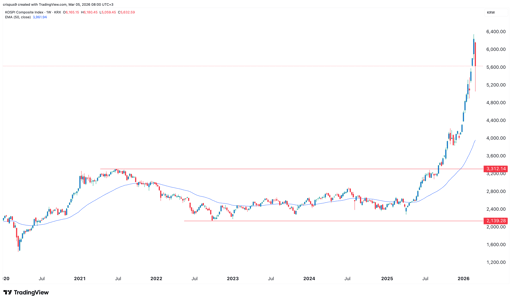
The Kospi Index has been one of the top gainers in the past few months. An index that was trading at KRW 2,298 in April last year, surged to a record high of KRW 6,330 this month.
A closer look at the weekly chart shows that the rally happened after the index remained in a narrow range between KRW 2,140 and KRW 3,312 between 2021 and 2025.
According to the Wyckoff Theory, this performance was part of the accumulation phase. It entered the markup stage last year after the president promised to push it to KRW 5,000.
Therefore, there are signs that the index is now entering the distribution phase, which is then followed by the markdown. If this happens, there is a risk that it may plunge to KRW 4,000 and below.
A good example of the Wyckoff Theory at work is Zcash, a top privacy token that emerged from a three-year consolidation last year and surged to a record high. It has now entered the markdown phase, which is characterized by panic selling among investors.
Another good example of this is XRP, an altcoin that soared by over 400% in November 2024 after years of consolidation. It jumped to a record high of $3.6 and then retreated when it moved to the markup stage.

Micron stock falls 3% as Taiwan unions threaten strike over bonuses

Duolingo stock jumps as charts flash warning amid transition from growth to value

Tesla stock falls 3%: here's what's dragging the stock down today

Duolingo stock surges 5% as this analyst sees 42% upside

Apple stock outlook under Ternus: AI is key, foldable iPhone a potential catalyst
No results found
Loading articles...
Failed to load articles. Please try again.