
Japan’s Kioxia stock is beating Micron, Sandisk, SK Hynix: here’s why

AI Sentiment: 72/100 Bullish
This score is generated through AI-driven analysis of the article's content.

powered by

Buy Kioxia (KIOXIA). The news points to a real operating turnaround: revenue >1T yen, operating profit 599.1B yen, free cash flow 241B yen, and management saying it’s operating at full capacity. Hyperscalers are requesting long-term contracts, which supports pricing and volume through the AI buildout. Guidance implies another sharp step-up (Q1 revenue +74%).
Key Risk: AI-driven memory demand drops faster than Kioxia can keep selling at strong prices, forcing margins and guidance to fall.
Buy Micron (MU) versus selling/underweighting weaker peers. The article frames the whole memory complex as in a demand surge, but Kioxia is the standout. That usually means the “next best” operator with scale and customer reach can still compound as capex stays elevated. MU is already in the trillion-dollar club and should benefit from the same AI memory spend, with less execution risk than a company still proving it can sustain full-capacity utilization.
Key Risk: Memory supply ramps and prices fall, crushing earnings even if AI demand remains strong.
- Kioxia stock price has surged by over 840% this year.
- This surge has been better than other top competitors.
- It has helped it become the biggest Japanese company by valuation.
Global investors have focused on the performance of top memory stocks like Micron (MU), Sandisk (SNDK), and SK Hynix this year as they surpass their all-time highs each week. However, Kioxia stock, a top competitor, is beating all of them by a large margin.
Kioxia stock is firing on all cylinders
Kioxia stock price is doing well this year, and is beating most companies in the memory industry. It has jumped by 847% this year and by 4,780% in the last 12 months. This growth has seen it overtake companies like Toyota and Softbank to becoming the biggest Japanese company by market cap. Its valuation has jumped to $370 billion.
Sandisk, the best-performing company in the US, has jumped by 4,755% in the last 12 months and by 795% this year. Micron, which entered the trillion-dollar club, is up by 285% this year, while South Korea’s SK Hynix has jumped by over 358% this year.
The ongoing surge reflects a major turnaround for a company that went public in 2024 at a valuation of less than $5 billion. Indeed, for a long time, it was a struggling memory company that was on the verge of going bankrupt. It had survived years in restructuring as its losses jumped, leading to a $1 billion rescue by the Japanese government.
Kioxia is operating at full capacity
The ongoing Kioxia stock surge is happening because of the surge in its demand as companies have boosted their investments in AI. This is important because the company sells its products to some of the top companies globally like Microsoft and Apple. Other top clients are firms like Dell and HP, which gives it a 25% market share in the NAND industry.
The most recent results showed that Kioxia’s revenue is surging and the management has said that it is operating at full capacity. Some of its hyperscaler clients have even requested long-term contracts to secure its products.
Kioxia’s revenue surged to over 1 trillion yen in the last year, while its operating profit soared to 599.1 billion yen. This growth brought its free cash flow to over 241 billion yen. This growth helped it end the year with over 470 billion yen in cash on its balance sheet.
The management also boosted its guidance, and now expects that its revenue will jump by 74% in the first quarter to 1.75 trillion yen. Its net income is expected to jump by 112% to 870 billion yen.
Kioxia shares face some notable risks
Still, despite these gains, there are signs that Kioxia stock faces some major risks ahead. First, there is a likelihood that the stock will reverse once the AI supercycle starts to cool. That is important because no supercycle lasts forever. For example, the commodity supercycle we experienced during the Covid era ended, with most of those items falling from their peak.
Second, there is a likelihood that the memory supply will start to catch up with demand, leading to lower prices over time. If this happens, we could see Kioxia and its top competitors reverse.
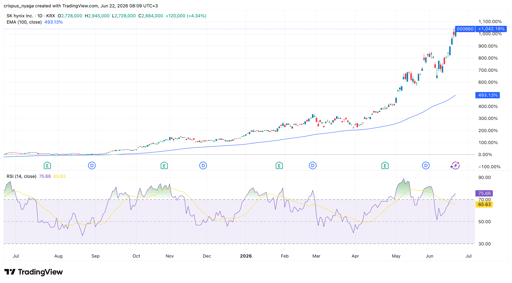
Kioxia stock chart | Source: TradingView
Finally, technically, Kioxia stock has become highly overbought, with the Relative Strength Index soaring to 75. Also, it remains much higher than its short and longer-term moving averages, raising the risk of a mean reversion. As such, while the rally may continue for a while, there is a risk of a reversal.

Dow closes 400 pts lower as US crude oil tops $100 and Fed rate-hike bets rise

Evening digest: Oil tops $100 as Bitcoin falls below $78,000

Reddit stock rises 6% as August user growth hits 2026 high

iPhone Duo: analyst explains how big of a revenue opportunity it really is

Why Wall Street is split on Meta’s Muse AI agent and stock outlook
No results found
Loading articles...
Failed to load articles. Please try again.