
Kospi Index slides as Samsung, SK Hynix sink; Barclays stays bullish on semis

AI Sentiment: 35/100 Bearish
This score is generated through AI-driven analysis of the article's content.

powered by

Buy Samsung. The article says compute demand still exceeds supply and most products are sold out for the year, so the selloff looks like position trimming, not collapsing fundamentals. Samsung is also a top Kospi weight, so any stabilization in semis should re-rate it quickly. Key catalyst is upcoming big-tech earnings confirming capex stays strong.
Key Risk: Big-tech earnings show capex cuts or demand destruction, breaking the “sold out for the year” story.
Buy SK Hynix. It’s down ~40% from its peak alongside memory peers, but the banks’ view is that supply constraints won’t ease quickly—supporting pricing and utilization. If compute demand stays ahead of supply, Hynix should outperform as investors rotate back into the highest-conviction memory winners.
Key Risk: Memory pricing reverses fast (inventory builds or cancellations), proving demand is not actually outstripping supply.
- The Kospi Index slumped by over 4% on Monday.
- Samsung and SK Hynix stocks continued their freefall.
- Barclays and UBS believes that semiconductor stocks will rebound.
The Kospi Index retreated by over 4% today, July 20, as concerns on the technology sector coincided with the ongoing US-Iran war. It slumped to 6,525 points, down substantially from the year-to-date high of 9,387. Still, despite this weakness, Barclays and UBS analysts believe that top semiconductor stocks have an upside.
Barclays and UBS are bullish on semiconductor stocks
The main reason why the Kospi Index has slumped is that its two biggest constituents are in the red. Samsung Electronics stock has slumped by 34% from its highest point this year and is hovering at its lowest level since May 6 this year.
SK Hynix, the second-biggest South Korean company, has dived by 40% from its peak this year. This crash has coincided with that of other memory and semiconductor companies in other places. In Japan, Kioxia has been in a strong freefall that has erased billions of dollars in value.
Top ETFs have also plunged in this period. The Roundhill Memory ETF (DRAM) dropped from a record high of $81 to $52, while other popular funds like SMH and SOXX have continued their freefall.
Still, despite all this, analysts at key banks like UBS and Barclays believes that semiconductor companies have more room to go. They cited the strong demand in the industry and the fact that most of their products are sold out for the year. In a note, a Barclays analyst wrote that:
“Demand for compute continues to exceed available supply, while capacity constraints along the supply chain are unlikely to ease quickly.”
In a separate note, a UBS analyst said:
“The selling is more passive and not aggressive and it seems more like trimming of positions rather than investors trying to leave the space.”
Semiconductor companies are now bracing themselves for the upcoming big-tech earnings, which will provide more color on capital expenditures. A sign that big-tech companies are still willing to spend will be bullish for Samsung and SK Hynix, which account for more than half of the Kospi Index.
US-Iran war raising volatility
The Kospi Index is also reacting to the ongoing tensions in the Middle East, which escalated during the weekend. As a result, crude oil prices jumped on Monday, with Brent topping $90 for the first time in over a month.
The US continued its strike against Iran overnight as Trump seeks to bring Iranian back to the negotiating table. Iran, on the other hand, has launched substantial attacks in the region, killing and injuring US forces.
Trump has threatened that the US will attack Iranian power plants and bridges this week. Iran has threatened to hit similar infrastructure in the region as well.
South Korea is impacted by these events because of the impact on the energy market. Soaring oil prices will fuel inflation in the country and push the central bank to hike interest rates again.
Kospi Index technical analysis
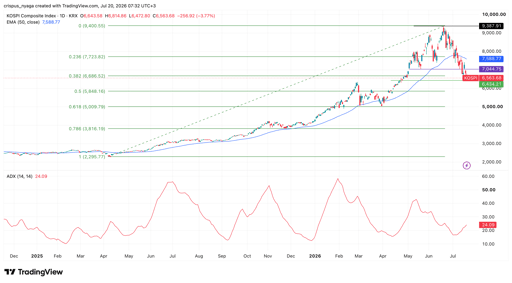
Kospi Index chart | Source: TradingView
The daily chart shows that the Kospi Index continued its strong downward trend on Monday. It has now slipped below the 38.2% Fibonacci Retracement level.
Kospi has also fallen below the 50-day Exponential Moving Average (EMA), while the Average Directional Index has risen to 24. That is a sign that the downward trend is gaining momentum.
Therefore, the stock will likely continue falling in the near term, potentially to the psychological level of 50,000. This target also coincides with the 61.8% retracement level.

Crude oil prices retreat: Brent, WTI slip even as rebound risks persist

Kospi Index at a crossroads as Samsung, SK Hynix leverage bets reverse

How Meta’s $18B teen safety settlement could reshape social media regulation

Nvidia is using its balance sheet to fuel the AI boom. Is it a double-edged sword?

Dow holds weekly gain as Warsh inflation warning lifts rate hike bets
No results found
Loading articles...
Failed to load articles. Please try again.