
Hacker mints 1B fake DOT in Hyperbridge exploit: here's what it means

AI Sentiment: 18/100 Bearish
This score is generated through AI-driven analysis of the article's content.

powered by

Buy stETH (or ETH via stETH) as a relative-value hedge against altcoin bridge contagion. The exploit is Ethereum-side (Hyperbridge on Ethereum) and the broader crypto tape was already weak; when bridge/security fear hits, capital typically rotates toward the most liquid, settlement-layer assets and away from cross-chain beta. StETH captures ETH upside while reducing volatility versus spot ETH.
Key Risk: A broader Ethereum-specific security/regulatory shock emerges from the same incident (or bridge risk spreads to Ethereum core), causing ETH to sell off alongside risk assets.
Short Polkadot (DOT) outright. The market is repricing cross-chain bridge risk after a Hyperbridge exploit that minted 1B fake DOT on Ethereum, and the article notes the selloff was driven by panic/uncertainty rather than native DOT mechanics—exactly the kind of sentiment overhang that keeps pressure on until credibility is rebuilt. Technicals were already bearish; the drop pushed DOT below ~$1.17 with next key level ~$1.15. Sell into any relief rallies toward $1.19–$1.20 resistance.
Key Risk: Polkadot/Hyperbridge quickly proves the incident is fully contained (no further minting/withdrawal risk) and DOT regains $1.17–$1.20 with sustained volume, flipping sentiment from panic to “overblown.”
- Attackers minted 1B fake Polkadot via a Hyperbridge exploit on Ethereum.
- DOT's price dropped on panic selling despite no change to native Polkadot supply.
- Next price swing depends on $1.15 support and short-term market sentiment.
A major security incident has shaken confidence around Polkadot’s cross-chain ecosystem after attackers managed to exploit a vulnerability in the Hyperbridge system on Ethereum.
The exploit, which has been acknowledged by the Polkadot team, allowed the creation of 1 billion fake DOT tokens, triggering panic across the market and dragging Polkadot’s price lower in the short term.
How the Hyperbridge exploit unfolded
The attack targeted a cross-chain bridge system that connects Polkadot-based assets to Ethereum.
In simple terms, these bridges are meant to lock tokens on one chain and mint equivalent “wrapped” versions on another chain so they can be used across different ecosystems.
In this case, the attacker found a weakness in the message verification process.
By forging a valid-looking cross-chain message, they were able to trick the system into believing a legitimate request had been made.
This gave them unauthorized administrative control over the Ethereum-side contract responsible for issuing bridged DOT.
Once inside, the attacker minted roughly 1 billion unbacked DOT tokens on Ethereum in a single sequence of transactions.
These tokens did not represent real assets on the Polkadot network, but they were still treated as valid within Ethereum-based liquidity pools.
The attacker quickly sold the newly created tokens on decentralised exchanges.
However, the liquidity in those markets was extremely thin, which meant the price collapsed almost immediately as selling pressure overwhelmed buyers.
Despite the enormous nominal value of the minted tokens, the attacker only managed to extract around $237,000 before the market became unusable for further profit-taking.
Polkadot’s DOT price reacted sharply to the hack
Polkadot’s native token dropped around 6% following the news, with price hovering near the $1.17 region at press time.
Notably, the move was not driven by any change in the underlying supply or protocol mechanics, but rather by fear and uncertainty spreading through the market.
Traders reacted quickly to the idea that “1 billion DOT tokens” had been minted, even though the event only affected a bridged representation of the asset on Ethereum.
The distinction between native DOT and wrapped tokens was largely ignored in the immediate reaction, which amplified selling pressure.
At the same time, the broader cryptocurrency market was already showing mild weakness, which added further downside pressure.
Bitcoin’s slight decline during the same period reduced overall risk appetite, making altcoins more vulnerable to sharper moves.
As a result, DOT underperformed compared to the wider market, not because of a fundamental failure in its core blockchain, but due to a combination of panic sentiment and technical breakdowns on the charts.
Polkadot price outlook
From a technical perspective, Polkadot’s price structure was already leaning bearish before the exploit occurred.
The token had been trending downward for an extended period, and the recent price drop only shows repeated failures to build strong upward momentum.
The drop has pushed DOT below a key support area around the $1.17 level, briefly testing lower levels near $1.16.
This zone now becomes important for traders watching short-term stability.
If buyers manage to defend the $1.15 area, the market could enter a consolidation phase, where price stabilises and attempts a recovery bounce.
In that scenario, the $1.19 to $1.20 range becomes the first meaningful resistance zone to watch, as it aligns with recent intraday pivot levels.
However, if selling pressure continues and the $1.15 support fails, the structure suggests there may be room for further downside, especially seeing that momentum indicators like RSI show the altcoin is almost oversold.
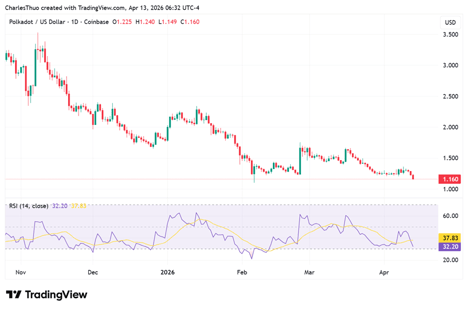
In that case, the market could extend its broader downtrend, especially if sentiment around bridge security remains weak or if no clear resolution is communicated by developers.

Interview: Aptos CEO on AI agents, stablecoins and the future of machine commerce

Will POL rally another 47% to $0.18, or is a correction coming first?

Is Dogecoin’s 34% rally just getting started, or is a pullback next?

Why is Injective price up 45% this week?

Polygon price erupts 50% as POL breakout sparks fresh $0.14 target
No results found
Loading articles...
Failed to load articles. Please try again.