
PI remains in red despite the launch of smart contracts on testnet

AI Sentiment: 28/100 Bearish
This score is generated through AI-driven analysis of the article's content.

powered by

Buy Stellar (XLM). Pi is built on Stellar, and the news is really a Stellar ecosystem “utility narrative” play. If Pi’s smart-contract push gains traction later (version 26), it can lift sentiment toward Stellar-based infrastructure and wallets, benefiting XLM even if PI stays weak near-term.
Key Risk: Pi’s smart-contract rollout fails to translate into real usage, keeping Stellar sentiment muted and leaving XLM range-bound.
Sell Pi Network (PI) spot. Smart contracts on testnet don’t matter if supply is hitting the market: ~30.5M tokens released by the Pi Foundation vs ~2.7M outflows to CEXs. Price is below the 50/100/200-day EMAs and momentum is weakening (RSI ~45; MACD histogram shrinking). Expect a move toward $0.1633 support; if it breaks, $0.1556 then $0.1310.
Key Risk: Pi token supply releases slow or reverse, and the market reprices smart-contract utility fast enough to overpower the sell pressure.
- The Pi Core team has announced the launch of its first smart contract capability on its testnet.
- PI token is down by less than 1% despite the upcoming upgrade on its network.
- PI could drop below the $0.1600 level in the near term if the selling pressure intensifies.
The cryptocurrency market has been bullish over the past 24 hours, with Bitcoin briefly topping the $78,100 level.
Ether is also approaching $2,400, while XRP has flipped BNB to become the fourth-largest cryptocurrency by market cap.
However, Pi Network (PI) is trading around $0.1700 at press time on Wednesday, down by less than 1% in the last 24 hours.
The launch of smart contracts on the Pi Testnet under a subscription model marks functionality-focused expansion through consistent protocol upgrades.
However, that wasn’t enough to push PI’s price higher in the near term.
Meanwhile, the over 30 million Pi tokens released by the Pi Foundation outweigh the roughly 2.75 million Pi tokens withdrawn from Centralized Exchanges (CEXs).
This could lead to further selling pressure.
PI dips despite broader crypto market recovery
PI is down by less than 1% in the last 24 hours despite the Pi Network announcing the launch of its first smart contract capability on its testnet.
The launch comes thanks to the project’s ongoing push for protocol upgrades.
Pi Network is built on the Stellar blockchain, with the mainnet having completed its upgrade to version 22. The network intends to reach version 26 by June.
Pi Core Team has released a second Pi Request for Comment (PiRC2) for a technical review and community feedback on the subscription-based smart contract functionality.
The new feature, expected with the version 26 release, will add utility to the PI token and could boost investors' confidence.
However, this network upgrade failed to push PI’s price higher due to the pressure from the growing token supply.
Pi Network’s second migration phase, which enables Know Your Customer (KYC)-verified users to transfer PI tokens to CEXs from the testnet.
The release of locked PI tokens from Pi Foundation serves as a consistent downside pressure on the spot price.
According to PiScan, the Pi Foundation wallets released 30.54 million tokens in the last 24 hours, while CEXs' data shows 2.73 million PI tokens in outflows.
The imbalance suggests an attempt to absorb the incoming supply pressure.
Pi Network risks dropping below $0.1600
PI rallied to the $0.217 level on April 17 but has underperformed since then.
At press time, it is trading at $0.16995, below the 50-day, 100-day, and 200-day Exponential Moving Averages (EMAs), which collectively frame a capped bias.
The Moving Average Convergence Divergence (MACD) remains above the signal line, but the positive declining histogram bars suggest a weakening bullish momentum.
The Relative Strength Index (RSI) on the 4-hour chart at 45 suggests subdued momentum, indicating that the recent upside attempts lack strength.
If the bearish trend persists, the April 13 low at $0.1633 would serve as the immediate support level.
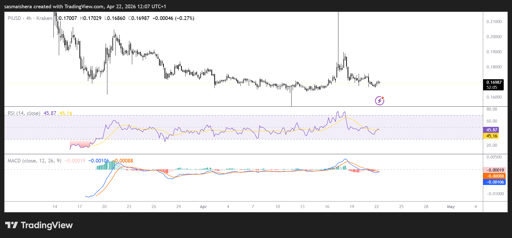
A break below this level would expose fresh lows targeting the February 23 and 11 lows at $0.1556 and $0.1310, respectively.
However, if the bulls regain control, initial resistance emerges at the 50-day EMA at $0.1774.
The 100-day EMA at $0.1858 reinforces a nearby resistance ahead of the falling channel pattern.

PUMP price nears $0.003 as revenue hits a 2026 high: is more upside coming?

Pi Network price drops for a third day: is $0.07 back in play?

XRP is hanging near $1: why traders are bracing for another sharp drop

Dogecoin price flashes a recovery signal as whales quietly buy the dip

Why Ethereum price fell below $1,900 after Sharplink’s $394 million loss
No results found
Loading articles...
Failed to load articles. Please try again.