
Micron rally has more room to run, BofA says as it raises PT; shares rise
AI Sentiment: 82/100 Bullish
This score is generated through AI-driven analysis of the article's content.

powered by

Buy MU. BofA’s higher PT is backed by a real supply squeeze: capex limits, advanced packaging bottlenecks, and power constraints keep memory pricing resilient while AI demand accelerates into 2026. Micron’s 256GB DDR5 sampling (faster, lower power per GB) supports premium “AI-ready” memory, not commodity DRAM. Upside is reinforced by the market still underpricing the AI/high-bandwidth mix (BofA’s split valuation).
Key Risk: AI server spending slows or hyperscalers cut memory upgrade pace, breaking the demand>constrained-supply pricing story.
Buy NVDA. Second-order: as AI data centers expand, they need more bandwidth and memory capacity per server; that increases the value of NVIDIA’s full-stack AI platform (GPUs + networking + systems) because customers buy complete AI infrastructure, not just chips. Micron’s 256GB DDR5 push and resilient pricing signal higher server build rates and faster adoption of next-gen memory configurations—tailwinds for NVIDIA’s system-level demand.
Key Risk: A GPU demand slowdown (or a shift to alternative compute stacks) reduces total AI infrastructure purchases despite memory improvements.
- BofA raised Micron’s price target to $950, citing strong AI memory demand.
- Micron unveiled new 256GB DDR5 modules aimed at improving AI server efficiency.
- Analysts expect AI-related memory demand to outpace supply for several years.
The stock of Micron Technology has been on a stunning rally over the last year, with its share price surging by more than 720% during the period, but Bank of America says it sees more upside.
BofA Securities lifted its price target on Micron MU stock to $950 from $500 while maintaining a Buy rating, reflecting growing optimism around long-term demand for high-performance memory chips used in AI servers and data centers.
The elevated PT represents an almost 19% upside from the level of $800 per share that the Micron stock is currently trading at.
Shares of Micron were trading higher by 4% at market open on Wednesday.
Micron shares have surged over the past year as investors increasingly position for rapid growth in AI-related semiconductor spending.
BofA bets booming demand from artificial intelligence infrastructure will continue to support the sector.
AI demand reshapes memory market
The brokerage said it expects demand for memory products tied to AI computing to continue growing faster than supply over the coming years.
BofA also increased its estimate for the total addressable market for AI data center systems in 2030 to roughly $1.7 trillion, up from a previous forecast of $1.4 trillion.
According to the firm, 2026 is likely to remain a year of accelerating AI revenue growth as cloud providers and enterprise customers continue ramping up infrastructure investments.
The bank added that 2027 could represent a broader turning point for AI efficiency and token economics as next-generation compute and memory architectures scale further across the industry.
BofA said memory pricing is expected to remain resilient because supply growth is being constrained by capital requirements, advanced packaging limitations, and rising power demands.
The firm noted that supply elasticity in the memory market has become structurally lower, creating favorable conditions for memory manufacturers relative to equipment suppliers over the medium term.
Its valuation model assigns approximately $240 per share to Micron’s AI and high-bandwidth memory business using a 27-times calendar year 2027 earnings multiple, while the company’s traditional DRAM and NAND operations are valued at around $710 per share based on historical industry cycle metrics.
Micron unveils advanced AI memory modules
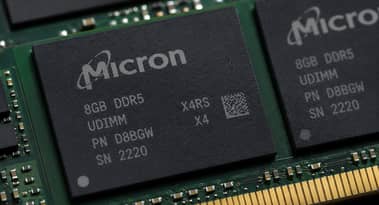
Separately, Micron announced on Tuesday that it has begun sampling 256GB DDR5 memory modules to key ecosystem partners.
The new modules are built using the company’s advanced 1-gamma technology and support speeds of up to 9,200 MT/s, making them more than 40% faster than memory products currently in mass production.
Micron said the modules use advanced 3D stacking and through-silicon via technologies to improve performance, capacity, and energy efficiency for AI workloads.
The company added that one 256GB module can reduce operating power consumption by more than 40% compared with using two 128GB modules, helping lower energy use in AI data centers.
“Capacity, bandwidth, and power are the defining drivers of AI efficiency. With our 256GB DDR5 RDIMM, Micron is enabling servers to deliver significantly higher performance,” said Raj Narasimhan, senior vice president and general manager of the Cloud Memory Business Unit at Micron.
Industry researchers have also turned increasingly positive on the memory-chip sector.
Research firm IDC recently said hyperscale cloud providers are purchasing a more advanced and expensive class of memory products to support AI workloads and are willing to pay premium prices to secure supply.
IDC expects NAND Flash revenue to reach $174 billion in 2026, representing growth of nearly 139% from the prior year, while enterprise SSD pricing continues to rise as hyperscalers lock in supply agreements.

Dell stock soars on blowout earnings, outlook: why analysts see a major rerating

Why OpenAI’s smartest new model could become a headache for Microsoft stock
Micron stock is booming, but Nvidia may have just put a date on the easy money

Nikkei 225 Index analysis as Japan bond yields surge, Softbank stock plunges

KOSPI tumbles despite chip buybacks: how much support can they really provide?
No results found
Loading articles...
Failed to load articles. Please try again.