
Why Nvidia stock is slipping around 3% today
AI Sentiment: 35/100 Bearish
This score is generated through AI-driven analysis of the article's content.

powered by

Buy Nvidia (NVDA). The stock is down ~3% on rotation, but Morgan Stanley’s view is intact: Nvidia has visibility into ~$20B CPU-related revenue opportunities and can improve AI-factory economics (head-node cost is ~half of total cost of ownership). That combination supports a “buy the dip” setup while investors wait for proof—Computex was the first step, not the finish line.
Key Risk: NVDA’s CPU/PC push fails to convert into real, fast-growing revenue and investors conclude the GPU story is the only game left.
Sell AMD (AMD). If investors are rotating within AI hardware, Nvidia’s multi-product expansion (CPU + platform + cost-down narrative) is the clearer path to sustained sentiment. AMD is more exposed to the market’s “prove ROI and adoption speed” debate, and today’s NVDA weakness looks like positioning churn rather than a fundamental break.
Key Risk: AMD gains share with faster, cheaper AI compute wins and the market starts rewarding AMD’s roadmap over Nvidia’s.
- Nvidia shares fell despite major announcements at Computex.
- Investors remain focused on CPUs, memory and networking markets.
- Jensen Huang defends AI spending as highly profitable.
Nvidia NVDA shares remained under pressure on Wednesday, falling around 3% to trade near $216 as investors continued to rotate toward other areas of the artificial intelligence hardware ecosystem.
The decline followed a volatile session on Tuesday when Nvidia shares briefly climbed above $230 before reversing course and ending the day down 0.7%.
While Nvidia remains the dominant force in AI accelerators and graphics processing units, investor enthusiasm has recently shifted toward other segments of the AI infrastructure market, including central processing units, memory chips, and optical networking technologies.
That shift has left Nvidia in an unusual position. The company continues to announce new products and outline major growth opportunities, yet its stock has struggled to match the momentum seen in some other AI-related names.
Computex announcements generate limited enthusiasm
Beyond its traditional GPU business, Nvidia is increasingly attempting to convince investors that its emerging CPU business could become a meaningful growth driver.
At Computex this week, Nvidia unveiled a range of new initiatives, including its RTX Spark AI-focused PC chip platform, which combines the company's graphics technology with a new Arm-based processor architecture.
The announcement was designed to expand Nvidia's reach into the personal computer market, an area historically dominated by Intel, Advanced Micro Devices, and Qualcomm.
However, investors appeared cautious about assigning significant value to the opportunity.
While the PC initiative broadens Nvidia's addressable market, many investors remain focused on the company's data center business, which has been the primary driver of its explosive growth during the AI boom.
Questions also remain about the ultimate size of the premium AI PC market and how quickly adoption could occur compared with the much larger demand environment for data center infrastructure.
As a result, Nvidia's Computex announcements provided only modest support for the stock.
Huang defends AI investment returns
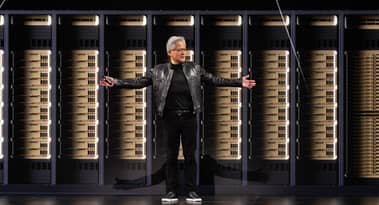
Nvidia Chief Executive Officer Jensen Huang spent much of the week promoting the long-term economic potential of artificial intelligence and addressing concerns surrounding the massive capital expenditures currently being directed toward AI infrastructure.
Huang argued that concerns about AI profitability are increasingly outdated.
According to a Bloomberg report, Huang, speaking at a private event in Taipei attended by investors, financial institutions, and family offices, said returns on AI investments have improved dramatically.
“Only for the last six months has the ROI been completely reset. It is now insanely profitable,” Huang said.
The Nvidia co-founder argued that the technology has already created trillions of dollars in value and suggested that skepticism about AI investment returns is misplaced.
Only "crazy" people would question the returns being generated by AI, Huang said, according to the report.
The comments come as investors continue debating whether the hundreds of billions of dollars being spent annually on AI infrastructure by technology companies will ultimately generate sufficient returns.
Analysts strongly bullish
Morgan Stanley reiterated its Overweight rating on Nvidia with a $288 price target and maintained the stock as its top pick within the processor sector.
The firm said Nvidia remains one of the most attractive valuations across the semiconductor industry and noted the company's growing presence across multiple product categories.
Following management presentations and investor discussions during Computex, Morgan Stanley highlighted Nvidia's expanding CPU opportunity.
According to the firm, company executives indicated that Nvidia now has visibility into approximately $20 billion of CPU-related revenue opportunities.
Morgan Stanley also pointed to Nvidia's efforts to improve the economics of AI infrastructure deployments, noting that roughly half of the total cost of ownership for AI factories is associated with head-node systems.
The firm said Nvidia's ability to demonstrate leadership in reducing those costs could become an important catalyst for investor sentiment over time.
For now, however, investors appear to be waiting for additional evidence that Nvidia's newer businesses can become meaningful contributors alongside its dominant GPU franchise.

Why SpaceX stock is up around 1% on Friday

Should you buy the dip in OKLO stock today?

Analyst: Adobe stock's post-earnings dip isn't about AI disruption fears only

Dow surges 500 points after four-day slide as oil prices retreat

Here’s why the Enbridge stock is in a strong downward trend
No results found
Loading articles...
Failed to load articles. Please try again.