
Amazon's freight push sinks LTL stocks but analysts say investors overreacted
AI Sentiment: 35/100 Bearish
This score is generated through AI-driven analysis of the article's content.

powered by

Buy XPO. The selloff is broad across LTL names, but Amazon’s move is not a like-for-like replacement for XPO’s broader logistics services. If shippers shift some freight to Amazon, it’s likely to be the most commoditized, smaller shipments—where XPO can re-route work into higher-value brokerage/managed transportation and use its network to capture displaced demand. Key risk: Amazon’s scale and tracking reliability quickly convert shippers away from XPO’s service mix, shrinking margins.
Key Risk: Amazon’s freight push quickly captures XPO’s higher-value lanes and forces margin compression.
Sell ODFL. Amazon’s LTL expansion opens a new, tech-forward channel for shippers that historically choose LTL for visibility and reliability—exactly where ODFL competes. If Amazon can win even modest share of mid-size industrial freight, ODFL’s pricing power and volume growth get pressured. Key risk: Amazon’s offering stays mostly “partner-driven” and doesn’t materially take share from ODFL’s core lanes/terminals, so volumes and pricing hold up.
Key Risk: Amazon fails to win meaningful LTL share from ODFL’s core customers, keeping ODFL volumes and pricing stable.
- LTL trucking stocks fell after Amazon opened its freight service to all customers.
- Investors fear rising competition from Amazon's growing logistics network.
- Analysts say established carriers still maintain advantages in density, networks and execution.
Shares of major less-than-truckload (LTL) transportation companies fell on Wednesday.
The decline came after Amazon unveiled a broader expansion of its freight business, raising concerns that the e-commerce giant could become a stronger competitor in the freight and logistics market.
The selloff hit several leading LTL carriers, with Old Dominion Freight Line dropping more than 5%, while XPO, FedEx Freight, Saia, and ArcBest all posted declines ranging between 3% and 4%.
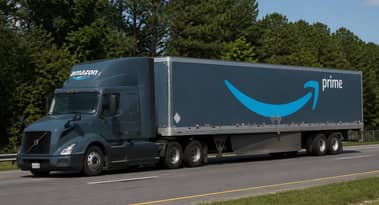
The market reaction followed Amazon's announcement that its less-than-truckload shipping service would now be available to all customers, expanding beyond its existing network of merchants shipping goods into Amazon warehouses.
Amazon broadens freight offering
The expanded service allows customers to move freight shipments ranging from one to six pallets, or between 150 and 15,000 pounds, across a network supported by roughly 80,000 trailers and 24,000 intermodal containers.
LTL shipping serves customers whose freight volumes are too small to fill an entire truck, making it a key segment for manufacturers, distributors, and industrial businesses.
According to Amazon Freight Director Jim Ruiz, demand from existing customers prompted the company to widen access to the service.
"The feedback from Amazon selling partners using our LTL service was clear: The technology, visibility, and reliability were exactly what they needed — and they wanted to use it more broadly," Ruiz said.
The service promises real-time shipment tracking and transportation reliability while offering a cost-effective alternative for customers who do not require full truckload capacity.
Investors react to growing competition
Amazon's ambitions in logistics have long been a source of anxiety for transportation investors.
The company has steadily expanded beyond its original role as an online retailer into warehousing, transportation, and last-mile delivery services.
Earlier this year, Amazon's announcement of its Supply Chain Service platform, which provides warehousing, distribution, and delivery solutions, also weighed on logistics stocks, with UPS shares falling sharply after the news.
The latest expansion raised fresh concerns that Amazon could increasingly compete for freight volumes traditionally handled by established carriers.
Analysts urge caution against overreaction
Despite investor concerns, several analysts argued that the market reaction may have been excessive.
Raymond James analysts said Amazon's scale and continued investment underscore its commitment to becoming a larger force in freight transportation.
"Amazon has an impressive trailer and container scale, and has already transformed the parcel landscape, the analysts say. Its continued expansion efforts demonstrate how serious the company is about the business," they said.
However, the analysts noted that established LTL operators still possess significant advantages, including extensive terminal networks, pickup-and-delivery capabilities, and operational expertise built over decades.
"We believe this is not an immediate fundamental disruption, but the risk of a more meaningful competitive threat over time from Amazon is rising," the analysts said.
Bernstein analyst David Vernon also downplayed the near-term impact, arguing that Amazon's announcement may have generated more concern than the actual capacity being added to the market.
"Headline bigger than capacity on offer," Vernon wrote, adding that Amazon's service would not be directly comparable to the offerings of established carriers.
Industry observers noted that Amazon has been expanding its logistics footprint for years without fundamentally disrupting every segment of the transportation market.
While competition is increasing, freight demand continues to grow, allowing room for multiple players to coexist.

Strategy (MSTR) stock rises 3% as company raises $333M through share sale

AMD stock forms a rare bullish pattern as valuation concerns persist

Alibaba stock rises on report Lingxi Games to be sold for $2B

DRAM: Here’s why this Micron, SanDisk, Western Digital ETF is soaring

Mizuho names the top 2 REITs worth owning in 2026
No results found
Loading articles...
Failed to load articles. Please try again.