
Aster price explodes as the DEX directs 99% of platform fees to token buybacks

AI Sentiment: 78/100 Bullish
This score is generated through AI-driven analysis of the article's content.

powered by

Buy ASTER. The protocol is routing up to 99% of platform fees into open-market token buybacks, with $100M–$200M already repurchased and 170M+ tokens burned. That creates steady, volume-linked demand: higher DEX activity directly funds more buy pressure. Elevated daily volume (~$349M) supports the fee base, making the buyback engine more likely to keep running through volatility.
Key Risk: A drop in platform trading volume (or fee revenue) that starves buybacks, while token unlocks still dilute supply.
Buy ASTER and sell short-term ASTER volatility via a tight-risk approach: sell ASTER call spreads (or buy ASTER puts) into the current hype. The news is bullish, but the article flags extreme volatility and pullbacks despite buybacks. You want to monetize the gap between “structural demand” and “price swings” as traders chase the narrative.
Key Risk: A sustained breakout that keeps ASTER trending up with rising spot demand, making downside hedges/short volatility lose money.
- ASTER price has jumped 16.5% with trading volume rising to $349 million.
- Up to 99% of Aster fees will be used to fund buybacks and token burns.
- The token price stays volatile despite strong buyback-driven demand.
ASTER price has moved sharply higher after renewed attention on its aggressive fee allocation model, where nearly all platform revenue is being funnelled into token buybacks.
The token surged above $0.80 on Binance before pulling back slightly to around $0.732 at press time.
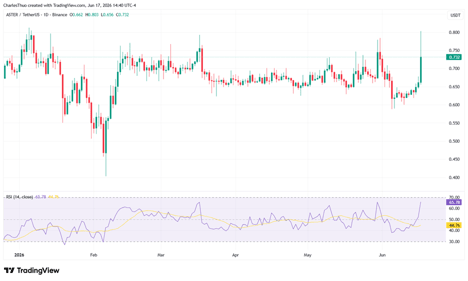
Trading activity has also picked up meaningfully, with daily volume climbing to roughly $349 million, reflecting increased participation from both spot traders and short-term speculators reacting to the latest updates around the protocol’s fee structure.
Buyback model drives market attention
At the centre of the recent price move is a new fee allocation system announced by Aster on June 17.
The protocol announced that up to 99% of platform-generated fees will be directed toward ASTER token buybacks, depending on the phase of implementation.
These buybacks are executed in the open market, with purchased tokens either removed from circulation through burning or allocated to structured reserves depending on program design.
Across reported program phases, more than $100 million to $200 million worth of tokens have already been repurchased, with over 170 million tokens burned in earlier cycles.
The mechanism ties platform activity directly to token demand, meaning higher trading activity translates into higher buy pressure in the market.
This structure has also evolved over time.
Earlier phases used periodic buyback batches, while later stages shifted toward more continuous execution, with a portion of daily fees automatically routed into purchases.
This change has made buyback activity more consistent, rather than dependent on isolated execution periods.
ASTER price reaction shows strength, but also volatility
Despite the aggressive buyback model, price movement has remained highly volatile.
ASTER is still trading well below its previous peak of $2.41, recorded in September 2025, leaving the token roughly 68% below its all-time high.
On the other hand, it has recovered significantly from its low near $0.0997, marking gains of more than 600% from that level.
The token’s recent strength comes as trading volume remains elevated, but market conditions continue to play a dominant role in direction.
Even with steady buybacks in place, ASTER has experienced sharp swings when broader market sentiment weakens or when liquidity conditions tighten.
Analysts tracking the token note that buybacks provide structural demand, but they do not fully offset external pressure from macro trends or token unlock dynamics.
A significant portion of ASTER’s supply remains subject to future release schedules, which can temporarily dilute the effect of buy-side activity during weaker market periods.
Supply structure and trading activity shape outlook
Total ASTER supply stands at just under 8 billion tokens, with a large share not yet in active circulation.
This creates a dynamic where ongoing buybacks are competing against future unlocks and existing holders adjusting positions during periods of volatility.
At the same time, platform usage remains a key support factor.
Aster’s total value locked stands at approximately $856 million, while daily trading activity continues to generate the fee base required to sustain buyback operations.
The relationship between volume and token demand remains direct, as fee generation determines how aggressively the protocol can continue purchasing tokens from the market.
The combination of strong trading activity and structured buybacks has helped maintain interest in ASTER, even during periods of broader market weakness.
However, price behaviour continues to reflect a balance between buyback-driven demand and the broader liquidity cycle in the crypto market.

Is Ethereum price at risk of losing $2,400 as oil tops $105?

Cardano slides 3% as futures volume declines to $652M

Bitcoin is flashing a warning near $78,000: is the market missing it?

Ethereum falls below $2,500: is this pullback setting up the next ETH surge?

Solana price at risk of falling below $100 as bearish momentum builds
No results found
Loading articles...
Failed to load articles. Please try again.