
Intel stock in focus after Trump confirms company to build chips for Apple
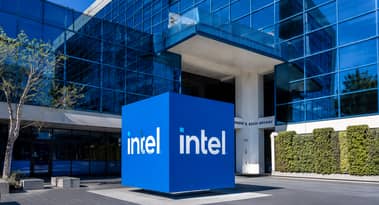
AI Sentiment: 78/100 Bullish
This score is generated through AI-driven analysis of the article's content.

powered by

Buy INTC. Trump’s confirmation that Apple will design/build chips with Intel is the clearest “foundry credibility” signal yet, turning Intel’s second-source story into real customer validation. It also adds demand visibility beyond Intel’s own chips, while AI/data-center capacity constraints keep pressure on alternative manufacturing. The 18A-P risk-production milestone supports the idea Intel can actually execute on advanced nodes.
Key Risk: Apple decides to delay or shrink the Intel foundry scope because yields/costs don’t meet its standards.
Buy NVDA. If Apple adds Intel as a second manufacturing outlet, it doesn’t remove the broader AI/compute bottleneck; it reallocates some “advanced capacity” pressure. The bigger second-order effect is that any credibility gain for US-based/alternative foundries increases overall willingness to fund more compute buildouts, keeping demand for GPUs and AI systems strong while TSMC remains the default for most leading-edge production.
Key Risk: AI capex slows or NVDA’s supply chain shifts enough that GPU demand growth decelerates faster than the market expects.
- Intel jumps after Trump says Apple will make chips with the company.
- Partnership would mark a major boost for Intel's foundry ambitions.
- Apple could gain additional manufacturing capacity beyond TSMC.
Shares of Intel rose on Thursday after US President Donald Trump said Apple had agreed to work with the chipmaker to design and manufacture chips in the United States, potentially handing Intel's foundry ambitions their biggest endorsement yet.
Intel shares were up about 2.7% in after-hours trading at the time of writing, after gaining as much as 5.7% in overnight trading following Trump's comments.
"First, we helped bring in Nvidia, and they agreed to build their first level Chips with Intel. Next, Elon agreed to build his TerraFab, the largest Chip Factory in the World, designed together with Intel’s Technology team. And, finally, Apple has agreed to work with Intel to design and build its Chips in America," Trump said in a post on Truth Social.
A major vote of confidence for Intel's foundry business
An Apple contract would represent the most notable validation yet of Intel's effort to transform itself into a contract manufacturer for other chip companies.
The Wall Street Journal reported in May that Intel had reached a preliminary agreement to manufacture some chips for Apple after more than a year of discussions.
The report had sent Intel's shares up by about 15%.
The partnership would provide Intel with steady demand from one of the world's largest consumer electronics companies while enhancing the credibility of a foundry business that has struggled to compete with industry leader Taiwan Semiconductor Manufacturing Co.
The deal would also mark a reunion between the two companies, years after Apple abandoned Intel-designed processors for Mac computers and shifted to its own custom silicon.
Over the past year, Intel has signed agreements with the US government and secured investments from companies including Nvidia and SoftBank as Chief Executive Lip-Bu Tan works to revive the company's fortunes.
Jim Cramer reiterates bullishness on Intel
Separately, CNBC's Jim Cramer said on Wednesday that Intel's rally may still have further room to run despite the stock's sharp gains this year.
"Which stock do you want to buy? I told Club members the answer is my new favorite stock in this market: Intel," Cramer said during the CNBC Investing Club's monthly meeting.
"I don't want to throw away the discipline of not touching a stock that's rallied like crazy, but when it comes to tech hardware that's connected to the data center, I think you may not have a choice," he said.
Cramer argued that investors should focus on future growth prospects rather than the stock's recent gains.
"You can't afford to care about where these stocks have been. You should only care about where they're going. When it comes to Intel, I think the answer is up."
He also pointed to the rapid buildout of AI infrastructure, saying demand for processors could outstrip supply and give chipmakers greater pricing power.
"There's a revolution going on, and this revolution requires as many CPUs as possible," Cramer said.
Cramer further highlighted Intel's foundry business, saying that surging AI spending and capacity constraints at Taiwan Semiconductor Manufacturing Co. could drive more chip designers toward alternative suppliers, particularly those seeking US-based manufacturing capabilities.
Apple seeks additional manufacturing capacity
For Apple, an agreement with Intel could help diversify its manufacturing footprint at a time when demand for advanced chip production remains exceptionally strong.
The iPhone maker relies heavily on TSMC, whose cutting-edge manufacturing lines are in high demand from artificial intelligence chip developers, including Nvidia and AMD.
Apple has also accelerated its in-house silicon efforts in recent years, designing most of the key chips that power iPhones, Macs, and other devices.
According to Creative Strategies analyst Ben Bajarin, Apple is TSMC's second-largest customer behind Nvidia.
"Intel is the only place that can scale up capacity as a viable second source," Bajarin said in comments reported by CNBC last month.
Manufacturing advances support Intel's turnaround
Intel's foundry business had long been plagued by manufacturing delays and concerns over production yields, raising doubts about its ability to make chips for outside customers.
For now, Intel remains the primary customer of its own foundry operations, producing processors and other chips for its internal product lines.
Bajarin, however, believes the company has moved beyond its most difficult period.
"They've got through the rough patch and can now be considered validated as a credible second source," he said.
The Apple news comes shortly after Intel unveiled its new 18A-P manufacturing process, which the company said delivers up to 9% higher performance, 18% lower power consumption, and between 20% and 40% better thermal resistance than its existing 18A process.
Intel said the 18A-P process has entered risk production, a low-volume manufacturing phase in which full wafers are produced to assess defect rates, performance, and manufacturing variability before full-scale production begins.
Investor enthusiasm around the company's turnaround efforts has already driven Intel's stock up more than 205% this year, with an Apple partnership potentially providing another catalyst for the chipmaker's manufacturing ambitions.

FTSE 100 slides as Fed outlook and sector losses weigh on markets

Dow futures jump 315 points: 5 things to know before Wall Street opens

Here’s why Barclays, NatWest, Lloyds shares are pumping this week
Micron stock in focus: can HBM demand unlock another 60% rally?

Nikkei tops 71,000 as Asian markets shrug off US-Iran deal risks
No results found
Loading articles...
Failed to load articles. Please try again.