
Gold likely to extend losses as Fed hawkish stance dominates

AI Sentiment: 12/100 Bearish
This score is generated through AI-driven analysis of the article's content.

powered by

Short XAU/USD (gold vs USD). The Fed’s hawkish pivot is dominating: FedWatch puts a December hike at 87%, the dollar is near a one-year high, and gold keeps failing to reclaim the 100-day EMA. Momentum is bearish (RSI ~36, MACD negative), so rallies likely get sold until gold can close above the 200-day EMA (~$4,399).
Key Risk: A clear dovish turn from the Fed (or a sharp inflation drop) that forces rate-cut expectations back up, triggering a sustained gold rebound.
Sell COMEX August gold futures. The article shows COMEX already broke down (Aug contract down ~2.3% to ~$4,147) and the market is pricing tighter policy later this year. With technical resistance overhead (~$4,399) and momentum-driven selling, futures should keep underperforming spot on any hawkish headlines.
Key Risk: Geopolitical shock that directly threatens physical supply (not just “easing tensions”), causing a fast safe-haven bid that overwhelms the rate narrative.
- Gold set for third weekly loss, pressured by Fed signals.
- Technical charts show RSI at 36, MACD negative,
- Outlook points to selling unless bulls reclaim key levels.
Gold is heading for its third consecutive weekly loss as a stronger US dollar and hawkish signals from the Federal Reserve overshadow optimism from the recent US-Iran peace deal.
Both spot prices and the contract on COMEX slipped below $4,190 per ounce on Friday, with traders bracing for tighter monetary policy under new Fed Chair Kevin Warsh.
Gold has struggled to hold ground despite easing geopolitical tensions, as the Fed’s stance has shifted market expectations toward higher rates later this year.
Fed’s hawkish stance dominates sentiment
At his first policy meeting, Warsh underscored the Fed’s determination to keep inflation under control, even as oil prices fell following the interim ceasefire between Washington and Tehran.
While the central bank left rates unchanged in the 3.50%–3.75% band, projections showed nine of nineteen policymakers now expect at least one hike in 2026.
According to CME’s FedWatch tool, traders have raised the probability of a December hike to 87%, up sharply from 61% before the meeting.
Bloomberg noted in a report that Warsh’s hawkish tone has “neutralised the geopolitical tailwind” that had briefly supported gold after the Hormuz reopening.
The dollar’s strength has been a key factor in bullion’s decline. The greenback hovered near a one‑year high, making dollar‑denominated gold more expensive for overseas buyers.
This has eroded demand, particularly in Asia, where markets in China and Hong Kong were closed for the Dragon Boat Festival holiday, limiting trading volumes.
The futures for August delivery on COMEX dropped 2.3% to $4,147.15 an ounce, while silver slipped 4.3% to $63.470 per ounce, with platinum and palladium also posting losses.
Analysts trim forecasts as pressure builds
Analysts have been quick to adjust their forecasts in light of the Fed’s hawkish pivot.
Goldman Sachs trimmed its year‑end target for gold to $4,900 per ounce, down from $5,400, citing expectations that the Fed will not cut rates in 2026.
The bank argued that while geopolitical risks remain, the overriding factor is the Fed’s determination to keep inflation in check.
Tim Waterer, chief market analyst at KCM Trade, told Reuters that Warsh’s stance has reminded investors that “monetary policy still calls the shots,” even as peace talks in the Middle East ease some supply concerns.
The reopening of the Strait of Hormuz, where an LNG tanker sailed this week under the ceasefire agreement, has reduced immediate inflation fears by lowering oil prices.
Yet the relief has been overshadowed by the Fed’s hawkish pivot.
Traders now see monetary policy as the dominant driver of gold, with geopolitical developments offering only temporary support.
Outlook: Technical weakness reinforces downside bias
From a technical perspective, this week’s repeated failures to break out through the 100‑day Exponential Moving Average (EMA) and the subsequent slide favor gold bears, according to FXStreet.com.
The Relative Strength Index (RSI) hovers near 36, reflecting weak demand rather than outright oversold conditions.
Meanwhile, the Moving Average Convergence Divergence (MACD) indicator remains in negative territory, with the line below its signal and a subdued histogram, suggesting ongoing downside pressure.
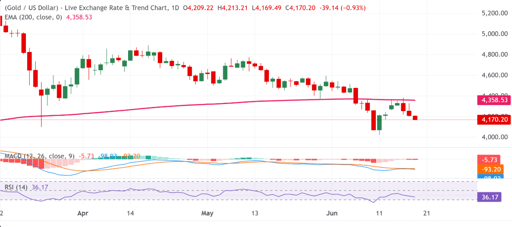
FXStreet added that the 200‑day EMA at $4,398.58 is the first meaningful resistance, and bulls would need a daily close above this level to ease the current downside bias and hint at a more sustained recovery phase.
Until then, the XAU/USD (gold/dollar) pair remains vulnerable to further declines, with fresh selling likely to be driven by momentum rather than interaction with a specific technical floor on the daily chart.
With the dollar firm and Fed policymakers leaning toward tightening, gold is likely to stay under pressure in the near term.
Traders are bracing for volatility around upcoming central bank meetings, particularly if Warsh reinforces his hawkish message.
While geopolitical developments such as the US–Iran pact may provide intermittent support, the overriding narrative is monetary policy.
Unless inflation eases more sharply than expected, bullion faces the prospect of extending its losing streak into July.

Gold slips from three-month high as PCE puts the $5,000 trade on trial

Oil drops 6% in two sessions as Hormuz diplomacy rewrites the risk premium

Gold rally explodes past $4,668 as dollar debasement fears return

Oil rebounds as US squeezes Iran, but China may decide how hard sanctions bite

India opens sugar imports as prices climb: Where are global sugar prices headed?
No results found
Loading articles...
Failed to load articles. Please try again.