
Micron rescues AI trade as blockbuster earnings spark global chip rally
AI Sentiment: 82/100 Bullish
This score is generated through AI-driven analysis of the article's content.

powered by

Buy MU. Blockbuster earnings (record revenue, gross margin, earnings) plus 16 strategic multi-year customer agreements and large customer commitments for high-bandwidth memory signal AI demand is shifting from “buy more” to “lock in scarce supply.” That supports sustained pricing power and reduces near-term boom-bust risk in memory for AI workloads.
Key Risk: AI customers cancel or delay memory build-outs, turning supply commitments into excess inventory and margin compression.
Buy ASML. Micron’s message that tight supply can extend beyond 2027 implies continued capex intensity across the memory/logic stack. That flows into leading-edge lithography demand and backlog durability, benefiting ASML as the bottleneck supplier when fabs keep upgrading for AI-driven capacity.
Key Risk: AI capex slows sharply and fabs defer leading-edge upgrades, shrinking ASML order growth and backlog conversion.
- Micron said it has secured $22 billion in customer commitments, easing concerns.
- Qualcomm raised its long-term data-center revenue target to $15 billion.
- Chip stocks rally globally and indices get a boost with eyes now on PCE data.
A blockbuster earnings report from Micron Technology NASDAQ:MU breathed fresh life into the artificial intelligence trade on Thursday, sending semiconductor stocks surging globally and temporarily easing investor concerns over stretched valuations and the enormous costs associated with building AI infrastructure.
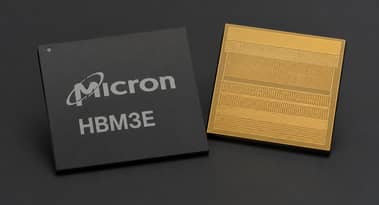
Micron shares rose 16% in premarket trading after the company reported record quarterly revenue, record gross margins and record earnings, while also unveiling long-term agreements designed to lock in supplies of its high-bandwidth memory chips.
The upbeat report helped reverse a recent pullback in technology stocks that had been triggered by concerns that years of blistering gains in AI-related shares had pushed valuations to uncomfortable levels.
Investor worries had also mounted over whether hundreds of billions of dollars being invested in AI infrastructure would generate returns quickly enough to justify the spending.
Micron's results show demand for AI hardware remains strong
Micron's results suggested demand for AI hardware remains exceptionally strong.
The company, the only US-based producer of high-bandwidth memory chips used alongside Nvidia's AI processors, said customers had committed $22 billion (approx. R 376,6 billion) to secure supplies of memory chips.
For an industry historically characterised by pronounced boom-and-bust cycles, analysts said the commitments represent an important shift.
Micron also announced it had signed 16 strategic customer agreements aimed at securing supply relationships over several years.
AI customers are no longer simply buying more memory chips.
Increasingly, they are attempting to guarantee access to scarce components viewed as critical to future computing infrastructure.
"The sun is shining again, as Micron's earnings announcement after the US close went very well," Swissquote senior analyst Ipek Ozkardeskaya said in an email.
She added that the earnings beat had improved sentiment across AI and technology stocks.
The company also outlined plans to increase capital expenditure, but investors appeared willing to overlook concerns about higher spending in light of the strength of demand.
Qualcomm adds to optimism
The positive sentiment was reinforced by Qualcomm.
Shares of Qualcomm climbed about 12% in premarket trading after the company forecast that its data-centre business could generate $15 billion (approx. R 256,8 billion) in revenue by 2029.
Chief Financial Officer and Chief Operating Officer Akash Palkhiwala also raised Qualcomm's fiscal 2029 revenue target for its non-handset businesses to $40 billion (approx. R 684,8 billion) from $22 billion (approx. R 376,6 billion).
The forecasts added to growing confidence that AI-related demand is broadening beyond a handful of companies and increasingly supporting a wider technology ecosystem.
Global chip stocks surge, pulling indices higher
The rally spread rapidly through global markets.
In South Korea, Samsung Electronics rose 5.3%, while rival SK Hynix surged more than 13%.
The gains helped propel the benchmark KOSPI index more than 5% higher as the world's best-performing major stock market this year continued its volatile, retail-driven AI rally.
"Micron's earnings offered confidence, or relief that blistering profit growth is yet to reach an end," said Huh Jae-hwan, analyst at Eugene Investment Securities.
Japanese equities also benefited, with the Nikkei 225 climbing 4.6% to a record closing high of 72,366.34.
European semiconductor companies joined the advance after Micron indicated that tight chip supplies could extend beyond 2027.
Shares of Dutch semiconductor equipment maker ASML Holding rose 5.1%, while ASM International gained 6.6%.
BE Semiconductor Industries advanced 5.5%, Germany's Infineon Technologies added 5.6%, and STMicroelectronics climbed 4%.
Nasdaq futures rose more than 2% as investors rotated back into technology stocks.
Despite Thursday's rebound, the Nasdaq remained on track for its largest monthly decline since March 2025, while the Philadelphia Semiconductor Index was headed for its worst week since the Middle East conflict escalated earlier this year.
Inflation remains a risk
Investors are now turning their attention to the latest release of the Personal Consumption Expenditures Price Index, the Federal Reserve's preferred measure of inflation.
Markets have been unsettled by expectations that the Federal Reserve could still raise interest rates this year after recent inflation data came in hotter than expected.
"The main question is less whether both headline and core go up—they are widely expected to—but rather how 'stale' these numbers already are," Mohamed El-Erian, Rene M. Kern Professor of Practice at the Wharton School and Lauder Senior Global Fellow at the University of Pennsylvania, said in a post on X.
"These numbers come before the recent sharp fall in oil prices, which will result in lower headline inflation and ease some of the pressures on core. The question being debated is by how much, including whether May will prove to be the peak inflation month," he added.
For now, Micron's results have reminded investors that despite concerns about valuations and spending, demand for AI infrastructure shows few signs of slowing.

Nasdaq futures skyrocket 650 points: 5 things to know before Wall Street opens

Why IAG and Rolls-Royce shares are surging this month

FTSE edges higher as retail and financial stocks lift London markets

Qualcomm wants $15 billion from data centres as phone-chip era shifts

Gold hits 7-month low: 3 'strong buy' stocks with 100%+ upside potential
No results found
Loading articles...
Failed to load articles. Please try again.
