
Silver’s rebound hopes fade as dollar strength turns $57 into resistance

AI Sentiment: 18/100 Bearish
This score is generated through AI-driven analysis of the article's content.

powered by

Buy the dollar because rate-hike expectations are the main driver and the dollar index is holding near highs. A stronger dollar mechanically weighs on silver and other dollar-priced commodities, reinforcing the silver downtrend. Use UUP as the cleanest expression.
Key Risk: Fed messaging flips to clear-cut easing (or inflation breaks sharply lower), causing the dollar to unwind.
Sell silver because the Fed is being repriced toward at least one hike and the dollar is near a one-year high—both directly pressure non-yielding, dollar-priced silver. The chart is also weak: silver is far below the 20-EMA (~$65.82) and rallies are likely to be sold until it reclaims ~$61.01. Execute via short SI futures or short SLV.
Key Risk: Core inflation suddenly drops fast enough to force the market back to rate cuts, sending the dollar lower and silver higher.
- Silver sinks near $56.50 as Fed rate bets trump lower oil prices in Asia.
- Core PCE at 3.4% keeps Fed pressure high as XAG/USD bears stay in charge.
- Strong dollar and weak charts leave silver exposed below $61 resistance.
Silver’s selloff is becoming a cleaner bet on tighter US policy.
The metal fell to around $56.50 an ounce in Asian trade on Friday, extending a sharp retreat as investors focused less on easing oil prices and more on stubborn inflation.
The latest US core PCE reading kept price pressures above the Federal Reserve’s comfort zone, while a firm dollar made the metal more expensive for overseas buyers.
For a market that offers no yield, that is a difficult mix.
Lower energy prices may help later, but traders are dealing with a Fed that still sounds uncomfortable with inflation today.
Fed repricing drives the selloff
The main pressure on silver is coming from the rates market.
Investors now expect the Fed to deliver at least one increase this year, a sharp reversal from earlier expectations that the next move would be a cut.
That shift followed a run of inflation data showing price pressures have not cooled enough.
Core PCE, the Fed’s preferred underlying inflation gauge, rose to 3.4% year-on-year in May from 3.3% in April, matching expectations but staying well above the 2% target.
New York Fed President John Williams also gave traders little reason to expect quick relief.
His message was that policy is already restrictive enough to lean against inflation, but that price pressures are still too high and may not return to target before 2028.
Dollar strength adds to the strain
The US dollar has become another drag on silver.
The dollar index has held near a one-year high, supported by the same rate-hike expectations that are weighing on precious metals.
That matters because silver is priced in dollars.
When the greenback strengthens, the metal becomes more expensive for buyers using other currencies, weakening demand from global investors and industrial users.
The move has also reduced the benefit from falling oil prices. Progress in US-Iran diplomacy has pulled crude back from conflict-driven highs, easing one source of inflation pressure.
But traders are not yet convinced that cheaper energy will be enough to change the Fed’s near-term stance.
Technical picture remains fragile
The chart still favours sellers. Silver is trading well below its 20-period exponential moving average near $65.82, keeping rallies vulnerable to fresh selling unless the metal can reclaim that area.
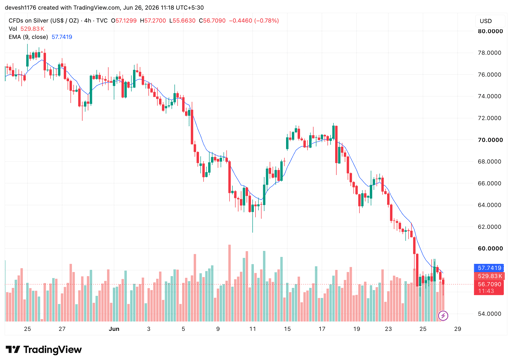
Source: TradingView
Momentum indicators are stretched, with the relative strength index in oversold territory.
That suggests the pace of selling could slow and leave room for short corrective bounces. It does not yet confirm a trend reversal.
The first important support sits near $55.63, followed by $53.35. A break below that zone would expose the psychological $50 level.
On the upside, $61.01 is the first serious hurdle before the market can even begin to challenge the broader downtrend.

Amos Hochstein dubs oil prices 'wrong and too low': find out more

Gold price forecast: Oil and US bond yields rally ahead of FOMC
Brent nears $108 after Saudi pipeline hit: why $120 oil is back on the table

WTI crude oil price forecast as Middle East risks remain elevated: can it hit $120?
Here’s why Brent crude oil price is falling today and what's next
No results found
Loading articles...
Failed to load articles. Please try again.