
South Korean shares slump 5.2% as AI valuation concerns trigger chip stock selloff
AI Sentiment: 18/100 Bearish
This score is generated through AI-driven analysis of the article's content.

powered by

Buy the dip. Despite the -3.59% drop, SK Hynix is the clearest beneficiary of the AI supply chain (HBM) and the won strength plus the planned US share sale should support liquidity and investor focus. The early +5.8% move that reversed suggests positioning is still fragile, but that also creates a better entry if the selloff is valuation-driven rather than demand-driven. Key risk: AI memory demand weakens or HBM pricing/shipments disappoint, making valuation fears turn into real earnings damage.
Key Risk: HBM/AI memory demand or pricing disappoints, turning valuation worries into earnings damage.
Sell/avoid new longs. The article shows AI-valuation fears hitting semis hard (Samsung -6.25%) and both Samsung and SK Hynix reversed after early gains—classic “relief rally” failure. With KOSPI now >20% off highs and volatility controls triggered, downside momentum is likely to persist until valuation concerns cool. Key risk: AI spending expectations re-accelerate and earnings visibility improves fast enough to force a sharp re-rating of Samsung and the whole Korea chip complex.
Key Risk: AI earnings visibility improves quickly and forces a fast re-rating of Korean chip stocks.
- KOSPI entered bear market territory after extending losses for a third session.
- Chip stocks declined as investors questioned sustainability.
- Officials pledged close monitoring as ETF concerns added market volatility.
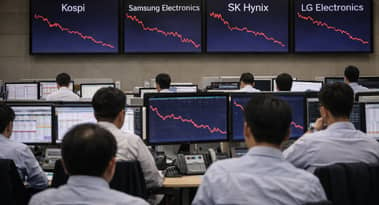
South Korean shares fell sharply for a third consecutive session on Wednesday, with heavy losses in semiconductor stocks and growing concerns over AI-related valuations dragging the benchmark index into bear market territory.
The sharp decline followed an early rebound in the session.
Samsung Electronics rose as much as 1.4% during morning trading, while SK Hynix gained up to 5.8% before both stocks reversed course.
Market volatility was further amplified by concerns surrounding recently introduced leveraged exchange-traded funds linked to chipmaker stocks.
KOSPI falls more than 20% from record high
The benchmark KOSPI fell 395.76 points, or 5.17%, to 7,260.55 as of 0519 GMT.
The decline left the index more than 20% below its record closing high of 9,114.55 reached on June 22, a threshold commonly regarded as confirmation that a market has entered bearish territory.
Trading remained highly volatile throughout the session.
The KOSPI opened lower before recovering to trade as much as 1.8% higher.
However, the rebound proved short-lived, with the index reversing course to decline by as much as 5.3%.
The sharp intraday move triggered a sidecar trading curb, temporarily halting algorithmic trading to help stabilize market conditions.
Chipmakers lead declines after US semiconductor selloff
Semiconductor stocks remained at the center of the market decline following a sharp overnight sell-off in US chip shares.
Samsung Electronics fell 6.25%, while SK Hynix declined 3.59%.
The weakness followed a 4.7% drop in the Philadelphia Semiconductor Index as investors questioned whether spending on AI infrastructure could continue at its recent pace.
The broader pressure on Seoul's market reflected growing scrutiny of AI-related valuations, with investors increasingly focusing on whether future earnings can justify the sector's strong rally.
The government monitors market risks
South Korea's Finance Minister Koo Yun-cheol said authorities would closely monitor risk factors that could increase stock market volatility.
The comments came amid concerns over newly introduced single-stock leveraged ETFs tied to semiconductor companies.
The latest decline follows Tuesday's 4.9% fall in the KOSPI, which triggered a circuit breaker for the sixth time this year and the 12th time in the market's history.
Large swings in heavyweight semiconductor stocks have remained a key source of market instability.
Deputy Finance Minister Moon Ji-sung said supply and demand dynamics in the dollar-won market were expected to improve during the second half of the year.
According to Moon, pressure from foreign investor profit-taking and portfolio rebalancing should ease going forward.
He also pointed to expected demand for the South Korean won stemming from SK Hynix's planned US share sale, which is expected to be among the world's largest new equity offerings.
Foreign selling slows as the won strengthens
Foreign investors remained net sellers, offloading shares worth 487 billion won ($323.18 million).
However, the scale of selling was notably smaller than in recent sessions, when daily outflows reached the trillion-won level.
Meanwhile, the South Korean won strengthened 0.5% to 1,508.4 per US dollar on the onshore settlement platform after touching 1,505.2 earlier in the session, its strongest level since June 15.
Despite optimism surrounding SK Hynix's planned US listing, which has supported investor interest in high-bandwidth memory and AI-related supply chains, sentiment remained dominated by concerns over semiconductor valuations.

Navitas stock is falling 9% today: what’s spooking investors?

Oracle’s record backlog is booming, so why is the stock down 50%?

Apple price hikes unlikely to hurt demand, JPMorgan says as it raises PT

JPMorgan says Tesla-SpaceX merger idea has logic: is TSLA a buy now?

Hang Seng Index rallies as Alibaba, Tencent, Lenovo shares surge
No results found
Loading articles...
Failed to load articles. Please try again.
