
Bitcoin price outlook: treasury sell-offs, Poolin bankruptcy and $1.2B options expiry

AI Sentiment: 28/100 Bearish
This score is generated through AI-driven analysis of the article's content.

powered by

Buy BTC. The news is net supply (treasury sell-offs + Poolin stress), but price is holding a tight range around $65k and the CLARITY Act progress is a real offset. With ~$1.2B options expiring and “maximum pain” near $64,500, the market is likely to pin/mean-revert rather than trend down hard. Entry: buy near $64.5k–$65k; add only if it holds above ~$62.2k support.
Key Risk: A clean break below ~$62,210 that turns treasury selling + mining stress into a sustained liquidation wave.
Sell MSTR. The article says MSTR hasn’t bought BTC in the last four weeks and raised cash by selling stock—classic balance-sheet defense. That removes the “buy-the-dip” catalyst while the stock still trades like a BTC proxy, so it’s exposed to BTC downside and to equity-specific dilution/financing fears.
Key Risk: MSTR resumes aggressive BTC buying or the stock decouples upward on a strong risk-on move in BTC.
- Bitcoin held near $65K despite rising market pressure.
- Poolin's bankruptcy renewed concerns over mining firms.
- $1.2B BTC options expiry raised short-term volatility.
Bitcoin traded near $64,900 on Friday after another eventful week for the cryptocurrency market.
BTC's price remained close to the $65,000 mark amid corporate selling, fresh signs of stress in the mining sector, and a major options expiry.
Treasury companies face tightening financing conditions
One of the biggest themes influencing Bitcoin this week has been the growing pressure on publicly listed companies that built their business strategy around accumulating BTC.
Several Bitcoin treasury firms, including Satsuma Technology (SATS) and Smarter Web Company (SWC), have begun reducing their holdings or restructuring their finances after a prolonged decline in both Bitcoin and their own share prices made raising fresh capital more difficult.
List of DATs who have abandoned Bitcoin and crypto accumulation strategies since:
— matthew sigel, recovering CFA (@matthew_sigel) July 23, 2026
🔴 Full Liquidations / Complete Exits
Satsuma Technology (SATS LN) — Shareholders voted on July 21, 2026 (>>90% approval) to liquid all 668 BTC (~$43.5M), return capital to investors, and delist… https://t.co/JEDlsnbjEJ
Rather than continuing to add to their Bitcoin reserves, some companies have opted to sell part of their holdings to repay debt and strengthen their balance sheets.
Strategy (formerly known as Microstrategy), the company that holds the most Bitcoins, hasn't purchased any of the top cryptocurrency in the last four weeks. The company, in this period, sold stocks to increase its cash reserves to $3.2 billion.
The shift comes after Bitcoin fell sharply from its all-time high of $126,080, recorded in October 2025.
Even with the recent recovery, the cryptocurrency remains roughly 48.4% below that record level.
The changing environment has also prompted some firms to diversify beyond Bitcoin-focused strategies.
Instead of relying primarily on digital asset accumulation or mining, several companies are redirecting resources toward artificial intelligence (AI) and high-performance computing (HPC), sectors viewed as offering more stable revenue opportunities under current market conditions.
For traders, treasury-related selling introduces additional supply into the market at a time when sentiment is still recovering from last year's correction.
Poolin bankruptcy filing highlights continued mining industry stress
The mining sector also came under renewed scrutiny after Poolin, once one of the world's largest Bitcoin mining pools, filed for Chapter 11 bankruptcy protection in the United States.
At its peak, Poolin controlled close to one-fifth of Bitcoin's global mining power, making it one of the industry's most influential operators.
The bankruptcy filing lists liabilities estimated between $100 million and $500 million, with reported debt of around $173 million and between 10,001 and 25,000 creditors.
The restructuring process includes plans to sell mining assets in West Texas through a proposed $52 million stalking-horse bid.
CLARITY Act progress offsets negative headlines
Despite these challenges, Bitcoin avoided a deeper sell-off as investors continued to monitor regulatory developments in the United States.
Market sentiment received support from progress surrounding the CLARITY Act, legislation designed to establish a clearer regulatory framework for digital assets.
A more defined regulatory environment has remained one of the key issues for institutional investors seeking greater certainty before expanding their exposure to cryptocurrencies.
The positive regulatory backdrop helped offset concerns created by several high-profile security breaches across the digital asset industry earlier in the week.
Although those incidents affected confidence across parts of the crypto market, Bitcoin continued to trade within a relatively stable range.
Broader macroeconomic developments also had a limited impact on price action.
Even as oil prices moved higher and briefly raised concerns about inflation and risk assets, Bitcoin held near the $65,000 level rather than experiencing heavy liquidation.
Bitcoin price analysis and prediction
At press time, Bitcoin traded at $64,923.86, down 0.7% over the past 24 hours.
According to Greeks live data, approximately 19,000 Bitcoin options worth $1.2 billion will expire on July 24, with a put-call ratio of 0.89 and maximum pain at $64,500.
Large expiries often increase short-term volatility as traders close positions or adjust hedges around key strike prices.
But even with those pressures, Bitcoin continued trading within its daily range of $64,623.60 to $65,744.76, suggesting that bulls and bears remained closely matched around current levels.
On a broader timeframe, Bitcoin is up 2.9% over the past seven days and 4.2% over the last 30 days, indicating that the recent recovery remains intact despite this week's pullback.
However, the asset is still trading well below its October 2025 peak.
In the near term, traders should watch whether Bitcoin can maintain support above $62,210, the lower end of its latest 24-hour trading range.
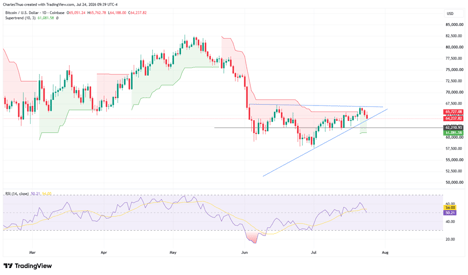
Holding above that support could allow the cryptocurrency to challenge resistance near $65,700 again.
However, a break below the support may invite additional volatility as the market absorbs the effects of corporate treasury sales and the latest options expiry while continuing to assess the impact of regulatory developments in the United States.

Strategy, Coinbase stocks rally as Bitcoin reclaims $80,000

Bitcoin reclaims $80K as Fed rate-hike odds fall on Fed Governor's comments

Can Bitcoin price reach $80,000 after its latest breakout?

Bahrain leads the Middle East stablecoin race, but where are the coins?

Could ADA rip past $0.21 as Cardano governance turns from risk to catalyst?
No results found
Loading articles...
Failed to load articles. Please try again.