
Crude oil price forecast as Iran ramps up attacks on Kuwait

AI Sentiment: 78/100 Bullish
This score is generated through AI-driven analysis of the article's content.

powered by

Buy UKOIL (Brent futures/ETF) as the Strait of Hormuz stays under pressure and EIA shows a 4.5M bbl inventory drop plus SPR at decade lows. Technicals back it: Brent is reclaiming the 50-day and pushing toward the $100 breakout level, with upside to ~$102 if escalation persists.
Key Risk: A rapid de-escalation that restores tanker traffic through Hormuz and forces oil back below the $95–$100 resistance zone.
Buy USOIL (WTI futures/ETF) because WTI is also near key resistance ($91 area) and the supply hit is likely to spread from shipping delays into real barrels. With inventories already falling far more than expected, any continued targeting risk keeps the bid under WTI.
Key Risk: Energy-infrastructure attacks fail to materialize and US inventories stop falling, causing WTI to break down from the current resistance.
- Crude oil price jumped to $95.25 as Iran continued its attacks.
- Iran attacked Kuwait on Thursday morning as its retaliations against the US continued.
- A sustained escalation may lead to higher oil prices for longer.
Crude oil price jumped to a crucial resistance level as the crisis in the Middle East continued. Brent, the global benchmark, jumped to $95.3, while the West Texas Intermediate (WTI) moved to $91.
Crude oil price jumps as Iran escalates
Brent and WTI benchmarks jumped as investors reacted to the latest attacks in the Middle East. Kuwait, a top American ally, said that it was confronting hostile missile and drone attacks from Iran.
Iran is retaliating after the US launched several attacks during the weekend. In a statement on Wednesday, the country said that the attacks had killed at least 50 people, including some who were attending a wedding.
The escalation means that traffic through the Strait of Hormuz remains under pressure this week, a move that is slowly affecting supply. What is unclear, however, is the number of ships crossing the Strait with their signals turned off.
In a statement on Wednesday, Trump said that the US was in control of the Strait and suggested changing its name to Trump Strait. He also suggested that the current phase of fighting would not last long.
However, the reality is that Trump has repeatedly changed his views and timelines about when the war would end. Several media reports suggest that he thought that the war would last just a few weeks.
All this is happening at a time when oil inventories remain under pressure. A report released by the EIA on Wednesday showed that inventories dropped by over 4.5 million barrels last week, higher than the expected 400k. Inventories at the Strategic Petroleum Reserves (SPR) have plunged to the lowest level in decades.
The main catalyst for Brent and WTI benchmarks is how the war evolves. If the fighting continues, chances are that prices will continue rising in the coming weeks. A prolonged escalation will make it worse, especially if the US and Iran start targeting energy infrastructure.
Brent crude oil price technical analysis
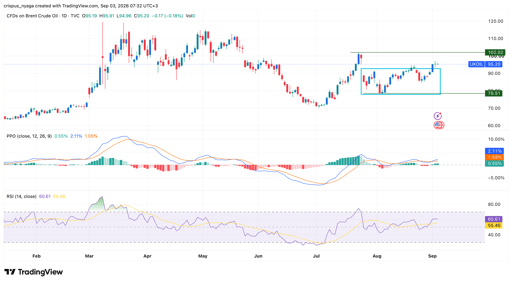
Brent crude oil price chart | Source: TradingView
The daily chart shows that Brent bottomed at $78.51 in August and then started rising as the crisis escalated. It is now attempting to fill the gap that formed on July 24 this year.
Brent also formed an island reversal pattern, which happens after a big down-gap, which is then followed by some consolidation. It has moved above the 50-day moving average, while the Percentage Price Oscillator (PPO) and the Relative Strength Index (RSI) have continued rising.
Therefore, the path of the least resistance for Brent is upward, with the next important target to watch being at $100. A move above that level will point to more gains, potentially to $102, the highest level in July this year.

Why is gold back above $4,400 and could payrolls send it even higher?

AUD/USD signal: forecast as RBA and Fed rate hike odds rise

Credo Technology stock has slipped after earnings: how low can it get?

Snowflake stock forms bearish divergence as earnings loom: will it rise or crash?

HPE stock forms rare cup-and-handle pattern as Dell earnings set up key catalyst
No results found
Loading articles...
Failed to load articles. Please try again.