
Here’s why SK Hynix stock is skyrocketing today
AI Sentiment: 86/100 Bullish
This score is generated through AI-driven analysis of the article's content.

powered by

Buy. The stock is rallying on two reinforcing drivers: (1) AI workloads are rising rather than being “efficiently” reduced, lifting server DRAM and HBM demand; (2) physical scarcity—KB estimates memory inventories at both SK Hynix and Samsung are below 10 days, with 2027 potentially the tightest supply in history. HBM4 is harder to scale (about 3x wafer capacity vs conventional DRAM), so SK Hynix can defend pricing while demand broadens beyond Nvidia-linked GPUs to Meta/Microsoft custom chips.
Key Risk: HBM supply catches up fast (new capacity ramps or inventory rebuilds), breaking the scarcity-and-pricing power story.
Buy. If memory inventories are truly sub-10-days across the sector, both SK Hynix and Samsung benefit from the same tight-supply pricing environment. Samsung is also exposed to AI server buildouts and HBM demand spillover, so the sector’s “tight supply into rising hyperscaler capex” thesis should lift Samsung even if SK Hynix leads the tape.
Key Risk: Samsung’s memory mix shifts toward cheaper/less constrained products or HBM execution disappoints, so it can’t capture the pricing power.
- SK Hynix rises nearly 5% as Astra revives AI memory demand and HBM optimism.
- KB sees memory inventories below 10 days as HBM4 deepens DRAM tightness.
- Mirae and DB raise SK Hynix targets as HBM demand broadens beyond Nvidia.
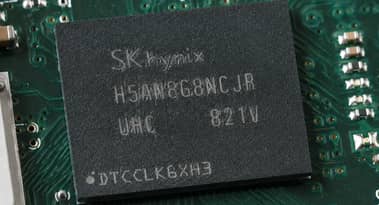
SK Hynix stock surged again on Wednesday, extending one of the sharpest rallies among Asian semiconductor stocks as investors doubled down on the idea that the next phase of the AI boom will require far more memory.
The stock was up nearly 5% to 1.87 million won during morning trading, taking its gain to roughly 17% in a week.
The main catalyst came from OpenAI’s GPT-6 Astra launch, but investors are also responding to exceptionally tight memory inventories and stronger demand for HBM from custom AI chips.
Astra has revived the AI memory trade
Astra has strengthened the argument that more capable AI models will not necessarily reduce computing demand through efficiency.
Agentic systems that run for longer and handle more complicated tasks can increase total workloads, lifting demand for accelerators, server DRAM and high-bandwidth memory.
That matters disproportionately for SK Hynix, already one of the industry’s leading HBM suppliers.
Kiwoom Securities analyst Han Ji-young told Seoul Economic Daily on Wednesday that earnings momentum across the AI industry has remained intact since OpenAI released GPT-6.
Han said the KOSPI’s resistance around 7,000 looked more like consolidation than a breakdown in the trend.
The resilience is notable because Korean shares are also dealing with higher oil prices, Middle East tensions and weaker US equities.
The bigger catalyst may be vanishing supply
The more powerful part of the SK Hynix story may be physical scarcity.
KB Securities estimates that memory inventories at Samsung Electronics and SK Hynix have fallen below 10 days of supply.
Kim Dong-won, head of research at KB Securities, told Korea JoongAng Daily that 2027 could bring the “tightest supply conditions in history” as hyperscaler AI infrastructure investment rises towards $1.3 trillion.
HBM4 makes that constraint harder to solve.
KB estimates HBM4 requires roughly three times the wafer capacity of conventional DRAM.
As manufacturers devote more production to higher-margin HBM, less capacity remains for ordinary DRAM, potentially tightening the broader memory market at the same time.
That changes the investment case, as investors are not simply betting on stronger AI demand, but also on demand rising into a supply base with very little short-term cushion, allowing memory makers to preserve unusually strong pricing.
HBM demand is spreading beyond Nvidia
SK Hynix’s HBM opportunity increasingly extends beyond Nvidia-linked GPUs as Meta, Microsoft and other hyperscalers develop proprietary AI accelerators that also require large amounts of advanced memory.
Mirae Asset analyst Kim Young-gun said that broader HBM adoption among ASIC developers is favourable for SK Hynix because it expands its customer base.
Mirae raised its price target to 3.1 million won from 2.8 million won this week.
DB Securities separately lifted its target to 2.3 million won from 2 million won. Analyst Seo Seung-yeon expects HBM4 shipments to accelerate from the third quarter, while resilient server demand helps offset pressure from the stronger won.

SoftBank stock jumps 5% while yen strengthens: why that combination is unusual

Dow falls 600 points as oil rises and Fed rate hike bets strengthen

Evening digest: AMD rallies, Gold drops on Fed rate hike bets
AMD stock jumps 6% as AI market opportunity seen at $3T

Here’s why Nebius stock is soaring today and what to expect next
No results found
Loading articles...
Failed to load articles. Please try again.